Vortex-Induced Vibration (VIV) Analysis
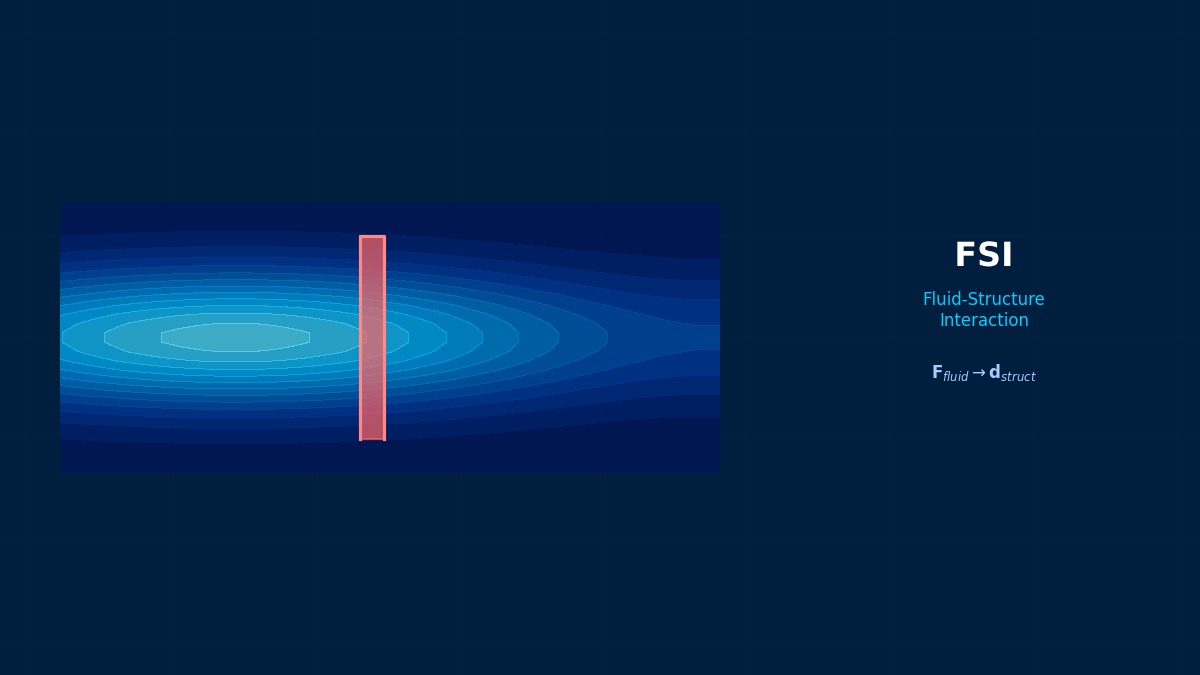
Vortex-Induced Vibration (VIV) Analysis: Theoretical Foundations
Physical Background of Vortex-Induced Vibration Phenomena
I heard that ocean risers and chimneys swaying in the wind isn't just simple wind loading. What's the mechanism?
When flow hits a cylindrical structure, a Kármán vortex street is alternately shed in the wake. This vortex shedding applies a periodic lift fluctuation to the structure, causing it to vibrate. This is Vortex-Induced Vibration (VIV).
The vortex shedding frequency $f_s$ is characterized by the Strouhal number $St$.
Here, $D$ is the cylinder diameter and $U$ is the uniform flow velocity. For the Reynolds number range $300 < Re < 3 \times 10^5$, $St \approx 0.2$ is commonly used.
It's bad when the vortex shedding frequency approaches the structure's natural frequency, right?
Exactly. When $f_s$ approaches the structure's natural frequency $f_n$, lock-in phenomenon occurs. The vortex shedding frequency synchronizes with the structure's vibration frequency, causing a sharp increase in amplitude.
This region corresponds roughly to a reduced velocity $U^* = U/(f_n D)$ in the range of approximately $4 < U^* < 8$.
Governing Equations
Since fluid and structure interact, do we need to solve both equations simultaneously?
The fluid side solves the Navier-Stokes equations. Assuming incompressibility,
The structural side is represented by the equation of motion. For a simplified 1-DOF model,
Here, $F_L(t)$ is the lift force from the fluid. The mass ratio $m^* = m / (\rho_f D^2 L)$ and the damping ratio $\zeta$ govern the response.
So these two equations are connected by interface conditions.
We impose velocity compatibility and force equilibrium conditions at the fluid-structure interface.
The standard approach is to handle the moving mesh using the ALE (Arbitrary Lagrangian-Eulerian) method.
The "Regularity" of Kármán Vortices — Order within Turbulence
The Kármán vortex street that appears in the laminar flow regime around Re 40–200 when fluid passes a cylinder is a prime example of nature's "ordered disorder." The vortex shedding frequency is surprisingly stable at Strouhal number St = fD/U ≈ 0.2. This demonstrates the beauty of the "similarity principle": whether the cylinder diameter is 1 mm or 1 m, the same dimensionless number emerges when velocity is normalized. Kármán vortices appear wherever cylindrical structures exist: chimneys, ocean riser pipes, bridge hanger cables, and even human blood vessels. While vortex-induced vibration is often treated as a "nuisance" in engineering, its regularity is exploited in "vortex flowmeters" (which measure flow rate via vortex frequency), widely used in chemical and petroleum plants.
Computational Methods for Vortex-Induced Vibration (VIV) Analysis
Mesh Movement via ALE Method
When the structure moves, the fluid mesh also needs to deform, right? How is that handled?
The ALE method introduces a mesh velocity $\mathbf{w}$ and modifies the advection term in the Navier-Stokes equations.
Mesh movement is determined by solving Laplace's equation or using a spring analogy. For large deformations, mesh remeshing is required.
How is the timing for remeshing decided?
Element quality metrics (aspect ratio, skewness) are monitored, and automatic remeshing is executed when they fall below a threshold. In Ansys Fluent, this is set via the Dynamic Mesh feature. STAR-CCM+'s morphing mesh works similarly.
Coupling Algorithm
Is the order in which fluid and structure are solved important?
Very important. Broadly, there are two types.
Weak Coupling (Loose/Weak coupling): Solves fluid → structure once per time step. Computationally fast but can become unstable for systems with small mass ratios (around $m^* < 5$).
Strong Coupling (Strong coupling): Performs sub-iterations within each time step to converge the interface conditions. Stable but computationally expensive.
For strong coupling, convergence is accelerated using Aitken relaxation or IQN-ILS (Interface Quasi-Newton Inverse Least Squares) methods.
So for cases with small mass ratios like ocean risers, strong coupling is essential.
Exactly. Underwater structures can have $m^* \approx 1$, so weak coupling can cause numerical instability due to the added mass effect.
Turbulence Model Selection
For VIV analysis, should we use RANS or LES?
LES or DES is desirable to accurately capture vortex shedding. The RANS $k$-$\omega$ SST model can capture the timing of 2D vortex shedding but cannot represent 3D vortex structures or spanwise correlations.
| Turbulence Model | Vortex Shedding Accuracy | Computational Cost | Recommended Re Range |
|---|---|---|---|
| URANS (k-omega SST) | Medium | Low | Re < 10^4 |
| DES/DDES | High | Medium | 10^4 < Re < 10^6 |
| LES (Wall-Resolved) | Very High | Very High | Re < 10^5 |
| LES (Wall-Modeled) | High | High | Re < 10^6 |
"Lock-in" Phenomenon — The Moment the Structure Controls the Vortex
The most important concept in VIV analysis is Lock-in. Normally, vortex shedding frequency changes proportionally with flow velocity. However, when the velocity approaches the structure's natural frequency, the vortex frequency gets "dragged" and sticks to the natural frequency. This state is lock-in; even if the velocity changes, vortices continue shedding at the same frequency, sustaining and amplifying vibration. The velocity range of lock-in (lock-in width) varies with the structure's mass ratio and damping ratio. Light structures with low damping (e.g., slim steel chimneys) have a wider lock-in region and are more dangerous. In VIV analysis, mapping "which mode resonates at which velocity within the lock-in region" is the core of design.
Vortex-Induced Vibration (VIV) Analysis in Practice
Analysis Model Construction Procedure
When actually starting a VIV analysis, what steps should I follow?
First, prepare the geometry. For a cylinder diameter $D$, ensure a computational domain of at least $20D$ in the inflow direction, $40D$ in the wake direction, and $20D$ in the transverse direction. This is the minimum size recommended by journals like the Journal of Fluids and Structures.
How fine should the mesh be?
The first cell height on the cylinder surface depends on the wall $y^+$. For URANS, $y^+ \approx 1$ is needed; for LES, $y^+ < 1$ is required. Ensure at least 200 divisions around the cylinder and resolve the boundary layer with an O-type mesh.
Related Topics
Experience the theory firsthand with the interactive simulator for this field
All Simulators| Mesh Parameter | URANS Recommendation | LES Recommendation |
|---|---|---|
| Cylinder circumferential divisions | 200 or more | 360 or more |
| Wall first layer height |