Permanent Magnet Synchronous Motor (PMSM) Design Simulation
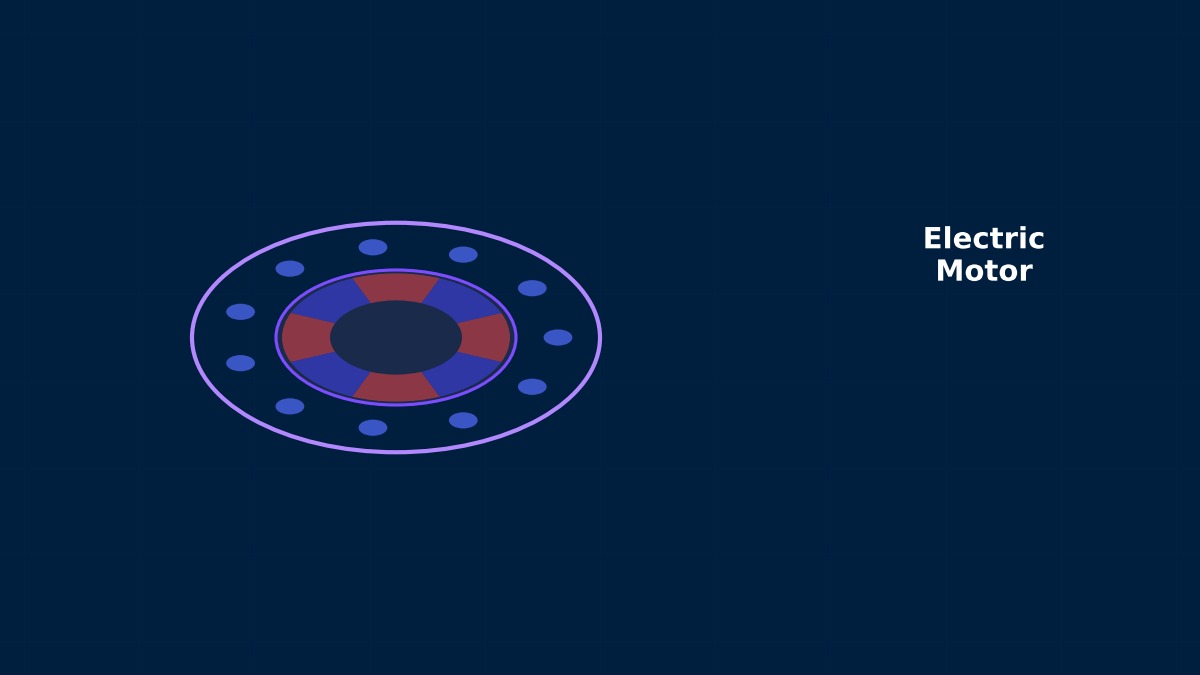
Permanent Magnet Synchronous Motor (PMSM) Design: Theoretical Foundations
What is a PMSM?
Professor, how is a PMSM different from an induction motor? I heard PMSMs are mainstream in EVs.
Simply put, a PMSM uses permanent magnets in the rotor, while an induction motor passes current through the rotor. PMSMs have zero rotor copper loss, so they are highly efficient. Since the first-generation Toyota Prius (1997) adopted an IPMSM, they have become the mainstream drive motor for EVs/HEVs.
What's the difference between SPMSM and IPMSM?
SPM (Surface Permanent Magnet) places magnets on the rotor surface, while IPM (Interior PM) embeds them inside the iron core. IPMs have "saliency," allowing them to use reluctance torque in addition to magnet torque. Most EVs use IPMs.
At what stage is FEM analysis used in PMSM design?
Initial design uses magnetic equivalent circuits for quick iteration, then FEM is introduced for detailed design. Especially, accurate d-q axis inductance values cannot be obtained without FEM. For IPMSMs where magnetic saturation has a large impact, relying solely on equivalent circuits can easily lead to 10-20% torque errors.
d-q Axis Model and Voltage Equations
The d-q axis model comes up often, but why go through the trouble of coordinate transformation?
Transforming three-phase AC quantities into a rotating coordinate system fixed to the rotor makes them DC quantities in steady state. This makes control and integration with FEM significantly easier. This method, called Park transformation (dq transformation), is fundamental to PMSM control and analysis.
The d-q axis voltage equations are as follows:
What is $\omega_e$? And $\psi_m$?
$\omega_e = p \cdot \omega_m$ is the electrical angular velocity, where $p$ is the number of pole pairs and $\omega_m$ is the mechanical angular velocity. $\psi_m$ is the flux linkage due to the permanent magnets. To obtain it via FEM, integrate the coil flux linkage when excited by magnets only:
Torque Equation: Magnet Torque and Reluctance Torque
Please explain the PMSM torque equation. I heard there's magnet torque and reluctance torque...
The torque for a three-phase PMSM can be expressed as:
The first term is the magnet torque (magnet torque) due to the permanent magnets, proportional to the q-axis current $i_q$. The second term is the reluctance torque, which only occurs if there is saliency ($L_d \neq L_q$). For SPMSMs, $L_d \approx L_q$, so reluctance torque is almost zero. For IPMSMs, $L_d < L_q$, so applying $i_d < 0$ can add reluctance torque.
In actual EV motors, what percentage of the total torque is reluctance torque?
For a typical EV IPMSM, reluctance torque can account for 30-50% of the total torque at the maximum torque operating point. Optimizing the saliency ratio $L_q / L_d$ is key to designing for high torque while reducing magnet usage. Recently, rare-earth-free ferrite IPMSMs, which rely mainly on reluctance torque, are also being commercialized.
Back-EMF
How does back-EMF affect the design?
Back-EMF $e = \omega_e \psi_m$ is proportional to rotational speed. At high speeds, the back-EMF reaches the inverter's output voltage limit, necessitating field-weakening control ($i_d < 0$) to effectively reduce $\psi_m$. In FEM, it's important to calculate the Back-EMF waveform and evaluate its harmonic content (THD). High THD causes torque ripple and vibration/noise.
The RMS value of Back-EMF is expressed as:
Physical Meaning of d-axis and q-axis Inductance
Physically, what's the difference between $L_d$ and $L_q$?
The d-axis is aligned with the magnets. The relative permeability of magnets is almost the same as air ($\mu_r \approx 1.05$), so the magnetic reluctance is high and $L_d$ becomes small. On the other hand, the q-axis is between magnets—the magnetic path goes through the iron core—so the magnetic reluctance is low and $L_q$ becomes large. Therefore, for IPMSMs, it's always $L_q > L_d$.
But catalog values are single numbers, right? Do they actually change with current?
That's a crucial point. When the iron core saturates, permeability decreases, so both $L_d$ and $L_q$ become current-dependent. Furthermore, there's cross-coupling (d-axis current affecting q-axis inductance). That's why FEM is used to calculate $L_d(i_d, i_q)$, $L_q(i_d, i_q)$ across the entire $i_d$-$i_q$ map. This is arguably the biggest reason FEM is indispensable in PMSM design.
| Parameter | SPMSM | IPMSM | Notes |
|---|---|---|---|
| $L_d$ vs $L_q$ | $L_d \approx L_q$ | $L_d < L_q$ | IPMSM saliency |
| Saliency Ratio $L_q/L_d$ | 1.0–1.1 | 2.0–4.0 | Higher ratio increases reluctance torque |
| Reluctance Torque | Almost zero | 30–50% of total torque | Core of IPMSM design |
| Field-Weakening Capability | Limited | High | Directly linked to high-speed operating range |
The First-Generation Prius Popularized "IPMSM" Worldwide
The debut of the first-generation Toyota Prius in 1997 was a historic event for the motor industry as well. Until then, induction motors were considered promising for EVs and HEVs, but the Prius deliberately adopted an IPMSM (Interior Permanent Magnet Synchronous Motor). The reason was "high efficiency and compact/lightweight," perfectly fitting the limited space of the hybrid system. This choice ingrained the equation "HEV/EV = IPMSM" in automakers worldwide, creating a trend where IPMSMs have remained the mainstream EV drive motor for over 20 years. Learning PMSM design analysis directly leads to understanding the heart of modern EVs.
Computational Methods for Permanent Magnet Synchronous Motor (PMSM) Design
Electromagnetic Field FEM Formulation
For PMSM electromagnetic field analysis, the governing equations are Maxwell's equations, right? How are they formulated in FEM?
At motor operating frequencies (hundreds of Hz to several kHz), the quasi-static approximation can be used. This means ignoring the displacement current term, and formulation using the magnetic vector potential $\mathbf{A}$ is standard. For 2D cross-section analysis, it reduces to a scalar equation for $A_z$:
What do the three terms on the right-hand side represent?
$\mathbf{J}_s$ is the forced current density in the stator windings, $-\sigma \partial \mathbf{A}/\partial t$ is the eddy current term (eddy currents in the iron core or rotor conductors), $\nabla \ti
Related Topics
Experience the theory firsthand with the interactive simulator for this field
All Simulators