Structured Grids
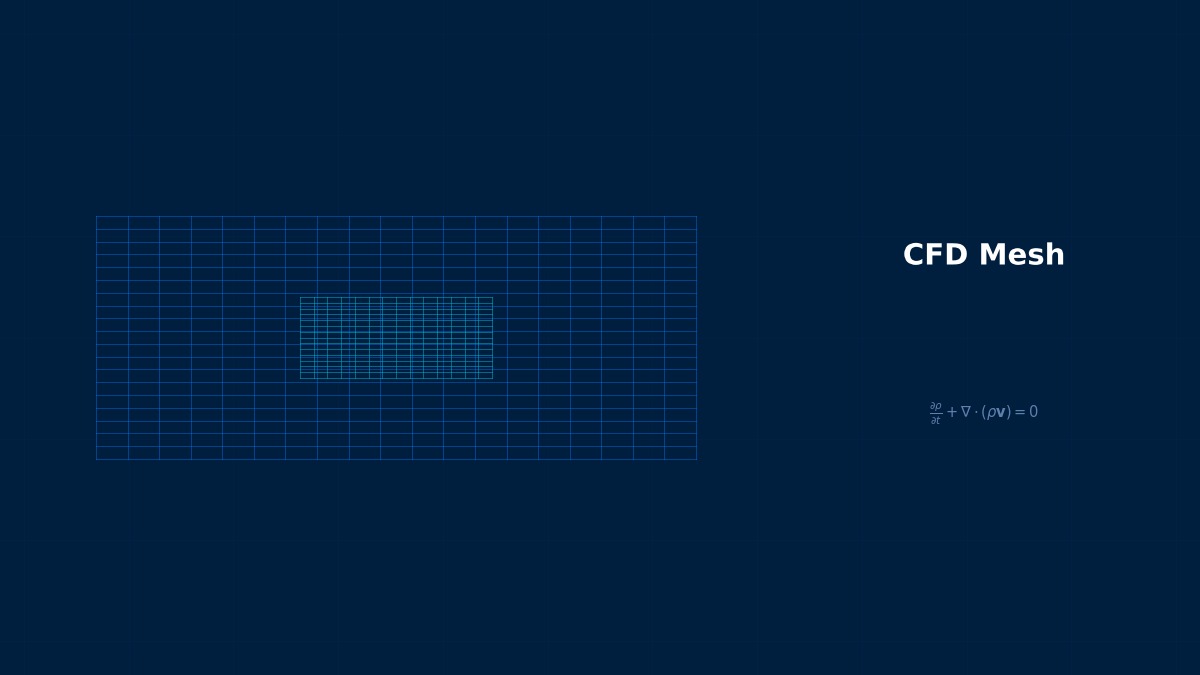
Structured Grids: Theoretical Foundations
Overview
Professor, what exactly is a structured grid? I'm having trouble grasping the difference from an unstructured grid.
A structured grid (structured mesh) is a grid that fills the computational domain with regularly arranged hexahedral (3D) or quadrilateral (2D) cells. Each cell's index can be uniquely represented by $(i,j,k)$. This means the adjacency relationships between grid points are implicitly determined, so there's no need to explicitly store connectivity information.
Not having to store adjacency information means it's memory efficient, right?
Exactly. In a structured grid, neighboring cells are always at $(i\pm1, j\pm1, k\pm1)$, so data access is contiguous and cache hit rates are high. For the same number of cells, memory consumption can be about half compared to an unstructured grid, and computational speed can be 2-3 times faster, which is not uncommon.
Body-Fitted Coordinate System and Metrics
But real-world shapes are curved and twisted, right? How do you handle that with a regular grid?
That's where the body-fitted curvilinear coordinate system comes in. It maps the physical space $(x,y,z)$ to a computational space $(\xi,\eta,\zeta)$. In the computational space, the grid becomes a uniform rectangular box, allowing finite-difference schemes to be written simply.
The Jacobian matrix of the coordinate transformation is crucial and is defined as follows.
If the determinant of this Jacobian, $|J|$, becomes zero or negative, it's evidence that the grid is collapsed or inverted, causing the computation to fail.
Under what circumstances does the Jacobian become negative?
Typically around sharp corners or when grid lines intersect. The golden rule during grid generation is to verify $|J| > 0$ for all cells.
Navier-Stokes Equations on Structured Grids
Does the governing equation change form on a structured grid?
The Navier-Stokes equations in physical space are transformed into computational space. In conservative form, it becomes:
Here, $\mathbf{Q}$ is the vector of conservative variables, and $\hat{\mathbf{E}}, \hat{\mathbf{F}}, \hat{\mathbf{G}}$ are the transformed fluxes containing metric terms.
What specifically are the metric terms?
For example, $\hat{\mathbf{E}} = \frac{1}{J}(\xi_x \mathbf{E} + \xi_y \mathbf{F} + \xi_z \mathbf{G})$, where the partial differential coefficients of the coordinate transformation $\xi_x, \xi_y$, etc., multiply the fluxes. If these metric terms are not discretized accurately, freestream preservation breaks down, generating spurious numerical errors.
Geometric Progression of Grid Spacing
You want the grid to be dense near walls, right? How is that controlled?
Using a geometric progression is fundamental.
Here, $\Delta s_1$ is the thickness of the first layer, and $r$ is the growth ratio. If $r = 1.2$, each layer becomes 1.2 times thicker than the previous one. The wall-side $\Delta s_1$ is determined from $y^+$ requirements, and a growth ratio $r$ of 1.1 to 1.3 is recommended.
What happens if the growth ratio is too large?
The size ratio between adjacent cells becomes too large, increasing truncation error and worsening numerical diffusion. Especially for second-order schemes, it's desirable to keep the volume ratio of adjacent cells below 1.2.
History of Structured Grids—The 1974 Thompson-Thames-Mastin Transformation and the Birth of BFM (Body-Fitted Mesh)
The systematic method for generating "Body-Fitted Mesh" along complex object shapes was established by Joe Thompson, Frank Thames, and C. Wayne Mastin in their 1974 paper "Grid Generation by Elliptic Partial Differential Equations (TTM method)." This method maps a complex computational domain in physical space to a "computational space" described by a uniform orthogonal grid in ξ-η-ζ using "Conformal Mapping." The equations are solved in computational space and then transformed back to physical space. This first made practical structured grid generation for arbitrary shapes like airfoils, ship hulls, and engine internal flow paths possible, enabling the explosive development of CFD in the 1980s. The grid generation code GRID2D, based on the TTM method, is still used for education and research even 50 years later.
Computational Methods for Structured Grids
Structured Grid Generation Methods
How do you actually create a structured grid?
Let me introduce three representative methods.
Algebraic Method (Transfinite Interpolation: TFI)
Given the distribution of grid points on the boundary, interior grid points are determined by interpolation. Computationally fast, but controlling grid quality for complex shapes is difficult.
Elliptic Grid Generation (Elliptic Grid Generation)
Grid points are placed by solving Poisson equations.
Grid concentration near walls and orthogonality can be controlled by adjusting the control functions $P, Q, R$. Produces the highest grid quality but requires iterative computation and takes time to generate.
Hyperbolic Grid Generation
A method that "grows" the grid from the wall in the normal direction. Particularly effective for boundary layer mesh generation, naturally ensuring wall orthogonality.
Which method should I choose?
In practice, a hybrid approach is common: first create an initial grid with TFI, then smooth it with an elliptic solver. This is the standard workflow in tools like ICEM or Pointwise.
Multi-Block Structured Grid
For complex shapes, a single block seems impossible...
In that case, use a multi-block structured grid. The computational domain is divided into multiple blocks, each containing a structured grid, and information is exchanged between blocks via interfaces.
There are two main types of connections between blocks.
- Conformal: Grid points match at the interface. No interpolation error.
- Non-conformal: Grid points do not match. Interpolation is required.
Conformal is obviously better, right?
In terms of accuracy, yes, but for complex shapes, maintaining conformity makes topology design extremely difficult. In practice, block topology editors like ICEM CFD Hexa are invaluable. However, this topology design is the biggest bottleneck for structured grids; even an expert can take days to weeks to mesh a single car.
Compatibility with Finite-Difference Schemes
I've heard finite-difference methods are easier to use with structured grids. What does that mean?
Because grid points are arranged regularly in structured grids, high-order accuracy finite-difference schemes can be naturally constructed. For example, 5th-order WENO schemes or compact finite-difference methods (Pade-type) truly shine on structured grids.
Achieving equivalent high-order accuracy on unstructured grids requires gradient reconstruction via least squares and handling of non-uniform spacing, which skyrockets computational cost.
So that's why structured grids are preferred for DNS (Direct Numerical Simulation) and LES.
Exactly. Structured grids are still mainstream for high-precision academic computations. Especially for DNS of relatively simple shapes like channel flow or pipe flow, structured grids are essentially the only choice.
Choosing Between O-Type, C-Type, and H-Type Grids—Decision Criteria for Structured Grid Design Around Airfoils
For structured grids around airfoils, the choice of grid topology directly impacts accuracy. O-type grids (concentric elliptical shape surrounding the airfoil) can uniformly and with high quality resolve the entire airfoil perimeter, naturally allowing continuous mesh from the leading edge to the trailing edge. However, grid lines bend at the airfoil's sharp trailing edge, potentially reducing shape accuracy for thin trailing edges. C-type grids (wrapping around in a C-shape from the front of the airfoil) make it easier to capture the separation region near the trailing edge in detail, suitable for stall analysis. H-type grids (deformed rectangular orthogonal grids) are simplest but cannot match the high quality of O-type grids around the airfoil. In practice, a hybrid OC-H type composite grid, where "an O-type or C-type grid is generated based on topology, and the far field is covered by an H-type structured grid," is the standard choice for high-precision RANS/LES of airfoils.
Experience the theory firsthand with the interactive simulator for this field
All Simulators