Cavity Resonator — CAE Glossary
Cavity Resonator
How does a cavity resonator work? What is the difference from a waveguide?
Put simply, it is a device that confines electromagnetic waves inside a metal box and makes them resonate. A waveguide is a pipe that transmits electromagnetic waves, but a cavity resonator has both ends closed off with walls as well. When this happens, only specific frequencies form perfect standing waves, allowing energy to be stored efficiently.
So electromagnetic waves bounce around inside a metal box continuously? Why do only specific frequencies survive?
The metal walls are conductors, so the tangential component of the electric field becomes zero at the wall surface due to boundary conditions. For this condition to be satisfied, the box dimensions must be an integer multiple of the half-wavelength of the electromagnetic wave. Waves at frequencies that don't satisfy this condition get reflected off the walls and cancel out. Only waves at frequencies that satisfy the condition can exist stably as standing waves—that's resonance.
Definition and Basic Principles
A cavity resonator is a structure where electromagnetic waves resonate as standing waves within a space completely enclosed by conductor walls. The condition for resonance reduces to the requirement that there exist eigenmodes of Maxwell's equations satisfying the boundary conditions inside the cavity.
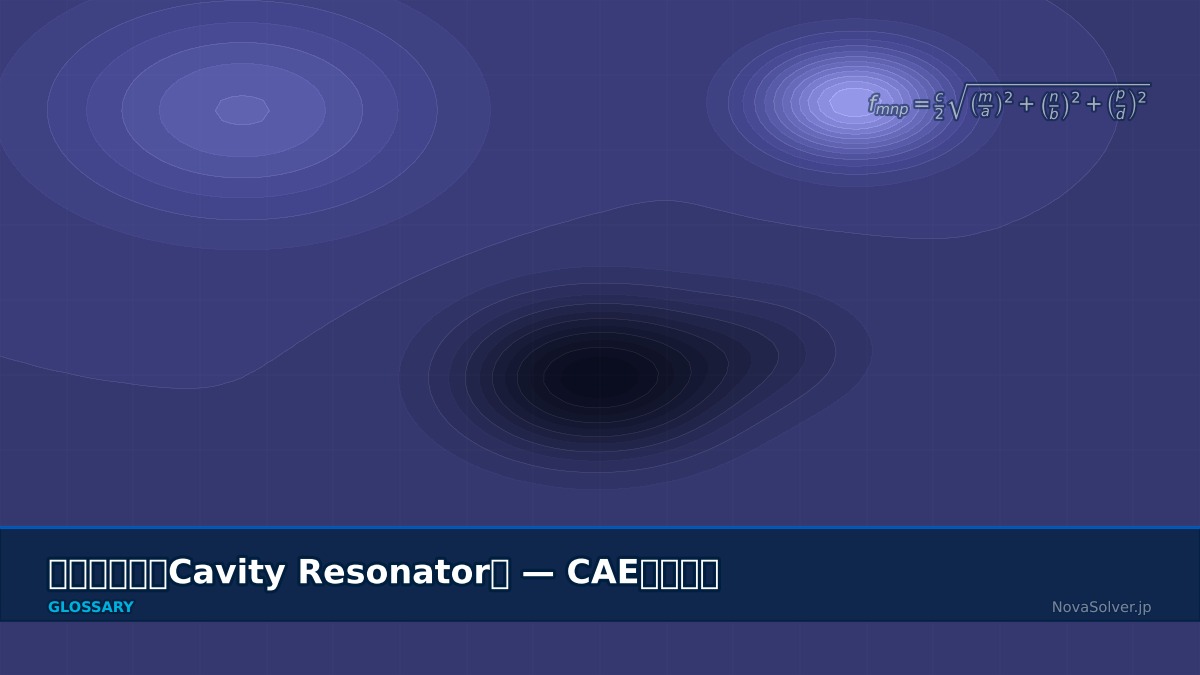
The resonant frequency of a rectangular cavity resonator (with dimensions $a \times b \times d$) is given by:
$$f_{mnp} = \frac{c}{2}\sqrt{\left(\frac{m}{a}\right)^2 + \left(\frac{n}{b}\right)^2 + \left(\frac{p}{d}\right)^2}$$where $c$ is the speed of light, and $m, n, p$ are mode indices in the $x, y, z$ directions (non-negative integers, but not all simultaneously zero).
For a cylindrical cavity resonator (radius $a$, length $d$):
$$f_{mnp}^{\text{TM}} = \frac{c}{2\pi}\sqrt{\left(\frac{\chi_{mn}}{a}\right)^2 + \left(\frac{p\pi}{d}\right)^2}$$ $$f_{mnp}^{\text{TE}} = \frac{c}{2\pi}\sqrt{\left(\frac{\chi'_{mn}}{a}\right)^2 + \left(\frac{p\pi}{d}\right)^2}$$where $\chi_{mn}$ is the $n$-th zero of Bessel function $J_m$, and $\chi'_{mn}$ is the $n$-th zero of $J'_m$.
Resonance Modes (TE, TM, TEM)
What is the difference between TE and TM modes? I've heard the names but can't visualize how the electromagnetic fields are distributed.
TE mode (Transverse Electric) is a mode where the electric field has no component in the propagation direction (usually z-direction). That is, $E_z = 0$, and the electric field exists only in the x-y plane. TM mode (Transverse Magnetic), on the other hand, has no magnetic field component in the propagation direction, meaning $H_z = 0$.
I learned that TE₁₀₁ is the lowest-order mode in rectangular cavities. Why is it labeled "₁₀₁"?
The subscripts $m, n, p$ represent how many half-wavelengths fit in the $x, y, z$ directions respectively. For TE modes, $p = 0$ is not allowed, so the minimum combination is $(1,0,1)$. When $a > b$, this gives the lowest resonant frequency. TE₁₀₁ is also commonly used in practical microwave filters.
Does TEM mode not exist in cavity resonators?
Correct. TEM mode has $E_z = H_z = 0$, which requires two or more independent conductors to exist. Coaxial cables are the classic example. Single-conductor-enclosed cavities cannot support TEM modes. This is an important point in electromagnetics.
Q-Factor (Quality Factor)
What does Q-factor measure? What is the benefit of having a high value?
Q-factor (Quality Factor) is a dimensionless quantity representing the sharpness of resonance, defined as:
where $W$ is the stored energy, $P_{\text{loss}}$ is the power loss, and $\omega_0$ is the resonant angular frequency. Higher Q values mean sharper resonance peaks and smaller energy losses. Alternatively, Q-factor can be viewed as "resonant frequency divided by bandwidth": $Q = f_0 / \Delta f$.
What Q-values are typical in real cavity resonators?
There is considerable variation depending on material and application. Copper or aluminum cavities at room temperature typically have $Q \sim 10^3 \text{ to } 10^4$. Superconducting niobium cavities used in particle accelerators can reach $Q \sim 10^{10}$. The main loss mechanism is surface resistance of the conductor walls, and the skin depth $\delta = \sqrt{2/(\omega\mu\sigma)}$ affects losses—deeper skin depths mean more losses. Higher frequencies generally reduce Q-factors due to increased wall losses.
Superconducting cavities have Q-values orders of magnitude different! When is such high Q needed?
The primary examples are CERN's LHC (Large Hadron Collider) and accelerating cavities at synchrotron radiation facilities worldwide. To accelerate particles, you need to impart energy on each revolution around the ring. With low Q, RF power escapes through the walls. With superconducting cavities, most input power goes into particle acceleration, saving enormous amounts of electricity.
Eigenvalue Analysis in CAE
How do you analyze cavity resonators with CAE? Is it different from regular electromagnetic field simulation?
You use eigenmode analysis (eigenvalue analysis). In standard EM analysis, you apply an external excitation source (port or antenna) and compute the response. Eigenmode analysis asks: "At what frequencies can this space resonate on its own?" Mathematically, you solve the generalized eigenvalue problem derived from Maxwell's equations:
The eigenvalue $k_0^2$ gives the resonant frequency, and the eigenvector $\mathbf{E}$ gives the electromagnetic field distribution (mode shape).
It sounds like the electromagnetic version of structural modal analysis! What solvers are typically used?
Exactly—it's the EM version of structural modal analysis. Common solvers include Ansys HFSS Eigenmode Solver, CST Microwave Studio Eigenmode Solver, and COMSOL's EM module. Open-source options include OpenEMS and Palace. FEM-based solvers typically use edge elements (Whitney elements), which is standard practice to suppress spurious modes (non-physical false solutions).
Why do spurious modes appear? Can't we just use regular nodal elements?
Nodal FEM for electromagnetic waves fails to automatically satisfy $\nabla \cdot \mathbf{E} = 0$ (Gauss's law in charge-free regions). This allows spurious "electrostatic" modes to creep in. Edge elements have degrees of freedom on edges rather than nodes, naturally enforcing $\nabla \cdot \mathbf{E} = 0$. So edge elements are essentially mandatory for EM analysis, especially eigenmode analysis.
Applications
Where are cavity resonators used besides particle accelerators?
Applications are quite broad. Some major examples:
- Microwave Filters: Used in satellite communications and radar front-ends as bandpass filters to pass only specific frequency bands. Multiple cavities are coupled to engineer filter characteristics.
- Magnetron in Microwave Ovens: The heart of household microwaves. Multiple cavities arranged in a ring generate 2.45 GHz microwaves.
- Frequency Standards and Atomic Clocks: Cesium atomic clocks use cavity resonators as the interaction region for atoms and microwaves.
- Electromagnetic Compatibility (EMC) Testing: Reverberation chambers are large cavities that, when stirred mechanically, excite many modes to create a statistically uniform electromagnetic environment for testing.
- Quantum Computing: Superconducting cavity resonators are used for readout of superconducting quantum bits.
So microwave ovens use cavity resonators too! Is the magnetron cavity designed with CAE?
Absolutely. The magnetron cavity must be tuned precisely to 2.45 GHz, and you must account for mode coupling and electron-beam interactions. Modern designs optimize the cavity geometry with 3D EM simulation to improve efficiency and bandwidth. For satellite communication filters, cavity dimensions are tuned to the micrometer level—CAE is indispensable.
Related Terms
- Waveguide: A tubular structure that transmits electromagnetic waves. The open-ended version of a cavity resonator.
- Q-Factor (Quality Factor): A performance metric for resonators, defined as the ratio of stored energy to losses.
- Skin Depth: The characteristic length over which EM waves decay in conductors: $\delta = \sqrt{2/(\omega\mu\sigma)}$
- Eigenmode Analysis: An analysis technique to find modes and frequencies at which a system can oscillate without external excitation.
- Edge Elements (Whitney Elements): Finite elements with degrees of freedom on edges (not nodes), the standard for EM field analysis.
- Spurious Modes: Non-physical false eigenmodes arising from discretization.
Precise understanding of CAE terminology is the foundation of team communication. — Project NovaSolver is committed to supporting practitioners' learning.
Tell us about challenges you face with cavity resonators in practice
Project NovaSolver aims to address the challenges CAE engineers face daily—complex setups, computational cost, result interpretation. Your practical experience fuels better tool development.
Contact Us (Coming Soon)Related Topics
Detail
Error