Chaboche Nonlinear Kinematic Hardening Model
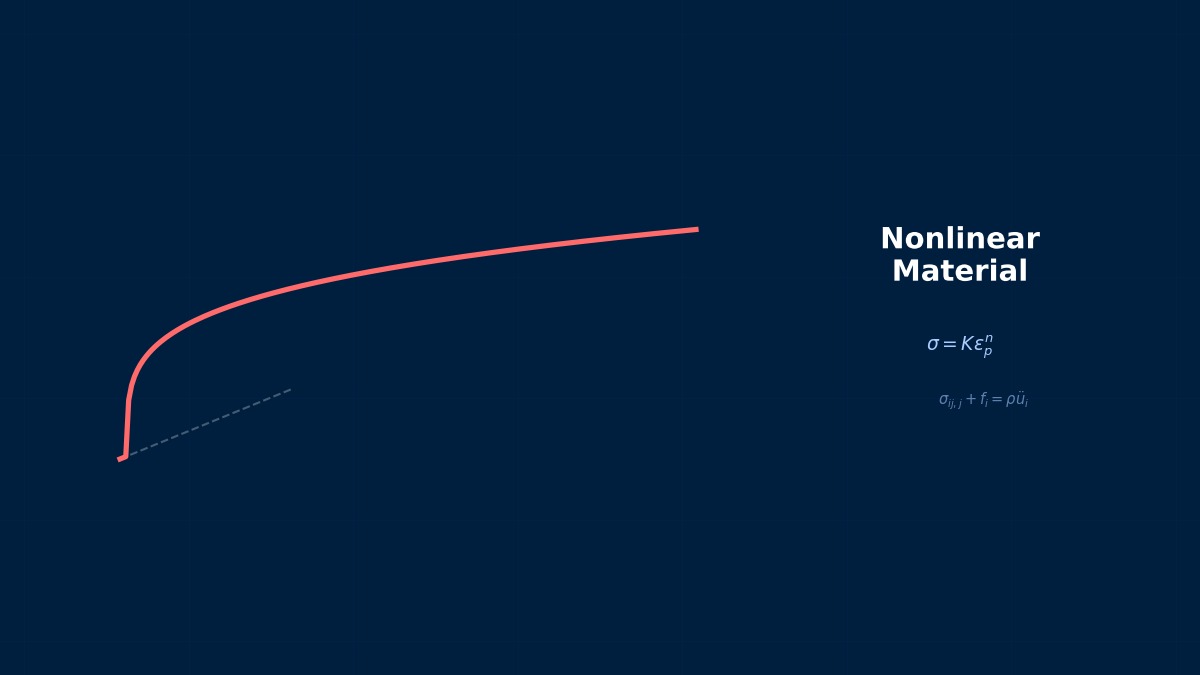
Chaboche Nonlinear Kinematic Hardening: Theoretical Foundations
What is the Chaboche Model?
Professor, is the Chaboche model the "main contender" for kinematic hardening?
Yes. The Chaboche model is a nonlinear kinematic hardening model and is the most widely used for analyzing cyclic plasticity (low-cycle fatigue, ratcheting, shakedown).
Nonlinear Kinematic Hardening Equation
Evolution law for back stress $\alpha$:
The first term is Prager's linear hardening (forward term), the second term is the dynamic recovery term (which "pulls back" the back stress via $\gamma \alpha$).
So the dynamic recovery term makes it "nonlinear". The back stress saturates at large strains.
For monotonic uniaxial plastic straining without static recovery, the equivalent backstress approaches $C/\gamma$ when $\gamma>0$; tensor components use a different factor. $C$ is the initial hardening rate, $\gamma$ is the speed of saturation. In practice, multiple backstresses are superposed ($N = 2 \sim 4$ terms):
Parameter Determination
$C_k, \gamma_k$ are determined from the stabilized hysteresis loop of a repeated tension-compression test (strain-controlled cyclic test). In Abaqus, define the isotropic hardening part with *CYCLIC HARDENING, and use *PLASTIC, HARDENING=COMBINED for combined hardening.
Summary
Key Points:
- $d\alpha = (2/3)C d\varepsilon^p - \gamma \alpha dp$ — Forward + dynamic recovery
- Superposition of multiple backstresses ($N = 2 \sim 4$) — Accurate over a wide stress range
- Determine $C_k, \gamma_k$ from cyclic tests
- Standard model for low-cycle fatigue, ratcheting, shakedown
- Abaqus *PLASTIC, HARDENING=COMBINED — Combined isotropic + kinematic hardening
Chaboche's Background: French Nuclear Power
Jean-Louis Chaboche was affiliated with the French National Aerospace Research Institute (ONERA) and the Atomic Energy Commission (CEA) in the 1970s-80s and developed this model to solve thermal fatigue problems in nuclear reactor piping. The background was France's aggressive nuclear power promotion policy in the 1970s, and the rapidly increasing demand for "engineer-usable cyclic plasticity models" at the time drove the development.
Computational Methods for Chaboche Nonlinear Kinematic Hardening
FEM Settings for Chaboche
*MATERIAL, NAME=steel_cyclic
*ELASTIC
200000., 0.3
*PLASTIC, HARDENING=COMBINED, DATA TYPE=PARAMETERS, NUMBER BACKSTRESSES=1
250., 10000., 50.
*CYCLIC HARDENING
250., 0.0
280., 0.1
300., 0.5
Use *PLASTIC, HARDENING=COMBINED, DATA TYPE=PARAMETERS for the initial yield stress and each Cₖ and γₖ. *CYCLIC HARDENING specifies isotropic hardening. Calibration from test data uses DATA TYPE=HALF CYCLE or STABILIZED and must be validated for the intended loading.
These illustrative inputs are not fitted material data. With stress in MPa, the initial yield stress is 250 MPa, C₁=10000 MPa and γ₁=50. For monotonic uniaxial plastic strain 0.02, zero initial backstress and no static recovery, C₁/γ₁×(1−exp(−γ₁×0.02)) ≈126.4 MPa.
Summary
The Ingenuity of 2-Backstress Superposition
The number of backstresses affects the flexibility of the fitted curve, but accuracy also depends on calibration data, strain range and loading path. Validate against cyclic tests and independent conditions.
Chaboche Nonlinear Kinematic Hardening in Practice
Chaboche in Practice
Used for thermal fatigue in high-temperature nuclear piping, thermal fatigue in automotive engine components, and low-cycle fatigue in aircraft engine turbine disks.
Practical Checklist
Turbine Blade Life Prediction
In the design of CFM56 engine (for Airbus A320) turbine blades, thermo-elasto-plastic cycle analysis using the Chaboche model has been conducted since the 1990s. By analyzing the plastic strain range at the blade root subjected to temperature fluctuations of about 600~1,050℃ per takeoff/landing cycle and evaluating low-cycle fatigue life combined with the Manson-Coffin rule, an overhaul interval of over 30,000 hours was achieved.
Chaboche Nonlinear Kinematic Hardening: Software & Solver Comparison
Tools for Chaboche
Selection Guide
Related Topics
Experience the theory firsthand with the interactive simulator for this field
All SimulatorsReferences: Abaqus *PLASTIC · Abaqus *CYCLIC HARDENING · Abaqus cyclic hardening models