Composite Wall Heat Conduction
Category: 熱解析 | Integrated 2026-04-06
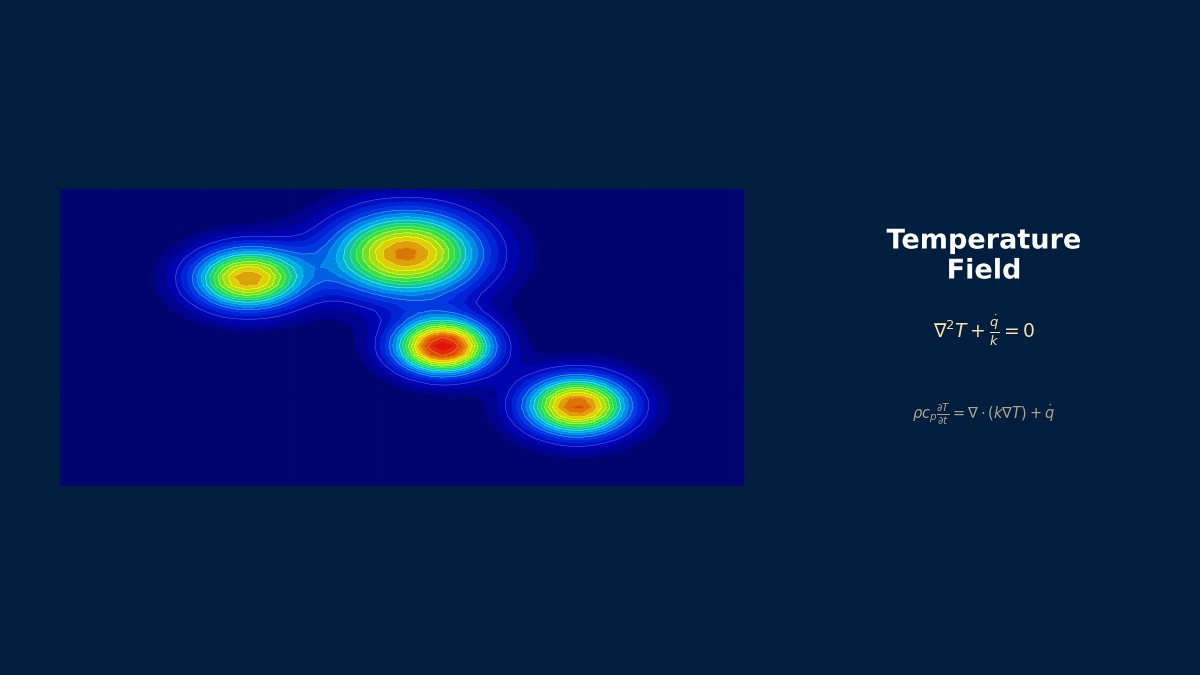
CAE visualization for composite wall theory - technical simulation diagram
複合壁の熱伝導

Theory and Physics

Fundamental Theory of Composite Walls

🧑‍🎓

A composite wall is a wall structure made of different materials stacked together, right?


🎓

That's correct. Almost all practical wall structures, such as building walls, refrigerator insulation walls, and furnace linings, are composite walls. The overall heat transfer is calculated by connecting the thermal resistances of each layer in series.


Governing Equations

🎓

The total thermal resistance of an n-layer composite wall is the sum of the thermal resistances of each layer.


$$R_{total} = \frac{1}{h_1 A} + \sum_{i=1}^{n}\frac{L_i}{k_i A} + \frac{1}{h_2 A}$$

The overall heat transfer coefficient (U-value) is


$$U = \frac{1}{R_{total} \cdot A} = \frac{1}{\frac{1}{h_1} + \sum\frac{L_i}{k_i} + \frac{1}{h_2}}$$

🧑‍🎓

The U-value is a figure I often hear about in building energy efficiency standards.


🎓

Exactly. Japan's energy efficiency standards (2016 standards) specify U-values for exterior walls by region. For example, in Tokyo (Region 6), the exterior wall U ≤ 0.53 W/(m²K).


Calculation of Interface Temperatures

🎓

The temperature at each interface is calculated sequentially after determining the overall heat flux $q$.


$$q = \frac{T_{\infty,1} - T_{\infty,2}}{R_{total}}$$

$$T_{i} = T_{\infty,1} - q\left(\frac{1}{h_1 A} + \sum_{j=1}^{i-1}\frac{L_j}{k_j A}\right)$$

🧑‍🎓

Can this also be used for condensation judgment?


🎓

Yes. Condensation occurs when any interface temperature falls below the dew point. The condensation surface changes simply by altering the position of the insulation, so the layer composition design of composite walls is extremely important.

Coffee Break Trivia Corner

Origin of the Thermal Resistance Analogy

The analogy between Ohm's law in electrical circuits (1827) and heat flow was established after Fourier's theory of heat analysis (1822). In the 1940s, the American Society of Heating, Refrigerating and Air-Conditioning Engineers (ASHRAE) standardized the electrical circuit-like series resistance model for calculating wall U-values, forming the foundation of today's insulation calculations.

Physical Meaning of Each Term
  • Heat Storage Term $\rho c_p \partial T/\partial t$: Rate of thermal energy storage per unit volume. 【Everyday Example】 An iron frying pan is slow to heat up and cool down, while an aluminum pot heats up and cools down quickly—this is due to the difference in the product of density $\rho$ and specific heat $c_p$ (Heat Capacity). Objects with large heat capacity experience slower temperature changes. Water has a very high specific heat (4,186 J/(kg·K)), which is why temperatures near the sea are more stable than inland. In unsteady analysis, this term determines the rate of temperature change over time.
  • Heat Conduction Term $\nabla \cdot (k \nabla T)$: Heat conduction based on Fourier's law. Heat flux proportional to the temperature gradient. 【Everyday Example】 Putting a metal spoon in a hot pot causes the handle to get hot—metals have a high thermal conductivity $k$, so heat transfers quickly from the high-temperature side to the low-temperature side. A wooden spoon doesn't get hot because its $k$ is small. Insulation materials (e.g., glass wool) have extremely small $k$, making heat transfer difficult even with a temperature gradient. This term mathematically expresses the natural tendency of "heat flowing where there is a temperature difference."
  • Convection Term $\rho c_p \mathbf{u} \cdot \nabla T$: Heat transport accompanying fluid motion. 【Everyday Example】 Feeling cool when facing a fan is because the wind (fluid flow) carries away the warm air near your body's surface and supplies fresh, cold air—this is forced convection. The ceiling area of a room becoming warm with heating is due to natural convection where heated air rises due to buoyancy. The fan in a PC's CPU cooler also dissipates heat via forced convection. Convection is an order of magnitude more efficient heat transport method than conduction.
  • Heat Source Term $Q$: Internal heat generation (Joule heat, chemical reaction heat, radiation absorption, etc.). Unit: W/m³. 【Everyday Example】 A microwave oven heats food via microwave absorption inside the food (volumetric heating). The heater wire in an electric blanket warms up via Joule heating ($Q = I^2 R / V$). Heat generation during lithium-ion battery charging/discharging and friction heat from brake pads are also considered as heat sources in analysis. Unlike boundary conditions that supply heat from the "surface" externally, the heat source term represents energy generation "inside" the material.
Assumptions and Applicability Limits
  • Fourier's Law: Linear relationship where heat flux is proportional to temperature gradient (non-Fourier heat conduction is needed for extremely low temperatures or ultra-short pulse heating).
  • Isotropic Thermal Conductivity: Thermal conductivity is independent of direction (anisotropy must be considered for composite materials or single crystals).
  • Temperature-Independent Material Properties (Linear Analysis): Assumption that material properties do not depend on temperature (temperature dependence is needed for large temperature differences).
  • Treatment of Thermal Radiation: Surface-to-surface radiation uses the view factor method; for participating media, the DO method or P1 approximation is applied.
  • Non-Applicable Cases: Phase change (melting/solidification) requires consideration of latent heat. Extreme temperature gradients necessitate thermal-stress coupling.
Dimensional Analysis and Unit Systems
VariableSI UnitNotes / Conversion Memo
Temperature $T$K (Kelvin) or CelsiusBe careful not to confuse absolute temperature and Celsius. Always use absolute temperature for radiation calculations.
Thermal Conductivity $k$W/(m·K)Steel: ~50, Aluminum: ~237, Air: ~0.026
Heat Transfer Coefficient $h$W/(m²·K)Natural Convection: 5–25, Forced Convection: 25–250, Boiling: 2,500–25,000
Specific Heat $c_p$J/(kg·K)Distinguish between specific heat at constant pressure and constant volume (important for gases).
Heat Flux $q$W/m²Used as a Neumann boundary condition.

Numerical Methods and Implementation

FEM Modeling of Composite Walls

🧑‍🎓

What are the key points in modeling composite walls with FEM?


🎓

Define each layer as a separate material region and share nodes at the interfaces (or use Tied Contact). The important thing is to ensure sufficient element division in the thickness direction of each layer.


Layer ThicknessRecommended Element Count (Thickness Direction)Reason
Insulation Layer (Low k)Minimum 4 layersSteep temperature gradient
Structural Layer (High k)2–3 layersGentle temperature gradient
Interface Layer (TIM)1–2 layersVery thin (watch aspect ratio)
🧑‍🎓

Do we put elements for TIM even though it's only tens of microns thick?


🎓

Modeling TIM with solid mesh leads to extremely poor aspect ratios. Instead, it's more efficient to treat it as a zero-thickness interface element using tools like Ansys Thermal Contact (Gap Conductance) or Abaqus *GAP CONDUCTANCE.


Parallel Thermal Resistance

🎓

When a wall has windows or columns, parallel thermal resistance must also be considered. Using area-weighted average:


$$\frac{1}{R_{parallel}} = \frac{A_1}{A_{total} R_1} + \frac{A_2}{A_{total} R_2}$$

However, this is an approximation that ignores 2D/3D effects (thermal bridging), so FEM is needed for precise evaluation.


🧑‍🎓

I've heard that steel frame columns become thermal bridges.


🎓

There's a difference of over 300 times between wooden columns (k=0.15) and steel columns (k=50). Around steel columns, the temperature drops locally, becoming a cause of condensation. 2D FEM cross-section analysis is the standard evaluation method.

Coffee Break Trivia Corner

Boundary Condition Selection is Key

In steady-state analysis of composite walls, setting the convective heat transfer coefficient h on the surface greatly influences overall accuracy. The ASHRAE 90.1 standard in the 1980s specified an indoor-side h=8.3 W/m²·K, but the 2010 edition allowed the use of local values calculated by detailed CFD, significantly improving the accuracy of energy-saving design.

Linear Elements vs. Quadratic Elements

In heat conduction analysis, linear elements often provide sufficient accuracy. For areas with steep temperature gradients (e.g., thermal shock), quadratic elements are recommended.

Heat Flux Evaluation

Calculated from the temperature gradient within an element. Smoothing may be required, similar to nodal stresses.

Convection-Diffusion Problem

When the Peclet number is high (convection-dominated), upwind stabilization (e.g., SUPG) is needed. Not required for pure heat conduction problems.

Time Step for Unsteady Analysis

Set a time step sufficiently smaller than the characteristic thermal diffusion time $\tau = L^2 / \alpha$ ($\alpha$: Thermal Diffusivity). Automatic time step control is effective for rapid temperature changes.

Nonlinear Convergence

Nonlinearity due to temperature-dependent material properties is often mild, and Picard iteration (direct substitution method) is often sufficient. Newton's method is recommended for strong nonlinearity like radiation.

Steady-State Analysis Convergence Criterion

Convergence is judged when the temperature change at all nodes falls below a threshold (e.g., $|\Delta T| / T_{max} < 10^{-5}$).

Analogy for Explicit and Implicit Methods

The explicit method is like "predicting the next step using only current information, like a weather forecast"—calculation is fast but unstable with large time steps (misses storms). The implicit method is like "prediction considering future states"—stable even with large time steps but requires solving equations at each step. For problems without rapid temperature changes, using the implicit method with larger time steps is more efficient.

Practical Guide

Application in Design Practice

🧑‍🎓

Is hand calculation sufficient for composite wall calculations?


🎓

1D series resistance calculation can be done instantly by hand, and creating an Excel sheet is convenient for optimizing insulation thickness. However, 2D/3D FEM is needed to evaluate the impact of thermal bridges.


Design Example: Refrigerated Warehouse Wall

🎓

Example of a refrigerated warehouse wall: interior -30°C, exterior 35°C.


LayerMaterialThickness [mm]k [W/(mK)]R [m²K/W]
Exterior WallSteel Plate0.6500.000012
InsulationUrethane Foam1500.0246.25
Vapor BarrierPE Film0.20.330.0006
Interior WallStainless Steel0.8160.00005

Total R = 6.25 m²K/W (insulation layer dominates), U = 0.16 W/(m²K)


🧑‍🎓

The insulation layer accounts for over 99% of the R-value.


🎓

Exactly. This means the layers other than the insulation are almost thermally negligible. The design points are the insulation thickness and construction quality (gaps, compression).


Consideration of Aging Degradation

🎓

Insulation materials degrade in performance over time. The k-value of urethane foam increases from an initial 0.024 to about 0.030 after 20 years. At the design stage, an aging degradation factor (typically 1.1–1.3) should be factored in.


🧑‍🎓

So we shouldn't just look at initial performance when selecting materials.


🎓

That's right. Long-term performance guarantee is important, and data from accelerated aging tests compliant with ISO 11561 should be checked.

Coffee Break Trivia Corner

Wall Thickness Calculation for Passive Houses

The world's first passive house, built in Darmstadt, Germany in 1991, was designed with an equivalent U-value for composite walls of 0.1 W/m²·K or less. This is 5–10 times the insulation performance of standard Japanese exterior walls (approx. 0.5–1.0 W/m²·K) and kept annual heating energy below 15 kWh/m².

Analogy for Analysis Flow

Think of the thermal analysis flow as "designing a bath reheating system." Decide the bathtub shape (analysis target), set the initial water temperature (initial condition) and outside air temperature (boundary condition), and adjust the reheating output (heat source). Predicting "whether it will become lukewarm after 2 hours?" by calculation—this is the essence of unsteady thermal analysis.

Common Pitfalls for Beginners

"Can I ignore radiation?" — Usually OK around room temperature. But it's a different story above several hundred degrees. Radiative heat transfer is proportional to the fourth power of temperature, so it overwhelms convection at high temperatures. Have you ever experienced how different the perceived temperature is in the sun versus in the shade on a sunny day? That's the power of radiation. Ignoring radiation in the analysis of industrial furnaces or engine surroundings is like insisting "sunlight doesn't matter" on a scorching hot day.

Way of Thinking About Boundary Conditions

Think of the heat transfer coefficient $h$ as "the insulation performance of a window." Large $h$ = thin window = heat escapes easily. Small $h$ = double-glazed window = heat escapes slowly. This single value greatly changes the results, so referencing literature values or identification through experiments is important. Are you just putting in "let's say 10 W/(m²·K)..." arbitrarily?

Software Comparison

Tool-Specific Support

🧑‍🎓

Please recommend tools suitable for analyzing composite walls.


🎓

Here are recommended tools by application.


ApplicationToolFeatures
関連シミュレーター

この分野のインタラクティブシミュレーターで理論を体感しよう

シミュレーター一覧

関連する分野

構造解析流体解析製造プロセス解析
この記事の評価
ご回答ありがとうございます!
参考に
なった
もっと
詳しく
誤りを
報告
参考になった
0
もっと詳しく
0
誤りを報告
0
Written by NovaSolver Contributors
Anonymous Engineers & AI — サイトマップ
About the Authors