NovaSolver›Lithium-Air Battery Energy Density Simulator Back
Li-Air Battery
Lithium-Air Battery Energy Density Simulator
The lithium-air (Li-O₂ / Li-CO₂) battery is often called the Holy Grail of energy storage: a theoretical 11,430 Wh/kg — roughly the same as gasoline. This tool shows the gap between that potential and reality once you account for oxygen access, OER overpotential and cycle degradation. Change the chemistry, voltages and cycle count to compare practical energy density and round-trip efficiency.
Parameters
Cell chemistry
Sets the theoretical energy density and practical factor
Cathode areal loading
mg/cm²
Porous carbon cathode loading — trade off capacity vs gas access
Discharge voltage V_disch
V
Charge voltage V_ch
V
Set by OER overpotential. Catalysts aim for < 3.5 V
Oxygen access ratio
%
Combined pore-blockage (Li₂O₂) and GDL permeability
Cycle number
Electrolyte mass
g
Results
—
Theoretical energy density (Wh/kg)
—
Practical energy density (Wh/kg)
—
Charge–discharge gap (V)
—
Round-trip efficiency RTE (%)
—
Ratio to Li-ion (×)
—
Cycle degradation (%)
—
Cell cross-section — Li anode / porous cathode / Li₂O₂
During discharge Li⁺ migrates through the electrolyte and reacts with O₂ at the porous cathode to form Li₂O₂. As the cycle count rises, the blue Li₂O₂ deposits clog the pores and reduce oxygen access.
Energy density vs cycle number
Chemistry comparison — theoretical vs practical energy density
Practical energy density. k_cell: cell-packaging factor, N: cycle count, η_O₂: oxygen-access ratio (%). The model decays to about 1/e after 500 cycles.
Lithium-Air Batteries — Theoretical capacity and practical efficiency for next-generation storage
🙋
Professor, I keep hearing that lithium-air batteries are "40× better than Li-ion" — a theoretical 11,430 Wh/kg, almost as much as gasoline. How is that even physically possible?
🎓
It feels too good to be true, but the trick is "you don't have to carry the positive active material with you". A normal Li-ion cell is full of cobalt/nickel oxide — that's heavy. A Li-O₂ cell uses the oxygen in the air as the positive active material, so it disappears from the cell mass budget. What's left is a Li-metal anode (3860 mAh/g, ridiculously high) and a porous carbon scaffold. That's how the theoretical number jumps to 11,430 Wh/kg — within striking distance of gasoline (≈12,000 Wh/kg per kg of fuel). For EVs and electric aircraft that's a dream.
🙋
Then what does the practical number look like? With the defaults (Li-O₂ DMSO, 100 cycles) I'm getting 1965 Wh/kg — only about 17% of the theoretical value.
🎓
Good catch. The theoretical value counts only the active materials. In a real cell you also drag along the electrolyte (DMSO, TEGDME), separator, current collectors, packaging and cooling. On top of that only a fraction of the cathode pores actually see oxygen. Even the best lab cells today deliver ~1000 Wh/kg, and commercial prototypes around 300–500 Wh/kg — still better than Li-ion (250–300 Wh/kg). In the tool the "practical factor 0.30" lumps in all that packaging loss; then we multiply by 70% oxygen access and exp(-100/500) = 0.819, giving 11,430 × 0.30 × 0.7 × 0.819 ≈ 1965 Wh/kg.
🙋
And the 2.6 V discharge versus 4.0 V charge — that's a 1.4 V gap. Is that normal? The round-trip efficiency comes out at 65%, way below Li-ion's 95%.
🎓
That gap is the single biggest problem with Li-O₂. It's caused by the "OER overpotential" — the oxygen-evolution reaction on charge. The Li₂O₂ formed on discharge is an insulator, and the reaction itself only happens at a 3-phase boundary of gas, solid and liquid. To rip Li₂O₂ apart on charge you need a huge overpotential to push electrons through, so the charge voltage climbs above 4 V and starts decomposing the electrolyte. Yang Shao-Horn at MIT, Khalil Amine at ANL and the IBM Almaden group are all searching for OER catalysts — RuO₂, MnO₂, Pt-based, graphene-supported — to bring V_ch down below 3.5 V.
🙋
The chemistry selector also has "Solid-state Li-air" and "Li-CO₂". What makes them different?
🎓
Solid-state Li-air swaps the liquid electrolyte for garnet LLZO or sulfide solid electrolytes to suppress decomposition — Toyota CRDL, AIST and Maria Forsyth's group at CSIRO are active here. Same theoretical value but the practical factor goes up to about 0.45. Li-CO₂ uses CO₂ as the active material with the reaction 5Li + 4CO₂ → 2Li₂CO₃ + C. Theoretical is only 1,876 Wh/kg, but it's interesting for CO₂ utilization (CCU) and Mars exploration — MIT, Beijing Institute of Technology and AIST are studying it. In Japan, NEDO's RISING2/RISING3 programs combine all these next-gen chemistries. Commercial deployment is realistically post-2030, mostly for long-range EVs and PHEV-style electric aircraft.
Frequently asked questions
In a Li-O₂ cell the positive-electrode active material (oxygen) is supplied from outside the battery (the air), so it does not need to be packaged inside the cell. Combined with the very high theoretical capacity of Li-metal anode (3860 mAh/g), the theoretical energy density reaches 11,430 Wh/kg — about 40× that of Li-ion (250–300 Wh/kg) and comparable to gasoline (≈12,000 Wh/kg). That number is on an active-material basis; once electrolyte, separator, current collectors and packaging are included, real cells deliver only 300–500 Wh/kg today.
The oxygen-evolution reaction (OER) on charge has an overpotential of more than 1 V, so a typical Li-O₂ cell discharges at ≈2.6 V but charges at ≈4.0 V, giving RTE = V_disch / V_ch ≈ 65% — far below Li-ion's 90%+. The root causes are (1) insulating Li₂O₂ deposit that blocks the reaction interface, (2) the lack of an efficient OER catalyst, and (3) side reactions (carbonate formation, electrolyte decomposition). Groups led by Yang Shao-Horn at MIT and Khalil Amine at ANL are actively working on this.
Li-O₂ aprotic (DMSO/TEGDME) is the most studied: 11,430 Wh/kg theoretical and ~30% practical factor. Li-O₂ aqueous forms LiOH and halves the theoretical value (5,790 Wh/kg) but is more stable. Solid-state Li-air uses garnet LLZO or sulfide electrolytes to suppress decomposition (same theoretical value, ~45% practical factor). Li-CO₂ uses CO₂ as the active material; theoretical density is lower (1,876 Wh/kg) but it is interesting for Mars exploration and CCU applications.
As of 2026, Li-Air is still at lab scale and cycle life is typically below 100. In Japan, NEDO's RISING2 and RISING3 programs gather AIST, Kyoto University and Toyota CRDL. In the US, IBM Almaden's Battery 500 and ANL's JCESR, and in Australia CSIRO's Maria Forsyth, lead the research. Commercial deployment targets are post-2030 for long-range EVs and electric aviation (NASA NEAT). In the shorter term, Li-S and all-solid-state Li-ion will likely reach the market first.
Real-world applications
Long-range EVs (1000+ km class): Current Li-ion EVs are limited to ~500 km on 250 Wh/kg cells. A Li-Air cell delivering 500+ Wh/kg in practice would double the range for the same battery mass, making electrified SUVs and trucks viable. Toyota positions all-solid-state Li-ion as a 2027 step and Li-Air as a next option for the late 2030s.
Electric aviation (eVTOL / regional aircraft): Aircraft are mass-critical and Li-ion (250 Wh/kg) caps a small electric plane at roughly 200 km one-way. NASA's NEAT (Next-generation Electric Aircraft Technology) program targets >800 Wh/kg for PHEV turbofan aircraft. Li-Air is the only secondary battery chemistry that can theoretically meet that requirement.
Mars exploration and space (Li-CO₂): 95% of the Martian atmosphere is CO₂, so a Li-CO₂ cell treats the local atmosphere as an "in-situ oxidant". MIT and Beijing Institute of Technology have built lab prototypes. On Earth, Li-CO₂ is also studied as a CCU pathway that turns flue-gas CO₂ into an active material.
Stationary grid storage: For seasonal storage of renewable surplus, Wh/$ and cycle life matter more than Wh/kg. Today's <100-cycle Li-Air is not ready for stationary use, but solid-state versions targeting 1000+ cycles could win on volumetric density and floor-space requirement once they mature.
Common misunderstandings and caveats
The biggest pitfall is to take the 11,430 Wh/kg theoretical number and plug it directly into an EV range calculation. That value is for Li and O₂ alone, with no electrolyte, separator, current collectors, packaging or cooling. Real cells lose nearly an order of magnitude. Whenever you read a paper or press release, check which level the number refers to: active-material basis, cell level or pack level. The "practical factor 0.30" in this tool is already a conservative estimate.
Next, do not underestimate the Li-metal anode dendrite problem. Because Li-Air uses metallic lithium foil as the anode, repeated cycling can grow dendrites through the separator and trigger internal short circuits — i.e., fires. This does not happen with the graphite anode of Li-ion. Solid-state electrolytes, artificial SEI layers and 3D current collectors are essential countermeasures. Without solving them, Li-Air cannot be considered intrinsically safe.
Finally, do not assume that an "air battery" can simply breathe ambient air. A real Li-O₂ cell dislikes H₂O, CO₂ and N₂: water reacts with Li metal, CO₂ converts active material into Li₂CO₃ (irreversible), and N₂ drives parasitic reactions. Commercial systems will need oxygen separators or pressure-swing adsorption (PSA) to deliver pure O₂, which lowers system-level efficiency further. Living up to the name "air battery" still needs major materials, catalyst and membrane work.
How to Use
Enter cathode area weight (mg/cm²) – typical range 2–5 mg/cm² for carbon-based air cathodes; higher loadings reduce energy density per unit mass due to structural overhead.
Input discharge voltage (V) – Li-O₂ cells typically discharge at 2.5–2.8 V; Li-CO₂ variants around 2.0–2.4 V depending on electrolyte and operating temperature.
Set charge voltage (V) – must exceed discharge voltage; overshooting to 4.5+ V increases round-trip losses and accelerates degradation of electrolyte and carbon matrix.
Adjust oxygen access ratio (0–1.0) – accounts for porosity and tortuosity; 0.85 represents realistic diffusion limitations in non-aqueous aprotic electrolytes.
Read outputs: theoretical vs. practical energy density, RTE%, cycle degradation rate, and performance ratio versus commercial Li-ion (typically 0.3–0.5× initially due to parasitic reactions).
Worked Example
Li-O₂ cell with 3.5 mg/cm² carbon cathode, 2.6 V discharge, 4.0 V charge, oxygen access 0.82: theoretical energy density ~8,900 Wh/kg (near theoretical Li-air limit of 11,430 Wh/kg minus electrolyte/separator mass). Practical energy density drops to ~4,200 Wh/kg after accounting for electrolyte decomposition losses. Round-trip efficiency 62% (charge–discharge gap 1.4 V × average current). Cycle degradation 8% per 100 cycles from carbonate formation and electrolyte oxidation. Relative performance 0.45× Li-ion due to coulombic inefficiency and side reactions.
Practical Notes
Cathode loading trade-off: 1–2 mg/cm² yields best specific energy but poor rate capability; 4–5 mg/cm² improves energy per electrode area at cost of volumetric density and charge transfer resistance.
Voltage window must stay below 4.3 V in most aprotic electrolytes (LiPF₆/DME or DMSO-based) to prevent irreversible carbon oxidation and oxygen evolution side reactions that worsen RTE.
Oxygen transport limitations in non-aqueous media are severe; oxygen access below 0.70 indicates diffusion blockage from electrolyte film buildup – consider cathode architecture redesign or humidity control in assembly.
Cycle degradation accelerates above 4.5 V charge voltage and after 500+ cycles; industry targets 1,000 cycles at >80% capacity retention, not yet achieved in prototype cells.
Real Li-air prototypes (e.g., Sion Power, IBM) achieve 400–500 Wh/kg in test cells; simulator values are design-space exploration, not production specs.
🎬 Watch it in motion
Chemistry Becomes Power | How a Battery Works
Why 3.7 V reads as 3.4 V | How a Battery works #Shorts
Why voltage sags under heavy load | How a Battery works #Shorts
Why two metals make electricity | How a Battery works #Shorts
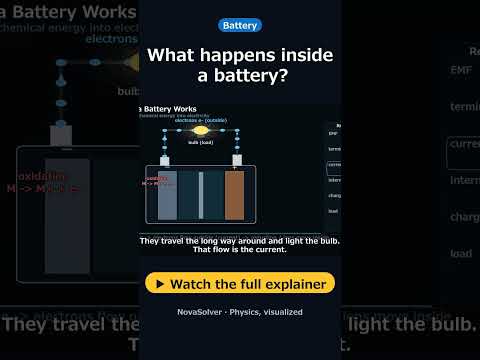
What happens inside a battery? | How a Battery works #Shorts