Tune the composition, bandgap and architecture of an ABX3 perovskite cell and watch Jsc, Voc, FF, PCE and the Shockley-Queisser limit update in real time. See how a Si tandem pushes you past the single-junction 33% ceiling.
Parameters
Perovskite composition
A-site and X-site choices shift the bandgap
Bandgap E_g
eV
Absorber thickness t
nm
Too thin under-absorbs, too thick exceeds the diffusion length
Cell architecture
Order of transport layers and tandem option
Defect density N_t
cm-3
Illumination I
suns
1 sun = AM1.5G 100 mW/cm²
Cell area A
cm²
Results
—
Short-circuit current Jsc (mA/cm²)
—
Open-circuit voltage Voc (V)
—
Fill factor FF
—
PCE (%)
—
SQ limit (%)
—
Cell power (mW)
—
Cell stack cross-section — photon absorption
Layer stack: transparent conductive oxide → electron transport layer → perovskite absorber → hole transport layer → metal electrode. Absorbed photons generate electron-hole pairs that drift toward the contacts.
Shockley-Queisser efficiency vs bandgap
PCE comparison across architectures
Theory & Key Formulas
$$PCE = \frac{J_{sc}\, V_{oc}\, FF}{P_{in}},\quad \eta_{SQ}(E_g) \text{ peaks at } 1.34\ \mathrm{eV}$$
J_sc: short-circuit current density (mA/cm²); V_oc: open-circuit voltage (V); FF: fill factor (dimensionless); P_in: incident optical power (mW/cm²); η_SQ: detailed-balance single-junction efficiency limit.
V_oc is approximated as E_g minus the thermalisation loss (~0.4 V) and the defect-recombination penalty. FF is scaled by an architecture factor f_arch (n-i-p meso = 1.00, n-i-p planar = 0.95, p-i-n = 0.97, Si tandem = 1.05).
Perovskite Solar Cell — Shockley-Queisser Efficiency Limit
🙋
I keep hearing about perovskite solar cells. What actually makes them different from a normal silicon panel, and what are MAPbI3 and FAPbI3 in this tool?
🎓
"Perovskite" is just the name of an ABX3 crystal structure — A is something like MA (methylammonium) or FA (formamidinium), B is Pb (lead), and X is iodine or bromine. MAPbI3 has a bandgap of about 1.55 eV and absorbs visible and near-infrared light very well. The killer feature versus Si (1.12 eV) is that you can tune the bandgap from roughly 1.2 to 2.3 eV just by changing the recipe — a chemically tunable semiconductor.
🙋
Why does tuning the bandgap matter? The SQ chart looks like a mountain when I move the slider...
🎓
That mountain is the Shockley-Queisser limit and the peak sits at E_g ~ 1.34 eV, about 33.7%. Lower E_g lets you grab more photons, but the voltage V_oc per photon falls. Raise E_g and V_oc goes up but you throw away the infrared, so J_sc collapses. MAPbI3 at 1.55 eV sits slightly to the right of the peak, with a single-junction theoretical limit of about 33% — essentially tied with Si.
🙋
If I pick Si tandem the PCE jumps above 30%. Does that break the SQ limit?
🎓
It doesn't, because SQ only applies to a single junction. A tandem stacks a wide-gap perovskite (~1.68 eV) above Si (1.12 eV), so each cell catches a different slice of the spectrum and the thermalisation loss roughly halves. The combined theoretical limit jumps to about 43%, and HZB hit 33.9% certified in 2023. Oxford PV and LONGi already ship 28%+ tandem modules. This tool models that as a 1.4x boost on the perovskite-only PCE.
🙋
When I raise the defect density N_t, Voc drops steadily. What's physically happening?
🎓
Extra defects act as trap states that recombine the photo-generated electrons and holes — that's Shockley-Read-Hall recombination. It raises the dark current J0, and since V_oc = (kT/q) ln(Jsc/J0), every 10x in N_t costs you about 60 mV. The whole perovskite field is now obsessed with growing cleaner films: self-assembled monolayers like 2-PACz and MeO-2PACz routinely push N_t below 1e15 cm-3.
🙋
So what's actually keeping perovskite cells from taking over the market?
🎓
Long-term stability, full stop. Humidity, UV and especially heat (85 °C) cause MAI to decompose and ions to migrate across interfaces. Early devices lost 20% in 1,000 hours; Si modules are warranted for 25 years. Mixed Cs/FA cations, PbI2 excess and hydrophobic encapsulation now get devices through IEC 61215 (1,000 h, 85 °C / 85% RH). Sekisui (Japan), Saule (Poland), Swift Solar (US) and GCL Perovskite (China) are running pilot lines for BIPV, lightweight and indoor IoT applications as of 2026.
Frequently Asked Questions
Under AM1.5G illumination, a single-junction cell cannot absorb photons below its bandgap E_g, and photons above E_g lose their excess energy as heat. From these two losses and detailed-balance arguments, the theoretical upper bound peaks at E_g ~ 1.34 eV with about 33.7%. MAPbI3 (1.55 eV) reaches about 33%, and FAPbI3 (1.48 eV) about 33.5% as a single-junction maximum.
In a perovskite/Si tandem the top cell (perovskite, E_g ~ 1.68 eV) absorbs short wavelengths while the bottom cell (Si, E_g ~ 1.12 eV) absorbs long wavelengths, drastically reducing thermalisation losses. The theoretical limit rises to about 43% and certified devices reached 33.9% (Helmholtz Berlin/HZB) in 2023. This tool applies a 1.4x boost when Si tandem is selected, taking a 22% perovskite cell to roughly 31%.
Higher N_t accelerates Shockley-Read-Hall recombination and raises the dark current J0. Because Voc = (kT/q) ln(Jsc/J0), a 10x increase in N_t lowers Voc by about 0.06 V, and FF also drops from recombination losses. This tool varies N_t from 1e14 to 1e18 cm-3 and flags N_t > 1e17 as risky. State-of-the-art crystals target 1e15 cm-3 or lower.
J-V hysteresis comes from ion migration (especially MA+ and I-) and interfacial traps. Mitigations include (1) using a p-i-n (inverted) architecture with PCBM, (2) additives (Cl-, K+, Cs+) that suppress ion diffusion, and (3) self-assembled monolayers (2-PACz, MeO-2PACz) that improve interface quality. The tool applies an architecture correction when p-i-n planar is selected to model the lower hysteresis case.
Real-World Applications
BIPV (building-integrated photovoltaics): Perovskites can be coated onto glass and made semi-transparent in a chosen colour, which makes them ideal for windows and façade panels. Saule Technologies (Poland) inkjet-prints decorative BIPV panels, and Swift Solar (US) targets lightweight modules for aerospace and mobility. Curved roofs and walls that were off-limits to heavy Si modules become viable when the cell weighs 1-2 kg/m².
Perovskite/Si tandem utility plants: LONGi, JinkoSolar and Trina Solar are commissioning hybrid lines in 2025-26 that deposit a perovskite top cell on top of an existing Si bottom cell. At 27-30% module PCE, a utility-scale plant generates 20% more energy from the same land and cuts LCOE by roughly 15%. Industry interest accelerated sharply after HZB's certified 33.9% world record in 2023.
Indoor IoT and low-light devices: Perovskites keep their efficiency under 200-1000 lux indoor lighting and beat amorphous Si by 2-3x in office environments. Sekisui Chemical sells battery-less perovskite IoT power modules for indoor temperature/humidity sensors and BLE beacons. Drop the illumination slider to about 0.05 suns (~500 lux) to see how PCE behaves in this regime.
Space and stratospheric platforms: The combination of lightweight and high efficiency is attractive for spacecraft. NASA Ames and Brown University have run early radiation tests on the ISS and find perovskites tolerate proton/electron flux better than crystalline Si. If tandems double the W/kg specific power versus Si, they could compete with GaAs for satellite and HAPS (high-altitude platform station) power.
Common Misconceptions & Pitfalls
The biggest trap is treating a published 25% PCE as if it were a product spec. Record values are measured on tiny aperture cells (<0.1 cm², often with a mask). When you scale to a full module (>100 cm²), interconnect losses, edge recombination and process yield typically cost 3-5 percentage points. HZB's 33.9% tandem is a 1 cm² lab cell — commercial modules are still in the 25-28% range. If you push the cell area in this tool above 100 cm², mentally apply an 80-90% derate to estimate field PCE.
Second, do not equate "hysteresis-free J-V" with "good cell." Sweeping the J-V curve fast enough hides any hysteresis. The number that really matters is the stabilised PCE under maximum power point tracking (MPPT) for 30+ minutes, which is often 5-15% below the initial J-V. p-i-n planar genuinely reduces hysteresis but that is independent of long-term stability. Always check papers for "MPPT-tracked stable efficiency."
Finally, "lead-free" does not automatically mean greener and equally efficient. Sn (tin) perovskites avoid Pb but Sn²⁺ oxidises rapidly to Sn⁴⁺, so PCE has stalled around 14% as of 2026. Meanwhile the Pb required per watt of PV is roughly 0.4 g/m² of module — less than the silver in a Si cell — and encapsulation contains any leakage. IEA-PVPS argues that gradual lead regulation is sufficient; reflexively rejecting Pb chemistry on environmental grounds without a lifecycle analysis is misguided.
How to Use
Set the bandgap energy (eV) for your ABX3 perovskite composition—typical range 1.2–1.8 eV affects both light absorption and voltage output via the Shockley-Queisser limit.
Adjust absorber layer thickness (nm) between 200–500 nm; thicker layers capture more photons but increase recombination losses.
Input defect density (cm⁻³, typically 10¹⁵–10¹⁷) and illumination intensity (suns, 0.1–1.5 AM1.5G); the simulator calculates Jsc, Voc, FF, and PCE in real time.
Worked Example
For a MAPbI₃ perovskite with bandgap 1.55 eV, absorber thickness 350 nm, defect density 10¹⁶ cm⁻³, and 1.0 sun illumination: expect Jsc ≈ 22 mA/cm², Voc ≈ 1.12 V, FF ≈ 0.78, yielding PCE ≈ 19.3%. Reducing defect density to 10¹⁵ cm⁻³ increases Voc to ~1.16 V and PCE to ~20.1%, while the SQ limit at 1.55 eV remains 33.5%.
Practical Notes
Bandgap–voltage trade-off: 1.4 eV compositions (Cs₀.₁FA₀.₉PbI₃) show higher Voc (~1.18 V) but lower Jsc than 1.6 eV materials; optimize for your target application.
Defect density dominates recombination; achieving <10¹⁵ cm⁻³ via passivation (PEA⁺, 4-SPEA) is critical for >20% PCE industrial devices.
Under concentrated light (1.5 suns), Jsc scales linearly but FF typically drops 1–2% due to series resistance; account for thermal losses.
🎬 Watch it in motion
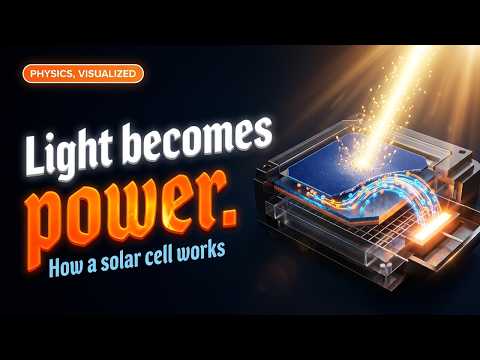
Light Becomes Power | How a Solar Cell Works
Weak light passes straight through | How a Solar Cell works #Shorts
More light: current up, volts flat | How a Solar Cell works #Shorts
Two layers turn light into power | How a Solar Cell works #Shorts
How does light become electricity? | How a Solar Cell works #Shorts