Reinforcement Learning Cae — Troubleshooting
By NovaSolver Editorial Team · AI for CAE
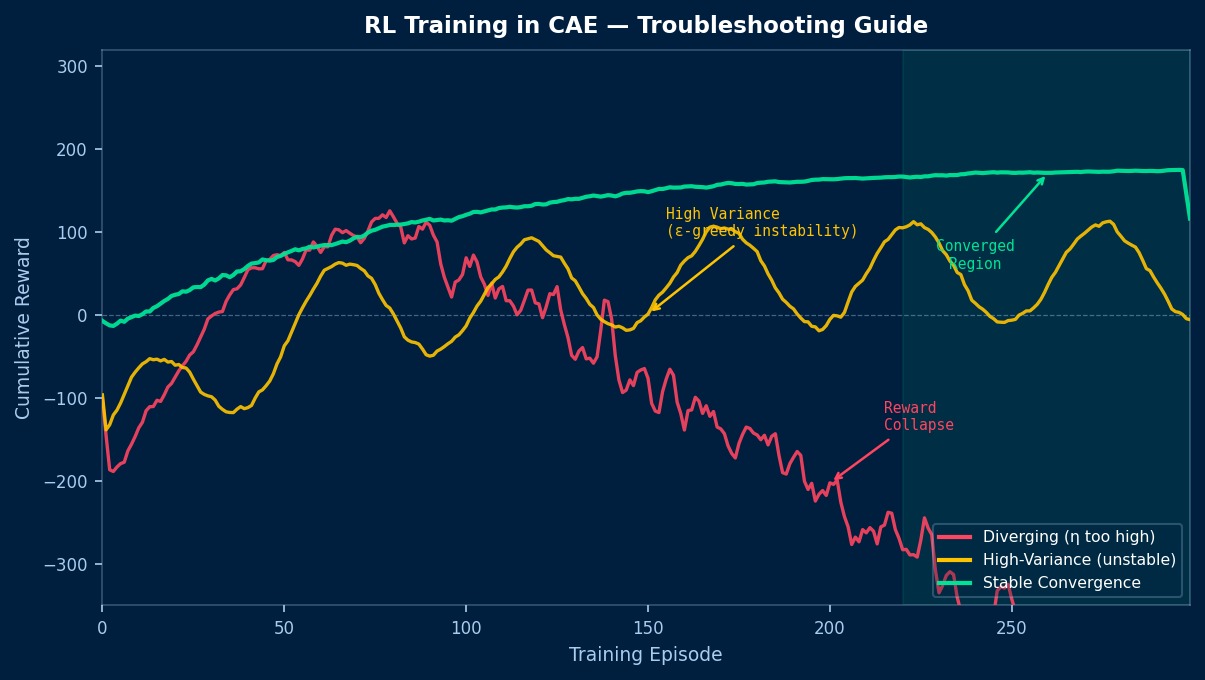
My Reinforcement Learning Cae simulation is giving me unexpected results — convergence issues, maybe. How do I diagnose this systematically?
Reinforcement Learning Cae troubleshooting follows patterns once you know what to look for. Most issues fall into three buckets: convergence failures, accuracy problems, and result misinterpretation. Let me give you a systematic diagnostic framework rather than a list of random fixes.
That framing helps. Before we dive in — what's the single most common mistake engineers make with Reinforcement Learning Cae?
Honestly, it's skipping the sanity checks. Engineers set up a Reinforcement Learning Cae model, it converges, and they trust the result without verifying it against a hand calculation or a known benchmark. The solver gives you an answer regardless of whether your model is physically correct. Always run a simplified version first.
Reinforcement Learning Cae — Governing Equations & Physical Basis
Let's start with the physics. What's the governing equation for Reinforcement Learning Cae?
Reinforcement Learning Cae in AI-assisted CAE replaces or augments the traditional PDE solver with learned models — neural networks trained on simulation data, physics residuals, or both. The fundamental equation is:
Each term carries a specific physical meaning. Misidentifying the balance of forces, fluxes, or rates is the most common source of modelling error. Always trace units and dimensional consistency before checking any numerical results.
I see. And how does this equation get discretised for actual computation?
The continuous form is approximated over a mesh of elements or cells. For Reinforcement Learning Cae, the key discretisation choices are the spatial approximation order (linear, quadratic, higher), the temporal integration scheme if the problem is transient, and the boundary condition enforcement strategy. Each choice has accuracy and cost implications.
Reinforcement Learning Cae in AI-assisted CAE replaces or augments the traditional PDE solver with learned models — neural networks trained on simulation data, physics residuals, or both. The derivation involves:
- Conservation law statement — What physical quantity is balanced (force, mass, energy, charge)?
- Constitutive relations — How does material respond (Hooke's law, viscosity, conductivity, permeability)?
- Boundary conditions — Essential (Dirichlet) and natural (Neumann) conditions that close the problem.
- Initial conditions — For transient problems, the state at $t=0$ must be physically meaningful.
Reinforcement Learning Cae — Troubleshooting Guide
Systematic Diagnostic Framework
When a Reinforcement Learning Cae simulation fails or produces unexpected results, follow this sequence:
- Check the obvious — Units consistent? Geometry correct scale? Material properties physically reasonable?
- Simplify the model — Remove features, reduce to 2D, use linear material. If the simple model also fails, the problem is fundamental.
- Check mesh quality — Maximum skewness, aspect ratio, non-orthogonality. A single bad element can crash the whole solution.
- Examine the residual history — Is the residual decreasing? Oscillating? Stalling? Each pattern has a different root cause.
- Verify boundary conditions — Are all DOF/flux constrained? Any rigid-body modes? Any physically impossible constraints?
- Check the solver log — Most solvers log the specific iteration, equation, and node where problems occur.
My Reinforcement Learning Cae model converges but the results look wrong. How do I tell the difference between a solver issue and a modelling issue?
If it converges, it's almost always a modelling issue. Run a benchmark first — apply known loading to a simple geometry and compare against the analytical solution. If the benchmark passes, the physics model is correct. Then apply the benchmark procedure (same element type, same material model) to the real geometry and add complexity incrementally until results degrade.
Common Error Patterns
- Negative Jacobian / element inversion → Reduce load step size; improve mesh quality; check for initial penetration in contact.
- Zero pivot / singular matrix → Missing constraint (rigid body mode); check for disconnected parts or under-constrained mechanisms.
- Oscillating residual → Timestep too large (CFL violation); contact stiffness too high; switch from explicit to implicit integration.
- Correct global but wrong local results → Mesh too coarse locally; stress concentration not captured; refine near high-gradient regions.
- Solver runs but wrong answer → Wrong boundary condition type (essential vs natural swapped); wrong material orientation; wrong loading direction.
Software Workflow & Settings
How do I actually set this up in a real CAE tool? What are the key settings I should pay attention to?
The workflow for Reinforcement Learning Cae in modern CAE tools follows a fairly standard pattern: geometry import → mesh generation → physics setup → solver run → result extraction. Let me walk through the key decision points at each stage.
Typical software workflow for Reinforcement Learning Cae:
- Geometry import — Use STEP or Parasolid for solid geometry. Check for gaps, duplicates, and geometric defects before meshing.
- Mesh generation — Select element type and order based on the physics: linear tetrahedral for quick iteration, quadratic for accuracy, hexahedral for high-quality CFD.
- Material assignment — Apply material models at the part level, not the element level, for maintainability.
- Boundary conditions — Use constraint equations (MPCs) for complex mechanical connections; avoid overconstraining which stiffens the model artificially.
- Solver configuration — Set convergence tolerance, maximum iterations, and output frequency. For nonlinear problems, set automatic time stepping.
- Post-processing — Export results in VTK or Ensight format for detailed analysis; always check reaction forces and global energy balance first.
- Always import geometry in a CAD-native format (STEP, IGES) for best surface fidelity
- Run a quick mesh quality check before submitting — catch problems early
- Save a baseline run with default settings before tuning solver parameters
- Archive input files and solver logs alongside results for reproducibility
- Document the software version — results can change between major releases
Verification, Validation & Benchmarking
How do I know if my Reinforcement Learning Cae results are actually correct? What benchmarks should I use?
Start with published benchmarks from recognised sources — NAFEMS, ASME, and the FEA community have documented test cases with reference solutions. The NAFEMS Round Robin tests and the LE-series benchmarks are the standard starting point for structural analysis. For CFD, the NASA Turbulence Modelling Resource provides validated test cases.
Recommended validation approach for Reinforcement Learning Cae:
- Unit benchmark — Solve a single-element problem analytically first. Confirms material model, DOF, and loading direction are correct.
- Patch test — A set of elements under linear loading should reproduce the exact analytical solution. If it fails, there's a coding or setup error.
- Mesh convergence study — Three mesh refinement levels with constant refinement ratio $r \approx \sqrt{2}$ (2D) or $\sqrt[3]{2}$ (3D). Report GCI.
- Published benchmark — Compare against the NAFEMS or equivalent test case for your specific analysis type.
- Physical test correlation — For critical applications, correlation with physical test data within ±10% is the target.
What's a realistic accuracy target for Reinforcement Learning Cae in engineering practice?
For stress analysis: within 5–10% of test data for simple geometries, 10–15% for complex assemblies with contact and welds. For CFD: drag coefficient within 5%, pressure drop within 10%, temperature within 5°C. For dynamics: frequency within 3%, mode shape MAC > 0.9. These are practical engineering targets, not research-grade accuracy.
Computational Performance & Design Integration
Computational Performance for Reinforcement Learning Cae
As Reinforcement Learning Cae models grow in size and complexity, computational performance becomes a primary concern:
- Model size — $10^5$ DOF: laptop in minutes. $10^7$ DOF: workstation in hours. $10^9$ DOF: HPC cluster required.
- Parallelism — Shared memory (OpenMP) scales to 32–64 cores on a workstation. Distributed memory (MPI) scales to thousands of cores on HPC.
- GPU acceleration — Linear algebra at the core of Reinforcement Learning Cae (sparse matrix–vector products, direct solves) runs 10–50× faster on GPU for large $n$.
- Cloud HPC — On-demand access to thousands of cores eliminates capital investment in hardware. AWS, Azure, and Google Cloud all offer pre-configured CAE environments.
My Reinforcement Learning Cae model takes 8 hours to run. What's the fastest way to speed it up without compromising accuracy?
First check if you actually need all that fidelity. Often a 2D model or a reduced submodel gives 90% of the information at 5% of the cost. If you need the full 3D model: (1) increase element order rather than refining — quadratic elements give more accuracy per DOF than refining linear elements; (2) enable HPC parallelism — going from 4 to 32 cores typically gives 6–8× speedup; (3) use in-core direct solvers if RAM permits — they're often 3× faster than iterative solvers for structural problems under $10^7$ DOF.
Integration with the Design Process
The real value of Reinforcement Learning Cae analysis comes from integration with the design-engineering workflow:
- Parametric studies — Automate variation of geometry and loading parameters to build a design response surface.
- Design optimisation — Topology optimisation, size optimisation, and shape optimisation driven by Reinforcement Learning Cae objective functions.
- Early-stage screening — Run coarse-mesh models to down-select concepts before investing in high-fidelity analysis.
- Digital twin integration — Reduced-order models derived from Reinforcement Learning Cae provide the physics backbone for real-time asset monitoring.
Summary & Key Takeaways
- When Reinforcement Learning Cae fails, 80% of cases are caused by mesh quality, unit inconsistency, or missing boundary conditions.
- Convergence and accuracy are separate problems — a converged solution can still be completely wrong.
- Systematic debugging (unit model → patch test → simple geometry → full model) isolates error sources efficiently.
- Preserve solver residual logs — the residual history is diagnostic gold and usually contains the root cause.
- The fastest path to correct results is never brute-force parameter tuning — always understand what changed and why.
Further Reading & Resources
Where should I go to learn more about Reinforcement Learning Cae beyond what we've covered?
For theoretical depth: the textbooks by Zienkiewicz & Taylor (FEM), Ferziger & Perić (CFD), or Bathe (FEA) are the standards depending on your domain. For AI-Assisted CAE specifically, the NAFEMS knowledge base and the IACM Computational Mechanics journal are excellent peer-reviewed sources. For practical workflow: the software vendor training courses are surprisingly good — they're designed for engineers, not mathematicians.
Recommended resources for Reinforcement Learning Cae in AI-Assisted CAE:
- NAFEMS — Benchmark library, best-practice guides, and professional courses; industry-standard reference for FEA quality.
- ASME V&V standards — V&V 10 (solid mechanics), V&V 20 (CFD), V&V 40 (medical devices) — define validation methodology for regulated industries.
- Journal of Computational Physics, CMAME — Peer-reviewed publication of new methods in AI-Assisted CAE.
- SimScale, CAE Forum — Active communities for practical troubleshooting questions.
- Related articles on this site — Use the category navigation and cross-topic tags below to explore adjacent methods.