Heart Valve FSI Analysis
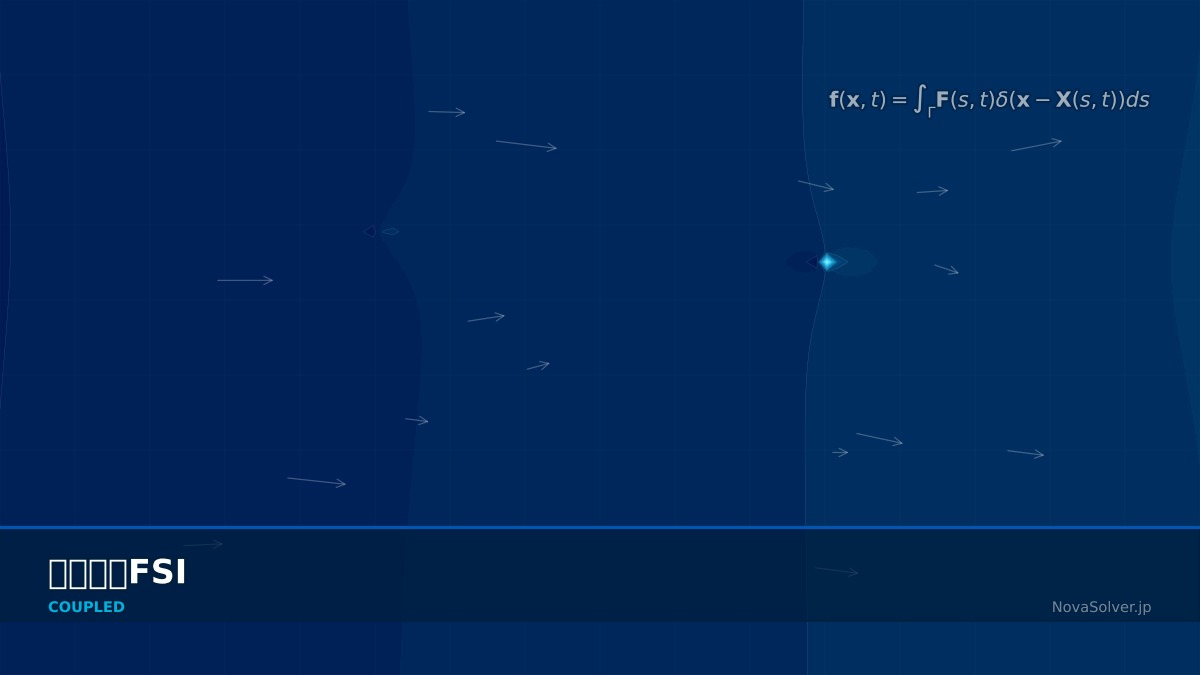
Heart Valve FSI: Theoretical Foundations
Heart Valve Simulation Background
In what situations is fluid-structure interaction analysis for heart valves necessary?
It is used for the design and evaluation of artificial heart valves (mechanical valves, bioprosthetic valves). The main objectives are to evaluate leaflet opening/closing behavior, wall shear stress (WSS), thrombus formation risk, and hemolysis risk.
Blood flow through the valve has a Reynolds number in the thousands, placing it in the transitional regime, and the leaflets undergo large deformation. Therefore, fluid-structure interaction (FSI) becomes essential.
Governing Equations
Is the mechanics of blood flow different from that of a Newtonian fluid?
In large vessels, blood is often approximated as a Newtonian fluid ($\mu \approx 3.5$ mPa·s). However, in low shear rate regions, non-Newtonian models such as the Carreau-Yasuda model are necessary.
For structural analysis of leaflets, a hyperelastic model is used. The Mooney-Rivlin model is used for bioprosthetic valves, and a rigid body motion model is applied for mechanical valve leaflets.
Here, $W$ is the strain energy density function, and $I_1, I_2$ are invariants of the Cauchy-Green deformation tensor.
Are the interface conditions the same as in standard FSI?
They are fundamentally the same. However, since leaflets are thin shell structures, additional handling of contact detection (when leaflets contact each other during valve closure) is required. Using methods like the Immersed Boundary Method or Immersed Finite Element Method allows handling large deformations without remeshing.
Heart Valves are a "Fully Passive System" – The Sophistication of Opening and Closing 100,000 Times a Day Driven Only by Blood Pressure Difference
From an engineer designing artificial devices, the operating principle of heart valves is surprisingly simple. There is no motor or electrical signal; the valve opens solely due to the pressure difference between the ventricle and the aorta, and closes due to the momentum of blood when backflow begins—a fully passive, fluid-driven system. The theory governing this opening and closing is a textbook example of FSI, where leaflet thickness (~0.5mm) and leaflet elastic modulus directly affect opening speed and backflow volume during closure. In particular, FSI analysis shows that "water hammer pressure" occurs at closure, generating instantaneous stress concentrations of 0.1–0.3 MPa on the leaflets. Since this repeated stress leads to valve calcification and fatigue failure, understanding the theory is directly linked to the lifespan design of artificial valves.
Computational Methods for Heart Valve FSI
Discretization Method Selection
What types of numerical methods are used in FSI analysis of heart valves?
There are three main approaches.
| Method | Fluid | Structure | Characteristics |
|---|---|---|---|
| ALE-FEM | FVM/FEM (body-fitted grid) | FEM | High interface accuracy. Requires remeshing for large deformations. |
| IB Method | FDM/FVM (fixed grid) | Fiber Model | No remeshing needed. Interface blurs. |
| IFEM | FEM (fixed grid) | FEM (embedded) | Can use FEM for structure. Implementation somewhat complex. |
For cases like heart valves that repeatedly open and close, remeshing every cycle with the ALE method must be tough, right?
That's why methods like the IB method and overset mesh method are becoming mainstream recently. Griffith et al.'s (IBAMR) open-source IB code is widely used in heart valve research.
Time Integration
What time step size is used to solve the cardiac cycle?
The heartbeat cycle is about 0.8 seconds. Valve opening/closing occurs in tens of milliseconds, so a $\Delta t = 0.1$ to $0.5$ ms is typically required. That's 1,600 to 8,000 steps per cycle.
Run at least 3–5 cycles to exclude initial transients, and obtain statistical quantities from stable cycles. Inflow boundary conditions are set using velocity or pressure waveforms from MRI measurements.
Wall Shear Stress Evaluation
You mentioned WSS evaluation is important. What metrics are used?
Time-Averaged WSS (TAWSS) and Oscillatory Shear Index (OSI) are representative.
Areas with low TAWSS (< 0.4 Pa) and high OSI (> 0.3) are considered high risk for thrombosis. These evaluations are also recommended in FDA (U.S. Food and Drug Administration) guidance.
Numerical Representation of Leaflet Contact – How to Code "Valve Closure"
The most numerically challenging aspect of heart valve FSI analysis is handling "contact between leaflets." When three leaflets close completely at the center, the gap between them approaches zero. From a fluid analysis perspective, this creates a singularity where "pressure becomes infinite at the moment the gap becomes zero," which does not converge with standard CFD grids. To avoid this, the Immersed Boundary Method (IBM) represents leaflets as "virtual volume force sources," approximating closure without deforming the grid. On the other hand, the CEL method represents closure by changing the fluid volume fraction when leaflets overlap Eulerian grids. Both are clever ways to avoid the singularity by not directly handling "zero gap"—a classic example where the choice of numerical method determines the success of the analysis.
Heart Valve FSI in Practice
Practical Model Construction Steps
Please explain the specific steps for model construction.
1. 3D geometry reconstruction from CT/MRI images (using Mimics, 3D Slicer, etc.)
2. CAD modeling of leaflet shape (patient-specific or artificial valve CAD data)
3. Mesh Generation: Polyhedral mesh for fluid domain, shell elements for structure.
4. Boundary condition setup: Flow rate waveform at inlet, Windkessel pressure model at outlet.
5. Material property definition: Leaflets, aortic wall, blood.
What is the Windkessel model?
It's a model approximating the downstream vascular system with an RC circuit. The three-element Windkessel is standard:
$R_p$ is proximal resistance, $R_d$ is distal resistance, and $C$ is compliance. This allows imposing a physiologically plausible pressure boundary downstream of the aortic valve.
Mesh Quality Standards
What level of mesh density is required?
Place at least 3 or more prism layers near the leaflets. In the literature, a total element count of 3 to 10 million is typical.
| Region | Element Size | Notes |
|---|---|---|
| Leaflet Surface | 0.2–0.5 mm | Accuracy required for stress evaluation. |
| Valve Orifice Jet Region | 0.3–0.8 mm | Resolution of velocity gradients. |
| Aortic Sinus | 0.5–1.0 mm | Resolution of vortex flow. |
| Far Field Region | 1.0–3.0 mm | Ensuring computational efficiency. |
With this scale, HPC is needed, right?
A typical calculation requires 64–256 cores and takes several days to a week. GPU-enabled solvers (like Ansys Fluent Native GPU Solver) can provide speedup.
Related Topics
Experience the theory firsthand with the interactive simulator for this field
All Simulators