Coupling Strategy with Ansys System Coupling
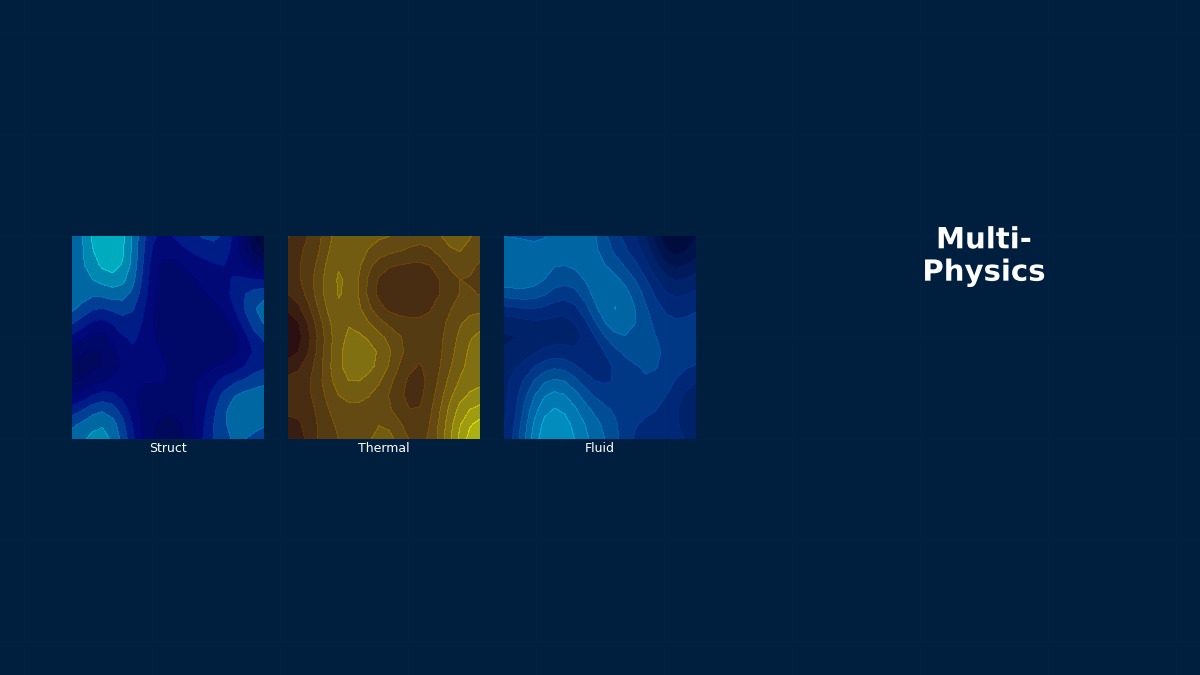
Concept: linking separate solvers
Overview
I set up fluid–structure coupling with System Coupling, but it diverges within a few steps. Where should I start?
Start with coupling iterations and relaxation. In partitioned coupling, the fluid solver computes forces and passes them to the structure, which computes displacement and passes it back, repeated several times within each time step (coupling iterations). With a light structure in heavy fluid, the corrections overshoot and grow until the run diverges. The basic remedy is relaxation — taking only part of each correction.
One time step
- The fluid solver solves with the current interface shape and computes interface forces (pressure and shear).
- Forces are mapped to the structural mesh and the structural solver computes displacement.
- Displacement is relaxed, returned to the fluid side and the fluid mesh is moved.
- Repeat 1–3 until changes in force and displacement are small enough, then advance.
Relaxation formulas
$g$ is one pass through fluid and structure, and $\omega$ the relaxation factor (0–1); $\omega = 1$ means no relaxation. The second formula is Aitken's method, which sets the next factor automatically from how the correction (residual $\mathbf{r}$) changed between iterations.
The added-mass barrier
In the 2000s it was clearly shown that partitioned coupling struggles when the structure is about as light as the surrounding fluid — blood in vessels, thin plates in water, air around light membranes. The cause is the added-mass effect: the force needed to move the fluid exceeds the structure's own inertia. Smaller time steps don't help and can even make things worse. This drove widespread adoption of smarter acceleration methods such as Aitken relaxation and quasi-Newton schemes (e.g. IQN-ILS).
Worked example: iterations on a model problem
A linear model problem $x = c - R\,x$ with the interface displacement split into 20 modes, the added-mass ratio of mode i being $r_{max}/i$ (long waves couple most strongly). Coupling iterations were counted until the error fell below one part per million:
| Max added-mass ratio | No relaxation | ω = 0.5 | ω = 0.1 | Best fixed ω | Aitken |
|---|---|---|---|---|---|
| 0.5 | 18 | 19 | 125 | 8 (ω=0.79) | 8 |
| 2 | diverges | 17 | 114 | 18 (ω=0.49) | 12 |
| 10 | diverges | diverges | 81 | 48 (ω=0.16) | 22 |
| 50 | diverges | diverges | diverges | 95 (ω=0.037) | 35 |
I thought a small relaxation factor was the safe choice, but the iteration count explodes.
Right. ω = 0.1 takes 125 iterations when the added mass is small and diverges when it is large. A fixed value must be small enough for the most strongly coupled mode, which slows the weakly coupled ones. Aitken adjusts the factor every iteration and needed only 35 even at a ratio of 50. Real tools often offer such adaptive schemes or quasi-Newton methods, so they are worth trying first when a run diverges. Keep in mind this is a linear model problem; real counts and optimal values will differ.
Setting up
Checklist
- Confirm each solver converges alone first; settings that fail standalone won't work coupled.
- Check that mapping between interface meshes conserves total force.
- Define convergence criteria for coupling iterations (changes in force and displacement) and log whether each step meets them.
- For large added-mass ratios, use adaptive relaxation or quasi-Newton methods.
- Decide whether weak (non-iterative) coupling suffices by comparing once with strong coupling, as in strong versus weak coupling.
Thinking about run time
- One iteration = one pass of each solver: five coupling iterations make each step roughly five times as expensive.
- Inner iterations: within coupling iterations, fewer inner solver iterations often suffice as long as the whole converges.
“A smaller time step made it diverge”
Coupled fluid–structure runs were unstable, so the time step was halved — and the run diverged sooner. This is common when added-mass effects are strong: a smaller step increases the fluid reaction relative to how far the structure can move per step, making partitioned iterations less stable. The fluid-only instinct that smaller steps stabilise things backfires. Revisit the relaxation method or coupling scheme (strong coupling, quasi-Newton or monolithic) rather than the step size.
Common mistakes
Mistakes and fixes
| Mistake | Effect | Fix |
|---|---|---|
| Starting without relaxation | Divergence with large added mass | Add relaxation or adaptive schemes |
| Over-small relaxation | Huge iteration counts | Aitken or quasi-Newton |
| Shrinking the step to stabilise | Less stable | Revisit the scheme |
| Not checking mapping conservation | Force or energy drift | Compare interface totals |
| Not logging coupling convergence | Advancing unconverged | Check residuals each step |
I'd like to learn more about coupling methods.
Method differences are covered in partitioned versus monolithic coupling and staggered coupling, convergence criteria in convergence of coupled analyses, interface data transfer in mapping between dissimilar meshes, and whether to iterate at all in strong versus weak coupling.
Related Topics
Experience the theory firsthand with the interactive simulator for this field
All Simulators