CAE Simulation of Phased Array Antennas
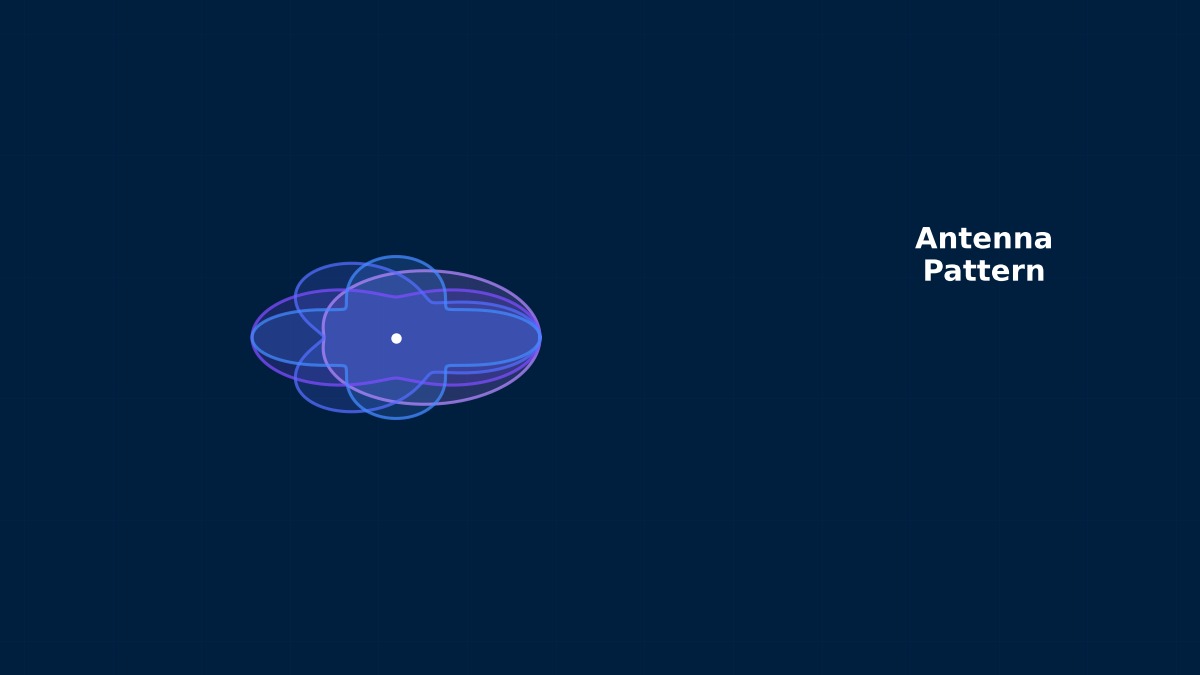
CAE Simulation of Phased Array Antennas: Theoretical Foundations
Overview — What is a Phased Array
Is a phased array the thing used in fighter jet radars?
Yes, AESA (Active Electronically Scanned Array) radars like the AN/APG-81 mounted on the F-35 are prime examples. Recently, they are also being installed in 5G base stations and Starlink satellite terminals. Their key feature is the ability to electronically control the phase and amplitude of each element to scan the beam in milliseconds.
So you don't need to mechanically rotate the antenna? That's amazing.
Exactly. With traditional rotating parabolic radars, beam scanning is limited by the speed of mechanical rotation. Phased arrays are electronically controlled, allowing for thousands of beam switches per second. They can simultaneously track multiple targets or switch between radar and communication functions. The Aegis system's SPY-1 radar covers all directions with about 4,400 elements, and 5G base stations use Massive MIMO with 64 to 256 elements to direct individual beams to users in urban areas.
And simulating that phased array with CAE... What are the key points?
There are three core aspects. (1) Array Factor — the directivity pattern determined by element spacing and phase difference, (2) Element Pattern — the radiation characteristics of each individual element, (3) Mutual Coupling — electromagnetic interference between adjacent elements. The reliability of the simulation depends on how accurately these three can be modeled.
Array Factor (AF)
Can you show me the formula for the array factor?
The array factor for a linear array (1D array) with N equally spaced elements is expressed as follows.
Let's clarify the meaning of each variable.
- $N$ — Number of elements
- $a_n$ — Excitation amplitude (tapering weight) of the $n$-th element
- $k = 2\pi/\lambda$ — Wavenumber in free space
- $d$ — Element spacing
- $\theta$ — Angle from the array normal
- $\beta$ — Phase difference between adjacent elements (for beam steering)
For uniform amplitude ($a_n = 1$), can it be written in a closed form?
Good question. For a uniform array with isotropic, equal amplitude elements, it closes using the geometric series formula,
Looking at this equation, when $\psi = 0$, $AF = N$ and takes its maximum value. That is, the main beam points in the direction $\sin\theta_0 = -\beta / (kd)$. Nulls (zeros) appear at $\psi = 2m\pi/N$ ($m \neq 0, N, 2N, \ldots$).
Element Pattern and Pattern Multiplication Principle
Is the entire radiation pattern determined solely by the array factor?
No, that's insufficient. Each element itself has its own inherent radiation pattern (element pattern). The overall radiation pattern is determined by the pattern multiplication principle.
For example, in an array using dipole elements, the dipole's inherent $\cos\theta$ pattern is multiplied by the AF. For patch antenna elements, the pattern would be something like $\cos^n\theta$. The envelope of the element pattern wraps the peaks of the AF, so for instance, if a grating lobe from the array factor coincides with a null in the element pattern, that grating lobe can be effectively suppressed.
So the choice of element also significantly affects the overall array performance, right?
Exactly. Therefore, in CAE simulation, the basic approach is a two-step process: first accurately determine the radiation pattern of a single element, then proceed to analyze the entire array.
Beam Steering Principle
Does just changing the phase difference $\beta$ change the beam direction? I want to understand it intuitively.
Think of it in terms of wavefronts. When all elements radiate in phase ($\beta = 0$), the wavefront is parallel to the array plane—meaning the beam points straight ahead (broadside). Now, if you gradually delay the phase for each adjacent element, the wavefront tilts. This is beam steering.
If you want to point the beam in the $\theta_0$ direction, set $\beta$ using the above formula. For example, if $d = \lambda/2$, $\theta_0 = 30°$, then $\beta = -\pi \sin(30°) = -\pi/2 \approx -90°$. Simply delaying each element by $90°$ tilts the beam to $30°$.
That's incredibly simple. But how far can it be steered?
Theoretically, it can steer up to $\pm 90°$, but in practice, the limit is around $\pm 60°$. There are two reasons. (1) The beamwidth widens proportionally to $1/\cos\theta_0$, and gain decreases (the $\cos\theta_0$ factor). (2) Grating lobes and scan blindness become more likely at large angles.
Grating Lobe Condition
I often hear about grating lobes, but why is $d < \lambda/2$ necessary?
Grating lobes are a phenomenon where radiation with intensity comparable to the main lobe appears in directions other than the main beam. They occur due to the same principle as diffraction gratings in optics.
The condition for grating lobes not to occur, when steering the beam to $\theta_0$, is:
If considering only broadside ($\theta_0 = 0°$), then $d < \lambda$ is sufficient, but for steering in all directions ($\theta_0 = 90°$), $d < \lambda / 2$ is required. In practice, the golden rule is not to exceed $d = 0.5\lambda$.
For 5G mmWave bands (28 GHz), $\lambda \approx 10.7$ mm, so element spacing is around 5 mm. That's quite dense.
Yes. In mmWave bands, physical space constraints become severe, so along with miniaturizing TR (transmit/receive) modules, element spacing design becomes extremely important. Conversely, for VHF band (hundreds of MHz) radars, $\lambda$ is around 1 m, so the entire array becomes tens of meters in scale.
Sidelobe Control — Tapering
Sidelobes are high in uniform arrays, right? How do you suppress them?
Use amplitude tapering. By exciting the central elements strongly and the edge elements weakly, sidelobes are suppressed. Let's summarize the relationship between typical window functions and sidelobe level (SLL).
| Window Function | First Sidelobe (dB) | Beamwidth Widening Factor |
|---|