Electromagnetic Field Analysis for MIMO Antenna Design
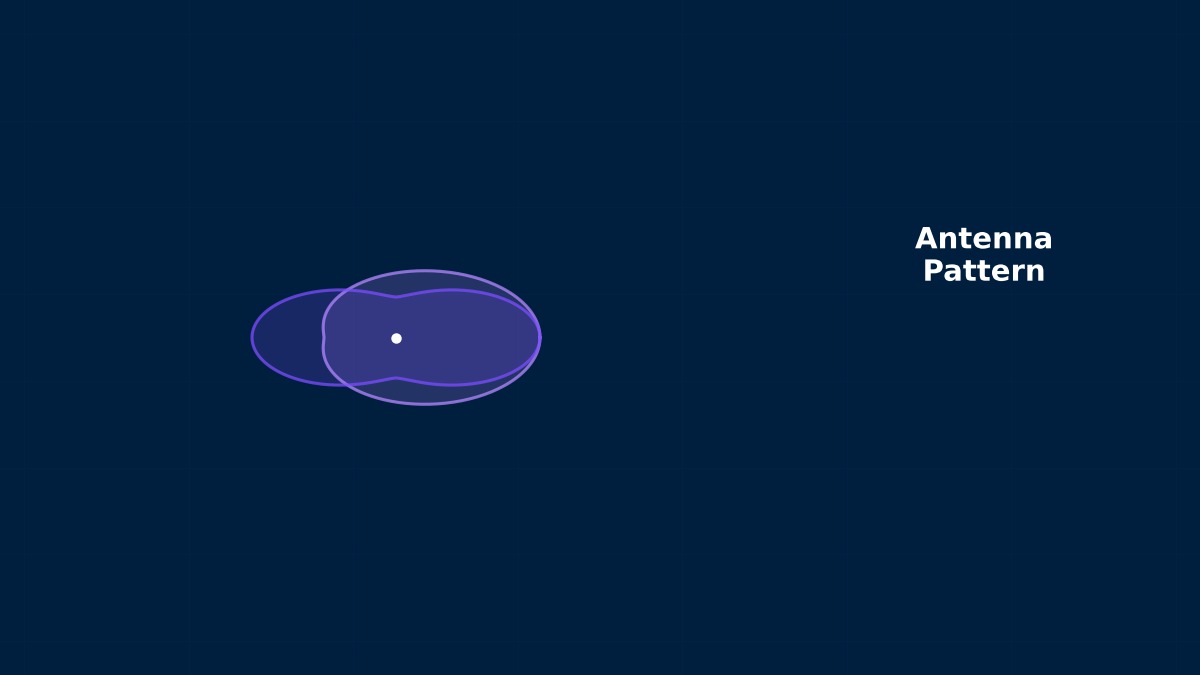
Electromagnetic Field Analysis for MIMO Antenna: Theoretical Foundations
What is a MIMO Antenna?
Don't multiple antennas interfere with each other when placed close together in a MIMO antenna?
That's the biggest challenge. MIMO (Multiple-Input Multiple-Output) is a technology that dramatically increases communication capacity by using multiple antenna elements for transmission and reception, but the core of the design is how to suppress mutual coupling between elements.
Specifically, how close are they placed?
In smartphones, the chassis size is only about 150mm. Four or even eight antennas are packed into that space. The iPhone 14 uses 4×4 MIMO, achieving over 15dB of inter-element isolation within that small chassis. Decoupling structures or DGS (Defected Ground Structure) are used to reduce mutual coupling.
What does 15dB actually mean?
In terms of S-parameters, it means $|S_{21}| < -15$ dB, i.e., the power leaking from port 1 to port 2 is about 3% or less. If this is not satisfied, the streams are not independent and the MIMO capacity gain cannot be achieved. For Sub-6GHz 5G terminals, the target is sometimes $|S_{ij}| < -20$ dB.
Channel Capacity
Does communication speed really double with MIMO?
Theoretically, yes. The MIMO channel capacity is expressed by the following formula:
Here $\mathbf{H}$ is the $N_r \times N_t$ channel matrix, $N_t$ is the number of transmit antennas, and $N_r$ is the number of receive antennas. For an ideal uncorrelated channel, the capacity increases linearly in proportion to $\min(N_t, N_r)$.
So, in theory, 4×4 MIMO is 4 times faster?
Ideally, yes. But in reality, if the scattering in the propagation environment is insufficient, the rank of the channel matrix $\mathbf{H}$ decreases and the capacity drops significantly below the theoretical value. For example, in a line-of-sight (LOS) environment, the rank approaches 1, and no matter how many antennas are added, the capacity hardly changes. That's why "propagation environment simulation" is just as important as element design.
Writing it in a decomposed form for each eigenchannel:
$\lambda_i$ are the eigenvalues of the channel matrix, representing the quality of each spatial stream. Capacity is maximized when all eigenvalues are equal (= ideal uncorrelated case).
Envelope Correlation Coefficient (ECC)
What is ECC? Is a smaller number better?
ECC (Envelope Correlation Coefficient) is an index that quantifies how "similar" the radiation patterns of two antenna elements are. The definition calculated from the far-field radiation pattern is this:
$\rho_e = 0$ means the patterns are completely orthogonal (best diversity performance), $\rho_e = 1$ means they are completely correlated (no MIMO gain).
What value should we aim for in practice?
For general MIMO terminals, $\rho_e < 0.5$ is a mandatory condition. For 5G terminals, $\rho_e < 0.1$ is often targeted. In practice, approximate calculation from S-parameters is more convenient, and under the assumption of a uniform propagation environment:
This formula is computationally light and can be used for screening during the design phase. However, to correctly evaluate contributions from non-uniform propagation environments or polarization, integral calculation from the far-field pattern is essential.
TARC (Total Active Reflection Coefficient)
How is TARC different from a normal reflection coefficient?
A normal S11 is the reflection coefficient looking at only one port, but in MIMO, signals enter all ports simultaneously. TARC is the "effective reflection coefficient" including the interaction of all ports. It is defined using the eigenvalues $s_i$ of the S-parameter matrix $\mathbf{S}$:
The goal is to satisfy $\Gamma_a^t < -10$ dB across the entire band. A poor TARC means "the band shifts when all ports are used simultaneously," so if you only check the single-port S11 for bandwidth, there's a trap where it could be out of band in actual operation.
Wait, so it's dangerous to think "OK" just by looking at S11?
Exactly. Especially in terminal designs with closely spaced elements, even if S11 satisfies -10dB, the active impedance can change and TARC may be out of band. HFSS and CST Studio have TARC post-processing functions, so you should definitely check it.
S-Parameters and Isolation
How should I interpret the S-parameter matrix for MIMO?
For an $N$-element MIMO antenna, you deal with an $N \times N$ S-parameter matrix. The diagonal elements $S_{ii}$ represent the reflection characteristics (impedance matching) of each element, and the off-diagonal elements $S_{ij}$ ($i \neq j$) represent the coupling (isolation) between elements.
| Parameter | Meaning | Target Value |
|---|---|---|
| $S_{ii}$ | Reflection coefficient of port $i$ | $< -10$ dB (in-band) |
| $S_{ij}$ ($i \neq j$) | Inter-port coupling (Isolation) | $< -15$ dB (recommended $< -20$ dB) |
| TARC | Reflection with all ports simultaneously excited | $< -10$ dB |
| ECC $\rho_e$ | Radiation pattern correlation | $< 0.5$ (recommended $< 0.1$) |
| Radiation Efficiency $\eta$ | Ratio of radiated power to input power | $> 50\%$ (recommended $> 70\%$) |
Maxwell's Equations and MIMO
Ultimately, which equations are being solved for MIMO antenna analysis?
The basics are Maxwell's equations. For high-frequency antenna analysis, assuming time-harmonic fields, they are reduced to the wave equation form:
Here $k_0 = \omega\sqrt{\mu_0\varepsilon_0}$ is the free-space wavenumber. For MIMO, each port is excited sequentially to obtain the S-parameter matrix. For $N$ ports, at least $N$ solutions are required, but HFSS's adaptive meshing and CST Studio's FDTD can efficiently handle multiple ports.
How MIMO's "Impossible" Theory Became Reality
The theoretical foundation of MIMO was independently published in the late 1990s by Foschini of AT&T Bell Labs and Gans of Telstra. They presented the shocking result that "in environments with rich scattering, capacity increases linearly as the number of transmit and receive antennas increases," but initially, there was much skeptical reaction like "That's too good to be true." However, after IEEE 802.11n (Wi-Fi 4) adopted MIMO in the 2000s, it rapidly became widespread, and now even elementary school tablets utilize this theory. It's a classic case of a theory thought "impossible" turning out to be real.