Electric Potential Distribution Analysis
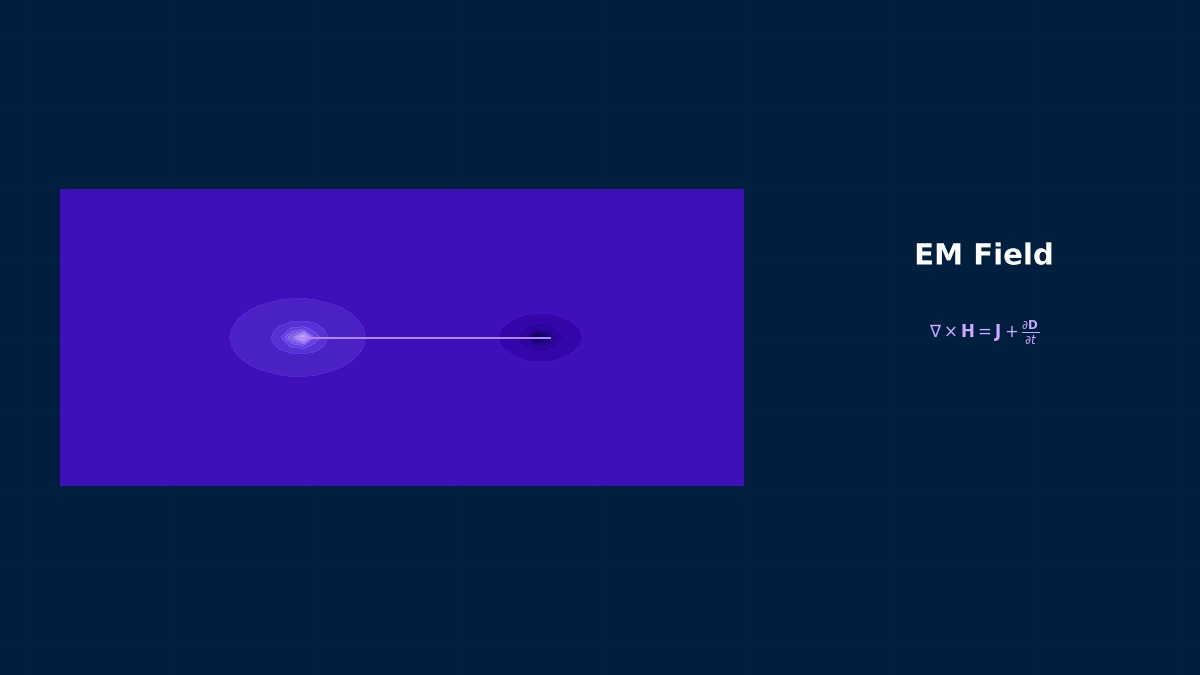
Electric Potential Distribution: Theoretical Foundations
Overview
Professor, how is electric potential related to the electric field?
The electric potential $\phi$ is a scalar field, and the electric field is its negative gradient.
Since a three-component vector field can be reduced to a single scalar field, solving for the potential is standard in FEM.
Reducing the number of unknowns to one-third is a big advantage.
The equation satisfied by the potential is Poisson's equation.
In charge-free regions, it becomes Laplace's equation $\nabla^2 \phi = 0$.
Boundary Conditions
What types of boundary conditions are there for potential analysis?
There are three basic types of boundary conditions.
Boundary Condition Mathematical Expression Physical Meaning Dirichlet $\phi = V_0$ Fixed potential (conductor surface) Neumann $\partial\phi/\partial n = -\sigma_s/\varepsilon$ Normal electric field specified Symmetric Boundary $\partial\phi/\partial n = 0$ Surface parallel to electric field lines
Conductors are equipotential, so $\phi = \text{const}$. In COMSOL, these can be set intuitively as "Electric Potential" and "Ground" boundary conditions.
Electrostatic Energy
How do you calculate electrostatic energy from the potential?
Electrostatic energy is obtained by volume integration of the square of the electric field.
$$ W_e = \frac{1}{2}\int_\Omega \varepsilon |\nabla\phi|^2\,d\Omega $$
This matches the capacitor energy $W = \frac{1}{2}CV^2$. It can be calculated directly using COMSOL's "Volume Integration".
Coffee Break Trivia Corner
"Potential is a scalar, so why is it more convenient than the vector electric field?"
The electric field $\mathbf{E}$ is a vector quantity (has x, y, z components), while the electric potential $\phi$ is a scalar quantity (a single number). When solving with FEM, solving for a scalar reduces the degrees of freedom to one-third, significantly lowering computational cost. It is overwhelmingly more efficient to "solve for the potential and then calculate the electric field via $\mathbf{E} = -\nabla\phi$" than to "solve for the electric field directly". This is why electric potential distribution analysis is the standard approach in CAE. On the other hand, in time-varying electromagnetic fields where potential cannot be defined (integral value changes depending on the path), "vector potential" is used instead of scalar potential. The choice between scalar or vector determines computational cost—this is a perspective worth keeping as a CAE engineer.
What types of boundary conditions are there for potential analysis?
There are three basic types of boundary conditions.
| Boundary Condition | Mathematical Expression | Physical Meaning |
|---|---|---|
| Dirichlet | $\phi = V_0$ | Fixed potential (conductor surface) |
| Neumann | $\partial\phi/\partial n = -\sigma_s/\varepsilon$ | Normal electric field specified |
| Symmetric Boundary | $\partial\phi/\partial n = 0$ | Surface parallel to electric field lines |
Conductors are equipotential, so $\phi = \text{const}$. In COMSOL, these can be set intuitively as "Electric Potential" and "Ground" boundary conditions.
How do you calculate electrostatic energy from the potential?
Electrostatic energy is obtained by volume integration of the square of the electric field.
This matches the capacitor energy $W = \frac{1}{2}CV^2$. It can be calculated directly using COMSOL's "Volume Integration".
"Potential is a scalar, so why is it more convenient than the vector electric field?"
The electric field $\mathbf{E}$ is a vector quantity (has x, y, z components), while the electric potential $\phi$ is a scalar quantity (a single number). When solving with FEM, solving for a scalar reduces the degrees of freedom to one-third, significantly lowering computational cost. It is overwhelmingly more efficient to "solve for the potential and then calculate the electric field via $\mathbf{E} = -\nabla\phi$" than to "solve for the electric field directly". This is why electric potential distribution analysis is the standard approach in CAE. On the other hand, in time-varying electromagnetic fields where potential cannot be defined (integral value changes depending on the path), "vector potential" is used instead of scalar potential. The choice between scalar or vector determines computational cost—this is a perspective worth keeping as a CAE engineer.
Computational Methods for Electric Potential Distribution
Details of Numerical Methods
Could you explain the FEM formulation for potential in detail?
Discretize the weak form of Poisson's equation. Approximating the potential with shape functions $N_i$, the element stiffness matrix is
It's positive definite symmetric, so the CG method is optimal. AMG is effective for preconditioning. COMSOL automatically selects MUMPS and AMG.
Improving Accuracy of Electric Field from Potential
Are there any tips for improving electric field accuracy?
The potential is continuous, but $\mathbf{E} = -\nabla\phi$ can be discontinuous at element boundaries.
- SPR Method: Reconstructs electric field on a patch basis from gradient values at superconvergent points
- Quadratic Elements: If potential is quadratic, electric field varies linearly, improving accuracy
- Smoothing Processing: Available as a post-processing option in COMSOL
Using quadratic elements is the minimum requirement in practice, right?
Exactly. With linear elements, the electric field becomes constant within an element, failing to correctly capture field concentrations. Ansys Maxwell's automatic adaptive meshing also operates based on quadratic elements.
The Designer's Ingenuity in "Equalizing" Potential Distribution on Power Line Insulators
The suspension insulators (those linked bowl-shaped ones) used on high-voltage power lines do not actually have equal voltage applied to each linked insulator. The wire side...
Practical CAE quality notes for Electric Potential Distribution Analysis
Electric Potential Distribution Analysis should be treated as an engineering model, not as an isolated formula. In electromagnetic analysis, reliable results come from a clear chain of assumptions: governing physics, material data, boundary conditions, numerical discretization, solver settings, and post-processing criteria. Before using this note in a design review, identify which quantities are prescribed, which are solved, and which are only diagnostic indicators.
Model setup checklist
- Define the scope: decide whether Electric Potential Distribution Analysis is being used for screening, detailed design, failure investigation, or verification of another simulation.
- Check dimensions and units: keep SI units internally and document every conversion applied to loads, geometry, material constants, and time or frequency scales.
- State assumptions explicitly: record linearity, steady-state or transient behavior, small-deformation limits, continuum assumptions, and any symmetry or ideal boundary conditions.
- Compare with a baseline: use a hand calculation, limiting case, mesh refinement trend, or independent solver result before accepting the final value.
Validation signals
| Review item | What to verify | Typical warning sign |
|---|---|---|
| Inputs | Geometry, material data, loads, and constraints match the intended electromagnetic analysis problem. | Correct-looking plots with unrealistic magnitudes or units. |
| Numerics | Mesh, time step, convergence tolerance, and solver options are adequate for Electric Potential. | Large changes after small mesh or tolerance adjustments. |
| Physics | The selected theory remains valid in the expected stress, temperature, velocity, or frequency range. | Results are used outside the assumptions stated in the model. |
For production use, keep the model file, input table, result plots, and review comments together. This makes Electric Potential Distribution Analysis traceable and prevents the page from being used as a black-box answer without engineering judgment.