Electromagnetic Field Simulation of Cavity Resonators
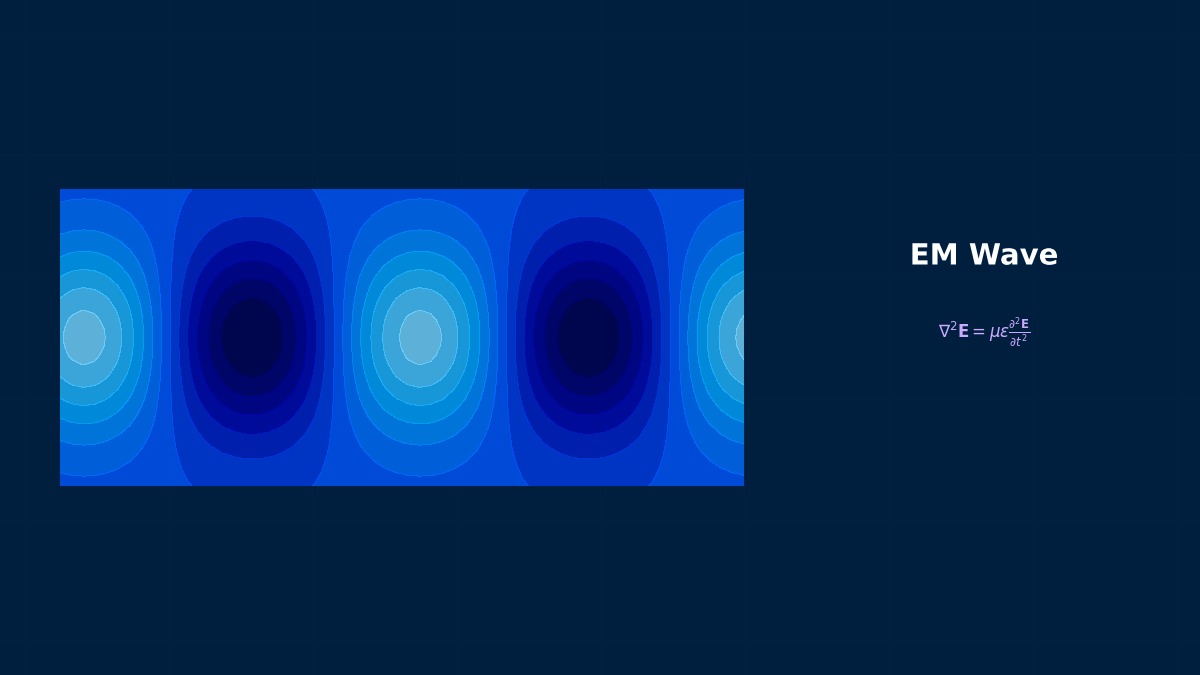
Electromagnetic Field Simulation of Cavity Resonators: Theoretical Foundations
What is a Cavity Resonator?
Professor, is a cavity resonator the same principle as a microwave oven?
Exactly. The magnetron in a microwave oven is a cavity resonator at 2.45 GHz. When electromagnetic waves are confined within a space completely surrounded by metal walls, standing waves form only at specific frequencies. This is "resonance," the fundamental principle of cavity resonators.
Are they used for things other than microwave ovens?
There are many applications. Bandpass filters for communication satellites, accelerating cavities for particle accelerators, oscillators for radar, filters for 5G base stations—all are applications of cavity resonators. In FEM analysis, the main objectives are to find the resonant frequency and Q factor. A higher Q factor results in a sharper, narrower-band resonance. High Q is required for filters, while low Q is desired for wideband antennas. The design philosophy is completely different depending on the application.
I see, so the target Q factor changes depending on the application. Could you teach me the specific method for finding the resonant frequency?
Resonant Frequency Theory
Let's start with the simplest rectangular cavity. For a rectangular cavity with side lengths $a \times b \times d$, solving Maxwell's equations with boundary conditions (tangential electric field is zero at the walls) yields a neat analytical solution for the resonant frequency.
Here $c$ is the speed of light in vacuum, $\mu_r, \varepsilon_r$ are the relative permeability and permittivity of the medium inside the cavity, and $m, n, p$ are mode indices (non-negative integers, but not all zero simultaneously).
Wow, does it become such a clean formula? What about a cylindrical cavity?
The cylindrical cavity (radius $a$, height $d$) is a bit more complex, involving zeros of Bessel functions.
$\chi_{mn}$ is the $n$-th zero of the Bessel function $J_m(x)$ (for TM modes). For TE modes, use $\chi'_{mn}$, the zeros of $J_m'(x)$. For example, for the $\text{TE}_{011}$ mode, $\chi'_{01} = 3.832$.
Do we have to memorize the zeros of Bessel functions...?
No need to memorize them. Look them up in a table or calculate them numerically. What's important in practice is that different mode indices $(m,n,p)$ result in different resonant frequencies and electromagnetic field patterns. Lower-order modes (like TE₁₀₁ or TM₀₁₀) have simple field distributions and are easy to use, but as frequency increases, higher-order modes become densely packed, making it difficult to distinguish the desired mode. This is "mode crowding," a major challenge in simulation.
Q Factor (Quality Factor) Physics
I often hear the term Q factor, but what does it represent intuitively?
Roughly speaking, it's "oscillation persistence." When you flick a wine glass, it rings with a long "kiiin" sound. That's a high Q factor. If you tap a cardboard box, it just goes "thud." That's a low Q factor. It's the same for cavity resonators; lower power loss at the walls results in a higher Q factor.
$W$ is the time-averaged stored energy inside the cavity, $P_{\text{loss}}$ is the time-averaged dissipated power at the walls.
How do you calculate the wall loss?
Wall loss is calculated from the surface resistance $R_s$ and the tangential magnetic field $\mathbf{H}_t$ at the wall.
$R_s$ is the surface resistance ($\Omega$), $\sigma$ is the conductivity of the wall conductor. For copper, $\sigma \approx 5.8 \times 10^7$ S/m.
In practice, we distinguish between "unloaded Q" and "loaded Q." Unloaded Q ($Q_0$) does not consider coupling to external circuits, while loaded Q ($Q_L$) includes coupling. With the coupling coefficient $\beta$, the following relationship holds.
$Q_{\text{ext}}$ is the external Q factor. When $\beta = 1$, it's critical coupling (all incident power is absorbed by the cavity).
Is critical coupling the same concept as impedance matching?
Exactly. It's the optimal coupling state where reflection is zero. Critical coupling is ideal for particle accelerators, but in filter design, over-coupling ($\beta > 1$) or under-coupling ($\beta < 1$) are intentionally used depending on the purpose. As a reference for typical Q values: copper cavities for communication filters have $Q_0 \sim 5{,}000$ to $20{,}000$, while superconducting cavities (niobium) can reach $Q_0 \sim 10^{10}$. The orders of magnitude are completely different.
Mode Patterns and Electromagnetic Field Distribution
What's the difference between TE and TM modes?
Relative to the cavity's axial direction (e.g., the $z$ direction), modes with no $z$ component in the electric field are TE (Transverse Electric) modes, and modes with no $z$ component in the magnetic field are TM (Transverse Magnetic) modes. The lowest-order mode in a rectangular cavity is typically TE₁₀₁, which is also the fundamental mode in microwave ovens.
| Mode | Characteristics in Rectangular Cavity | Main Applications |
|---|---|---|
| TE₁₀₁ | Lowest order. Electric field only in $y$ direction. Simple field distribution. | Microwave ovens, basic filters |
| TM₀₁₀ (Cylindrical) | Axisymmetric. Maximum axial electric field. | Particle accelerator cavities |
| TE₀₁₁ (Cylindrical) | Wall currents are only circumferential. Very high Q factor. | Frequency standards, high-precision filters |
| Higher-order modes | Complex field distribution. High mode density. | Multimode heating |
Why does the TE₀₁₁ mode have a high Q factor?
In the TE₀₁₁ mode, the wall currents do not cross junctions (boundaries between corners, end faces, and side walls). Therefore, it is less affected by contact resistance. Moreover, it has the rare characteristic that the Q factor increases as frequency rises. That's why this mode is used in frequency standards—cavity resonators are even inside cesium atomic clocks that determine the world's time.
Uneven Heating in Microwave Ovens is Pure Cavity Resonator Physics
The interior of a household microwave oven is precisely a cavity resonator. Microwaves at 2.45 GHz create standing waves in modes like TE₁₀₁ and TE₁₀₂, resulting in fixed patterns of electric field "antinodes" and "nodes." Food heats strongly at antinode positions and hardly heats at node positions—this is the physical cause of "uneven heating." The rotating turntable is a trick to distribute these antinodes across the entire food. In industrial microwave heating equipment, mode stirrers (rotating metal blades) are used to excite multiple modes and temporally stir the electromagnetic field distribution to achieve uniform heating. FEM simulation of cavity resonators is absolutely essential for this design.
Experience the theory firsthand with the interactive simulator for this field
All Simulators