Waveguide Mode Analysis
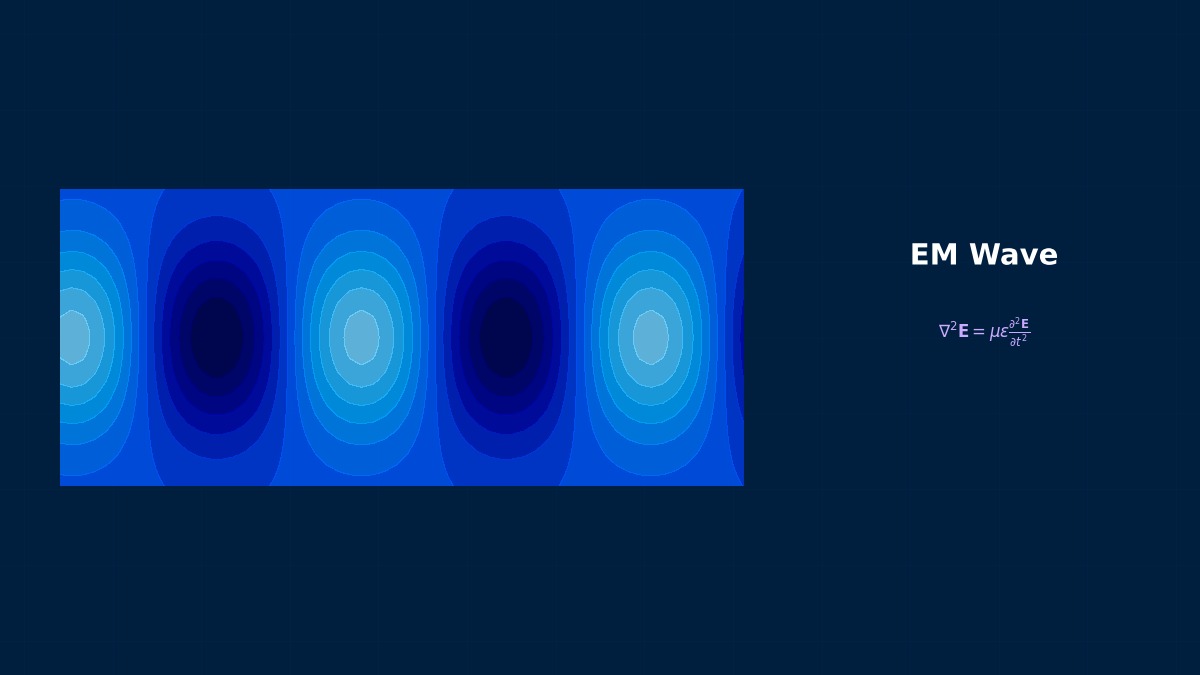
Waveguide Mode: Theoretical Foundations
TE/TM Mode Classification
Are there many types of waveguide modes? Which ones are used?
In rectangular waveguides, TE₁₀ is the fundamental mode. It can only propagate above the cutoff frequency. For the standard WR-62 waveguide used in the Ku band (12–18 GHz) for radar and satellite communications, the TE₁₀ cutoff is 9.49 GHz.
What do TE and TM stand for?
TE stands for Transverse Electric, a mode where the electric field component in the propagation direction $E_z = 0$. TM stands for Transverse Magnetic, a mode where $H_z = 0$. Structures like coaxial cables can have TEM modes ($E_z = H_z = 0$), but single-conductor waveguides cannot support TEM modes. This is because the electric field inside a waveguide must necessarily form a "standing wave" in the transverse direction.
What does "forming a standing wave" mean specifically?
Roughly speaking, imagine the electromagnetic wave zigzagging forward while repeatedly reflecting off the waveguide walls. Only modes that satisfy the condition where "an integer number of half-wavelengths fits exactly between the walls" can exist. The subscripts m and n in TEmn indicate how many half-wavelengths fit in the width and height directions, respectively. For TE₁₀, it's "one half-wavelength in the width direction, zero in the height direction."
The mode indices $m, n$ determine the standing wave pattern in the cross-sectional direction. The mode classification for a rectangular waveguide (width $a$, height $b$, $a > b$) is shown below.
| Mode | $E_z$ | $H_z$ | Lowest Order | Example Application |
|---|---|---|---|---|
| TEmn | 0 | $\neq 0$ | TE₁₀ | Standard transmission (most common) |
| TMmn | $\neq 0$ | 0 | TM₁₁ | Higher-order mode filters |
| TEM | 0 | 0 | — | Coaxial lines only (not possible in waveguides) |
Cutoff Frequency
Does cutoff frequency mean that below it, radio waves cannot pass through at all?
Yes. Below the cutoff frequency $f_c$, the electromagnetic wave becomes an evanescent wave and decays exponentially. A waveguide functions as a high-pass filter.
The cutoff frequency for TEmn and TMmn modes in a rectangular waveguide is given by:
Here, $c$ is the speed of light in the medium, $a$ is the width (long side), and $b$ is the height (short side). For the TE₁₀ mode ($m=1, n=0$), it takes the simplest form.
So the cutoff frequency is determined solely by the waveguide width. For example, what are some actual numerical values?
For example, the WR-90 waveguide used in the X band (8–12 GHz) has $a = 22.86$ mm and $b = 10.16$ mm. The TE₁₀ cutoff is $f_{c,10} = 3 \times 10^8 / (2 \times 0.02286) = 6.56$ GHz. The next mode, TE₂₀, has a cutoff of $13.12$ GHz. Therefore, the band from 6.56 to 13.12 GHz becomes the "single-mode band" where only TE₁₀ propagates. In design, it's typically used in the range of 1.25 to 1.9 times the cutoff frequency.
The order of cutoff frequencies for the first few modes of a typical waveguide (for $a = 2b$) is shown below.
| Rank | Mode | $f_c / f_{c,10}$ | Notes |
|---|---|---|---|
| 1 | TE₁₀ | 1.000 | Fundamental mode (design band) |
| 2 | TE₂₀ | 2.000 | Upper limit of single-mode band |
| 3 | TE₀₁ | 2.000 | Degenerate with TE₂₀ when $a=2b$ |
| 4 | TM₁₁ / TE₁₁ | 2.236 | Start of higher-order modes |
Propagation Constant and Phase Velocity
When propagating above cutoff, is the wave speed the same as in free space?
No. The phase velocity inside a waveguide is faster than the speed of light in free space. However, the group velocity, at which information and energy travel, is slower than the speed of light. This does not contradict relativity.
The propagation constant $\beta$ for an electromagnetic wave propagating above cutoff ($f > f_c$) is given by:
From this, the phase velocity $v_p$ and group velocity $v_g$ are derived.
Their product always satisfies the relation $v_p \cdot v_g = c^2$. As $f \to f_c$, $v_g \to 0$ (energy does not propagate) and $v_p \to \infty$.
So if you use a frequency right at cutoff, the group velocity is almost zero and the signal barely moves?
Exactly. That's why in practice, frequencies at least 1.25 times the cutoff are used. Below that, dispersion is too large, causing pulse signals to distort. For applications like radar pulse compression, if the frequency dependence of group velocity is not accurately understood, distance accuracy plummets.
Wave Impedance
The wave impedance inside a waveguide differs depending on the mode type (TE/TM).
Here, $\eta = \sqrt{\mu/\varepsilon} \approx 377 \, \Omega$ (intrinsic impedance of free space). For TE modes, the impedance increases sharply near cutoff, while for TM modes, it approaches zero.
If the wave impedance changes with frequency, impedance matching at the junction between a waveguide and a coaxial cable must be difficult.
That's precisely the key point in microwave circuit design. For waveguide-to-coaxial transitions (e.g., probe couplers), adjusting the probe insertion length and position to suppress VSWR (Voltage Standing Wave Ratio) below 1.2 over a broad band is the practical goal. In CAE, the reflection characteristic S₁₁ is swept over frequency in S-parameter analysis; if it's below -20 dB, it's generally considered acceptable.
Circular Waveguide Modes
Modes in a circular waveguide (radius $a$) are described by Bessel functions. The cutoff for TE modes is determined by the roots of $J_n'(x_{nm}') = 0$, and for TM modes by the roots of $J_n(x_{nm}) = 0$.
| Mode | $x_{nm}'$ or $x_{nm}$ | Example Application |
|---|---|---|
| TE₁₁ | $x_{11}' = 1.841$ | Fundamental mode. Most commonly used. |
| TM₀₁ | $x_{01} = 2.405$ | Axisymmetric. Suitable for rotationally symmetric structures. |
| TE₀₁ | $x_{01}' = 3.832$ | Low-loss mode. Advantageous for long-distance transmission. |
What does it mean that the TE₀₁ mode in circular waveguides is low-loss?
In the TE₀₁ mode, the wall current flows only in the circumferential direction. As frequency increases, the wall current density decreases, reducing loss. In the 1970s, AT&T researched TE₀₁ circular waveguides for long-distance communication, but they were superseded by optical fiber. However, they are now gaining attention again as transmission lines for the terahertz band.
Waveguide "Cutoff" – The Same Principle as Acoustic Resonance in a Tunnel
The cutoff phenomenon in waveguides is similar to acoustic resonance in a tunnel. If the tunnel's cross-sectional width is smaller than the half-wavelength of sound, a transverse standing wave cannot form and sound does not propagate. Waveguides are the same; electromagnetic waves with a frequency where the width $a$ is less than half the wavelength $\lambda/2$ cannot propagate. That is, $a > \lambda/2$, i.e., $f > c/(2a)$ is the propagation condition for the TE₁₀ mode. This "high-pass filter" property also has the advantage of naturally removing undesired low-frequency noise, helping to eliminate unwanted low-frequency interference signals in radar receiver front-ends.
Experience the theory firsthand with the interactive simulator for this field
All Simulators