Horn Antenna — Theory, Gain Calculation, Optimal Design, and CAE Simulation
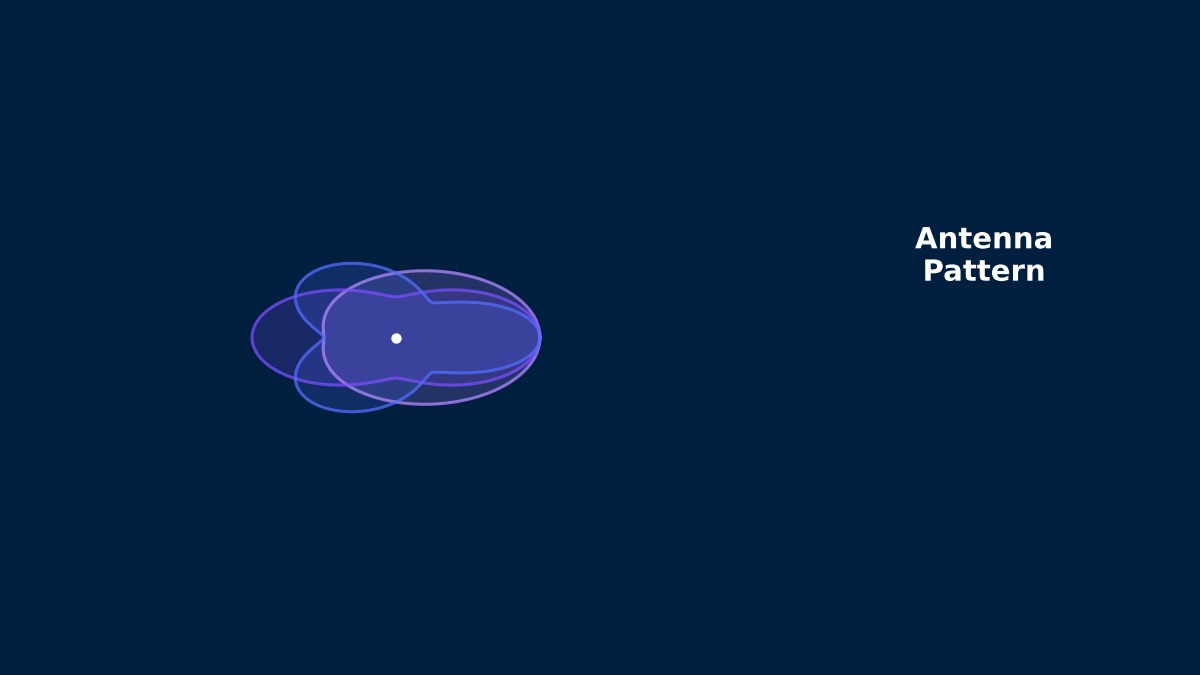
Horn Antenna: Theoretical Foundations
Overview
Are horn antennas used as reference antennas for measurement? Why do they have that horn shape?
Exactly. A horn antenna has a structure where the open end of a waveguide is flared out like a trumpet. If you simply open the waveguide, there's a large impedance mismatch causing significant reflection. By gradually widening the aperture, you can achieve impedance matching with free space, allowing efficient radiation of electromagnetic waves while suppressing reflection.
I see, it's similar to the image of projecting your voice with a megaphone. So why are they used as reference antennas?
Because their gain can be calculated theoretically with high accuracy, making them a standard for antenna calibration. The gain of a pyramidal horn is determined by the flare angles in the E-plane and H-plane, and the difference between theoretical and measured values can be kept within 0.1 dB or less. No other antenna can predict gain with such precision. That's why they are widely used as Standard Gain Antennas (SGA) in EMC test sites and satellite communication ground stations.
Within 0.1 dB, that's amazing! Is it because the simple shape makes theory and reality match easily?
That's right. With patch antennas or dipoles, measurements can easily deviate due to ground plane size or connector effects. The horn's structure naturally flares from the waveguide, so if manufacturing precision is achieved, you get performance as per theory. They are typically used in the frequency range of about 1 GHz to 300 GHz, i.e., from microwave to millimeter-wave bands.
Types of Horn Antennas
Are there different types of horn antennas?
There are mainly four types. They are used according to the application.
| Type | Structure | Characteristics | Main Applications |
|---|---|---|---|
| Sectoral H-plane Horn | Flared only in H-plane direction | Controls H-plane beamwidth | Feed element, simple measurement |
| Sectoral E-plane Horn | Flared only in E-plane direction | Controls E-plane beamwidth | Feed element, simple measurement |
| Pyramidal Horn | Flared in both E-plane and H-plane directions | Most accurate gain calculation | Standard gain antenna, EMC testing |
| Conical Horn | Flared conically from circular waveguide | Symmetric beam, easy circular polarization | Satellite communication, parabolic feed |
Is the pyramidal horn the most common one seen in practice?
Almost all Standard Gain Antennas used in EMC test sites are pyramidal horns. They can be directly connected to rectangular waveguides (like WR-90, WR-62, etc.), and the E-plane and H-plane can be designed independently, offering high flexibility. On the other hand, conical horns are often used as primary feeds for parabolic antennas because an axisymmetric beam is required.
Aperture Electric Field Distribution
Before getting into gain, what is the electric field distribution on the aperture like?
For a pyramidal horn, the electric field on the aperture inherits the TE10 mode of the waveguide. In the H-plane (the direction of width $a_1$), it has a cosine distribution, and in the E-plane (the direction of height $b_1$), it has a uniform distribution.
The electric field distribution on the aperture can be written as:
The first term $\cos$ is the amplitude distribution in the H-plane direction, and the content inside $\exp$ is the phase error of the spherical wave. $R_H$ is the flare length in the H-plane, and $R_E$ is the flare length in the E-plane.
Wait a minute. What are $R_H$ and $R_E$? Flare length?
Good question. The horn's wall surface flares out from the waveguide's open end, right? The length of that wall surface—the length of the hypotenuse from the waveguide end to the aperture edge—is the flare length. The flare length in the H-plane direction is written as $R_H$ (or $\rho_H$), and in the E-plane direction as $R_E$ (or $\rho_E$). A longer flare length improves phase uniformity at the aperture, increasing gain. However, the antenna becomes physically larger, so it's a practical trade-off.
Discretization Methods
How do you actually solve this equation on a computer?
We use spatial discretization via the Finite Element Method (FEM). We assemble the element stiffness matrix and construct the global stiffness equation.
We perform a transformation to the weak form (variational form) and use Galerkin method formulation with test functions and shape functions. The choice of element type (low-order elements vs. higher-order elements, full integration vs. reduced integration) directly affects the trade-off between solution accuracy and computational cost.
Matrix Solution Algorithms
What exactly do you mean by matrix solution algorithms?
We solve the system of equations using direct methods (LU decomposition, Cholesky decomposition) or iterative methods (CG method, GMRES method). For large-scale problems, preconditioned iterative methods are effective.
| Solver | Classification | Memory Usage | Applicable Scale |
|---|---|---|---|
| LU decomposition | Direct method | O(n²) | Small to medium scale |
| Cholesky decomposition | Direct method (symmetric positive definite) | O(n²) | Small to medium scale |
| PCG method | Iterative method | O(n) | Large scale |
| GMRES method | Iterative method | O(n·m) | Large scale, non-symmetric |
| AMG preconditioning | Preprocessing | O(n) | Very large scale |
So, if you cut corners on the finite element method part, you'll pay for it later. I'll keep that in mind!
Implementation in Commercial Tools
So, what software can be used for horn antennas?
| Tool Name | Developer/Current | Main File Format |
|---|---|---|
| Ansys HFSS | Ansys Inc. | .aedt, .hfss |
| CST Studio Suite | Dassault Systèmes | .cst |
Related Topics
Experience the theory firsthand with the interactive simulator for this field
All Simulators