Jet Impingement Heat Transfer (Impinging Jet Cooling)
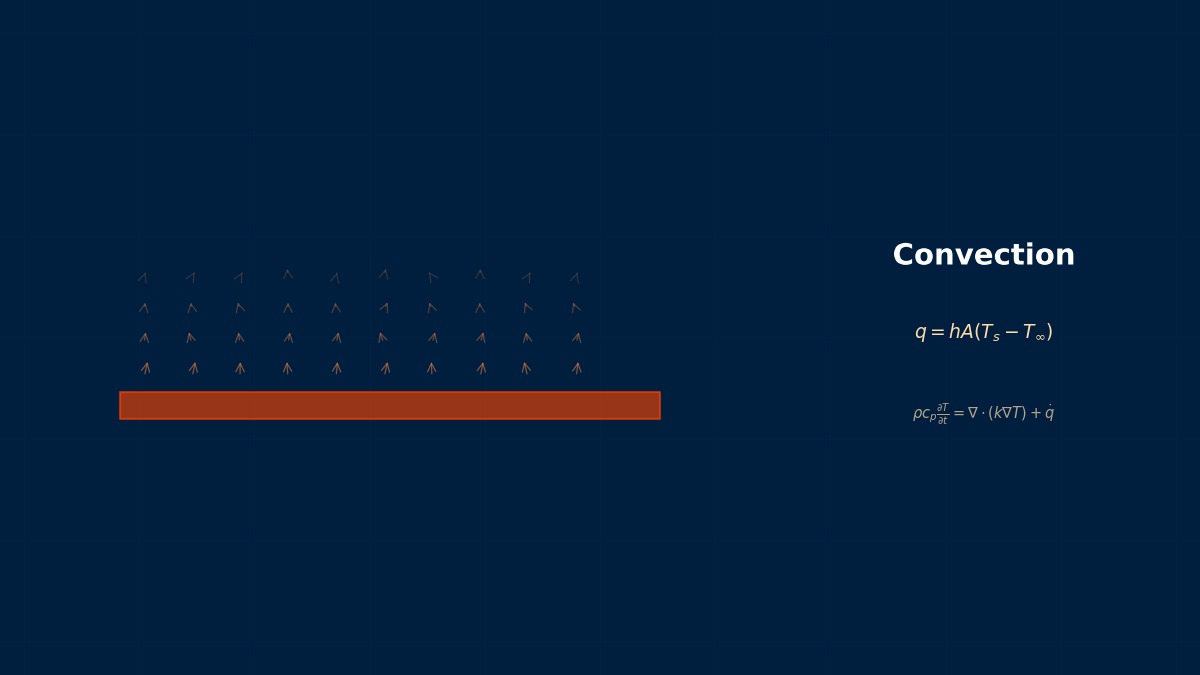
Jet Impingement Heat Transfer: Theoretical Foundations
Overview — What is Jet Impingement Heat Transfer?
In what situations is jet impingement heat transfer used? I've only heard the name...
A typical example is internal cooling of gas turbine blades. The combustion gas temperature reaches 1500°C, but the melting point of the Ni-based superalloy blade material is about 1350°C. This means it operates in an environment exceeding the material's melting point. Therefore, cooling air is injected internally to keep the wall temperature within an acceptable range.
What? It operates above the melting point!? That requires significant cooling...
Exactly. Jet impingement can achieve locally high heat transfer coefficients of $h = 1{,}000 \sim 10{,}000\ \mathrm{W/(m^2 \cdot K)}$, making it suitable for such extreme environments. It is also used in other situations where "a large amount of heat needs to be removed quickly from a localized area", such as cooling high-heat-generating chips in electronics (over 50 W/cm² in GPUs), rapid cooling in glass tempering, and continuous casting lines for metal sheets.
How is it different from ordinary forced convection?
In normal parallel flow, a boundary layer develops on the wall, creating thermal resistance. Jet impingement strikes the fluid perpendicularly into that boundary layer, so the boundary layer thickness becomes nearly zero at the stagnation point, minimizing thermal resistance. That's why the Nusselt number becomes very large.
Jet Flow Structure
When a jet hits a wall, what structure does the flow take?
It can be divided into three main regions:
- Free jet region: The path from the nozzle exit towards the wall. It consists of a potential core (central part with nearly uniform velocity) and a shear layer that entrains surrounding fluid. The length of the potential core is roughly $4 \sim 6d$ ($d$ is the nozzle diameter).
- Stagnation region: The region near the wall where the flow decelerates rapidly and changes direction. The Nu number peaks here. The radial extent is about $r/d < 1$.
- Wall jet region: A thin boundary layer flow spreading radially from the stagnation point. Nu decreases monotonically as $r/d$ increases—however, under certain conditions, Nu can show a secondary peak around $r/d \approx 2$. This is due to transition or vortex structures.
A secondary peak, that's interesting. Can CFD reproduce that properly?
RANS models have difficulty reproducing the secondary peak. In LES (Large Eddy Simulation) or DNS, it can be reproduced as a process where large-scale vortex structures generated near the stagnation point collide with the wall in the wall jet region. In practical work using RANS, it's common to design with a safety margin assuming "the secondary peak will not appear."
Martin Correlation (Single Circular Jet)
I saw something called the Martin correlation in a textbook. What kind of equation is it?
It is a correlation for the local Nusselt number of a single circular jet, compiled by Martin (1977) from experimental data. First, the definition of the jet Reynolds number:
Here $V_j$ is the jet velocity [m/s], $d$ is the nozzle diameter [m], and $\nu$ is the kinematic viscosity [m²/s].
The Nusselt number at the stagnation point ($r = 0$) is:
A more practical form often used is:
Here $F(Re_j) = 2\sqrt{Re_j} \cdot (1 + 0.005 Re_j^{0.55})^{0.5}$, representing the effect of jet velocity. The applicable range is $2{,}000 \leq Re_j \leq 400{,}000$.
The $Pr^{0.42}$ part changes depending on the type of fluid, right?
Exactly. For air, $Pr \approx 0.71$; for water, $Pr \approx 7$. Water jets yield a larger Nu at the same $Re$ because the Prandtl number is larger (the thermal boundary layer is thinner). In practice, this equation is often used for initial hand calculations and to check the validity of CFD results. If the CFD result deviates by more than 50% from the Martin correlation, you should first suspect the model.
Effect of H/d Ratio
What's the best distance between the nozzle and the wall?
The effect of the $H/d$ ratio can be summarized as follows:
- $H/d < 4$: The potential core directly impinges on the wall. The stagnation point Nu is maximum, but spatial uniformity is poor (only the center is cooled, the surroundings are not).
- $H/d = 4 \sim 8$: The potential core collapses, and the jet impinges on the wall after turbulent mixing has developed. This is the sweet spot where the area-averaged Nu is maximized. In practice, we aim for this range.
- $H/d > 10$: The jet decays significantly before reaching the wall. The stagnation point Nu decreases, and cooling efficiency deteriorates.
I see, too close or too far is no good. Gas turbines probably have space constraints too, so designing $H/d$ seems quite critical...
Yes. Inside turbine blades, there's only a few millimeters of space, so the nozzle diameter $d$ itself often becomes a sub-millimeter micro-jet. When you can't physically fit $H/d = 6$, design decisions like accepting $H/d = 2 \sim 3$ and compensating for uniformity with the jet array pitch become necessary.
Array Jet
In actual products, using just a single jet is rare, right? What happens when you arrange multiple jets?
In practice, using array jets is standard. The biggest problem here is the generation of crossflow. Spent fluid from adjacent jets creates a lateral flow, deflecting downstream jets. This significantly reduces cooling performance.
Design parameters for array jets are:
- Jet-to-jet pitch $p/d$: Generally $p/d = 4 \sim 8$. If $p/d$ is too small, interference is severe; if too large, "uncooled valleys" appear between jets.
- Exhaust direction: One-side exhaust leads to significant crossflow effects, with cooling performance degrading further downstream. Two-side exhaust improves uniformity.
- Array pattern: In-line vs. staggered. Experiments show staggered arrays yield 5-15% higher area-averaged Nu.
Can the effect of crossflow be predicted with CFD?
It can, but accuracy strongly depends on the choice of turbulence model. For array jets, the interaction between crossflow and individual jets is complex, so ideally the entire array (or the minimum repeating unit using symmetry) should be modeled. "Calculating just one jet and multiplying" is a major source of error.
GE's CF6 Engine and the History of Jet Impingement Cooling
One of the earliest full-scale adoptions of jet impingement cooling in gas turbines was the GE CF6 engine (mounted on the Boeing 747) in 1971. To raise the turbine inlet temperature to a groundbreaking 1260°C at the time, a design was introduced that impinged cooling air jets inside the blades. The insights from this contributed to Martin's (1977) correlation compilation. In today's GE9X engine, turbine inlet temperatures reach about 1700°C, making combined cooling with jet impingement + film cooling + TBC (thermal barrier coating) essential.
Computational Methods for Jet Impingement Heat Transfer
Governing Equations
Are the equations solved in CFD analysis of jet impingement the same as ordinary Navier-Stokes?
Basically the same. For incompressible steady RANS equations, they are:
Continuity Equation:
Momentum Equation (RANS):
Energy Equation:
Here $\mu_t$ is the turbulent viscosity, and $Pr_t \approx 0.85$ is the turbulent Prandtl number. What requires particular attention in jet impingement is the anomalous production of turbulent kinetic energy near the stagnation point. This is the most critical point in selecting a turbulence model.
Turbulence Model Selection — Why SST k-ω is Recommended
Which turbulence model should I use? A senior in the lab said SST k-ω is good...
Your senior's advice is correct. The SST k-ω model is the first choice. Let me explain why.
At the stagnation point, the flow decelerates rapidly, resulting in large velocity gradients. The standard k-ε model calculates the $k$ production term as
but at the stagnation point, this $S$ (magnitude of the strain rate tensor) becomes very large. As a result, $k$ is overproduced, $\mu_t$ becomes unjustifiably large, and it overpredicts Nu by up to 40%.
The SST k-ω model (Menter, 1994) mitigates this problem in two ways:
- It switches to a k-ω formulation near walls, allowing natural handling of wall boundary conditions for $k$.
- A viscosity limiter (upper limit control of $\mu_t$ based on Bradshaw's hypothesis) suppresses overproduction at the stagnation point.
What about other models? I've heard of RSM, v2-f, etc.
| Turbulence Model | Stagnation Point Nu Accuracy | Computational Cost | Recommendation |
|---|---|---|---|
| Standard k-ε | Overprediction (+20~40%) | Low | Not Recommended |
| Realizable k-ε | Slight Overprediction (+10~25%) | Low | Second Best |
| SST k-ω | Good (±10~15%) | Low~Medium | First Choice |
| v2-f | Good (±10%) | Medium | Acceptable but limited implementation |
| RSM | Theoretically Best | High | Difficult to converge |
| LES | Highest Accuracy (±5%) | Very High | For research/verification |
For practical purposes, you can think of it as SST k-ω being the only choice. The v2-f model is theoretically superior, but its implementation in Fluent is limited, while it's more user-friendly in STAR-CCM+. RSM has more degrees of freedom, making convergence difficult and not recommended for beginners.
Mesh Strategy
What should I be especially careful about when meshing for jet impingement?
The most important thing is managing the $y^+$ of the first wall cell. If using SST k-ω, aim for $y^+ \leq 1$. This means "directly resolving the boundary layer without using wall functions."
Let's look at some specific numbers. For an air jet with $Re_j = 23{,}000$, $d = 10\ \mathrm{mm}$:
- Jet velocity $V_j \approx 35\ \mathrm{m/s}$
- Wall friction velocity $u_\tau \approx 1.5\ \mathrm{m/s}$ (near stagnation point)
- First cell height corresponding to $y^+ = 1$: $\Delta y \approx 10\ \mu\mathrm{m}$
You need quite thin cells. The standard practice is to stack 15~25 prism layers (inflation layers) with a growth rate of 1.15~1.2.
10-micron cells? Doesn't that make the total cell count huge?
That's the fate of jet impingement CFD. A 2D axisymmetric model can be handled with around 100,000 cells, but a full 3D array jet model typically requires 5 million to 50 million cells. Tips for saving mesh:
- Axisymmetry: For a single jet, 2D axisymmetric is often sufficient.
- Periodic boundary conditions: Model only the minimum repeating unit of the array jet.
- Omit nozzle upstream: Apply a fully developed velocity profile as the inlet condition at the nozzle exit.
- Coarse mesh away from walls: Only the region near the wall needs to be fine; above the nozzle can be coarse.
Recommended Solver Settings
Please tell me what to watch out for in solver settings.
| Setting Item | Recommended Value | Reason |
|---|---|---|
| Pressure-Velocity Coupling | SIMPLE or Coupled | Coupled often converges faster |
| Spatial Discretization (Momentum) | 2nd Order Upwind | 1st order underestimates Nu due to numerical diffusion |
| Spatial Discretization (Pressure) | PRESTO! or Body Force Weighted | Standard may cause checkerboarding in strong pressure gradients |
| Under-Relaxation Factor (Pressure) | 0.3 | Lower for stability in complex flows |
| Under-Relaxation Factor (Momentum) | 0.7 | Standard value |
| Under-Relaxation Factor (k, ω) | 0.8 | Higher than standard (0.5) to accelerate convergence |
| Residual Criteria | 1e-6 (energy), 1e-5 (others) | Nu requires stricter energy convergence |
Why is the under-relaxation factor for k and ω set higher?
In the SST k-ω model, the equations for k and ω are strongly coupled. If the under-relaxation factor is too low (like the default 0.5), convergence becomes extremely slow. Setting it to 0.8 often improves convergence speed without causing instability. However, if divergence occurs, temporarily lowering it to 0.5 is a good troubleshooting step.
Boundary Conditions
How should I set the boundary conditions for the nozzle inlet and the target wall?
This is crucial. Typical settings are:
Nozzle Inlet:
- Velocity inlet or Mass flow inlet. For a single jet, velocity inlet is simpler.
- Velocity profile: Ideally, specify a fully developed turbulent pipe flow profile (1/7th power law is acceptable). A uniform profile is also often used, but note it overestimates Nu by about 5-10%.
- Turbulence specification: Use Intensity and Hydraulic Diameter. Intensity = 5% (for internal flow), Hydraulic Diameter = nozzle diameter $d$.
Target Wall:
- For heat transfer coefficient calculation: Constant heat flux or Constant temperature boundary condition.
- In practice, constant heat flux is often easier. Set a small value like 100 W/m², calculate the resulting wall temperature $T_w$, then get $h = q'' / (T_w - T_{ref})$. $T_{ref}$ is typically the jet inlet temperature.
- Wall roughness: Usually smooth (default).
Other Boundaries:
- Side boundaries (for single jet): Pressure outlet with gauge pressure = 0 Pa. Backflow conditions should be set to the jet inlet temperature.
- Symmetry axis (for axisymmetric model): Axis boundary condition.
What about the top boundary above the nozzle?
If you're modeling only from the nozzle exit, that boundary becomes the wall (the nozzle wall). If you're including the nozzle interior, it's the pressure outlet for the upstream plenum. In many cases, to save cells, modeling from the nozzle exit with a velocity inlet is sufficient.
Post-Processing — How to Calculate Nu
After the calculation converges, how do I calculate the Nusselt number?
The procedure is as follows:
- Calculate local heat transfer coefficient $h$: $$ h = \frac{q''}{T_w - T_{ref}} $$ $q''$ is the wall heat flux [W/m²] (constant if you set constant heat flux BC), $T_w$ is the local wall temperature [K], $T_{ref}$ is the reference temperature (usually jet inlet temperature). In Fluent, you can create a custom field function for this.
- Calculate local Nusselt number $Nu$: $$ Nu = \frac{h \cdot d}{k} $$ $d$ is the nozzle diameter [m], $k$ is the thermal conductivity of the fluid [W/(m·K)].
- Plot Nu distribution: Create a line on the target wall from the stagnation point ($r=0$) outward, and plot Nu against $r/d$.
- Compare with Martin correlation: Overlay the Martin correlation curve. If they match within ±15%, your model is likely valid.
For area-averaged Nu, calculate the area-weighted average of $h$ over the target wall region (e.g., within $r/d < 5$), then convert to Nu.
What if I used a constant temperature wall condition?
In that case, $T_w$ is constant. Read the local wall heat flux $q''$ from the CFD result, then calculate $h = q'' / (T_w - T_{ref})$. The procedure after that is the same. Note: Under constant temperature conditions, the Nu distribution is slightly different from constant heat flux conditions (typically a few percent difference). When comparing with literature correlations, check which condition the correlation is based on.
The Challenge of GPU Cooling: From Air Jets to Liquid Jets
High-end GPUs (e.g., NVIDIA H100) have heat fluxes exceeding 100 W/cm². Air jet impingement cooling was once considered, but its cooling capacity has reached its limit. Current solutions use liquid cold plates with microchannel flow or two-phase cooling. However, research into dielectric liquid jet impingement cooling is active. 3