Kirchhoff's Laws
The Theoretical Basis of Kirchhoff's Law
The Exact Statement — It Holds Spectrally and Directionally
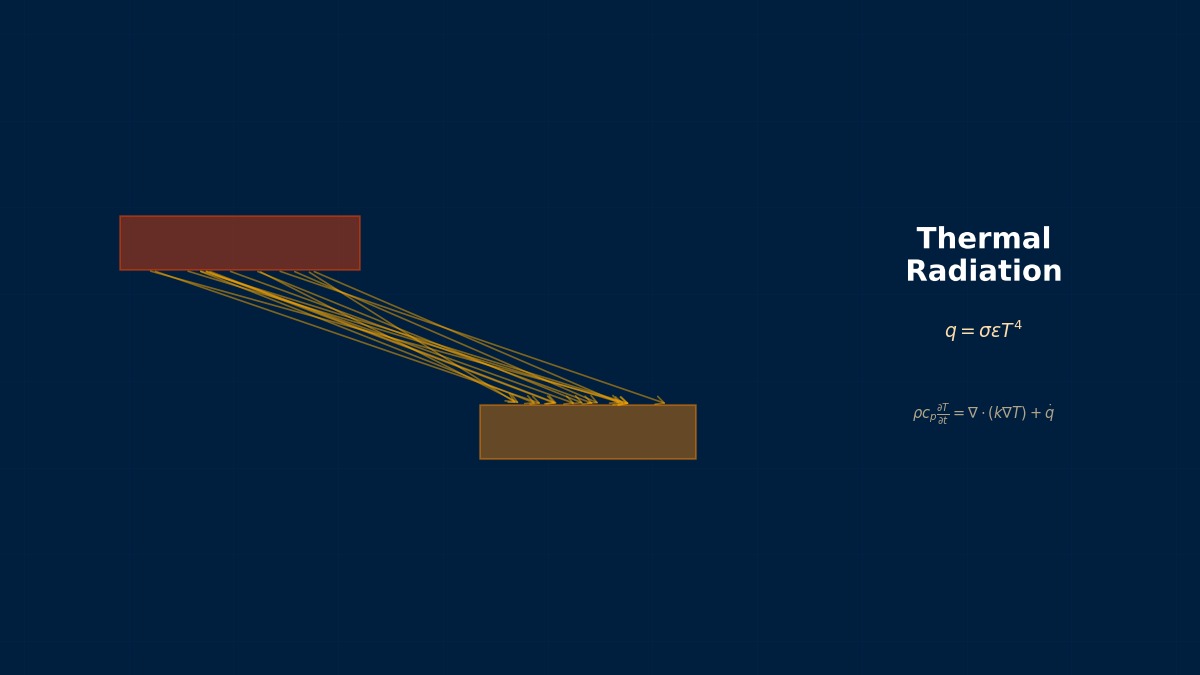
Kirchhoff's law of thermal radiation states that for a surface in thermal equilibrium the emissivity equals the absorptivity. Its rigorous statement, however, concerns spectral and directional quantities taken at matched wavelength \( \lambda \), direction \( \theta \) and temperature \( T \).
$$ \varepsilon(\lambda, \theta, T) = \alpha(\lambda, \theta, T) $$
It comes from detailed balance: if, inside an equilibrium blackbody radiation field, there were a surface that absorbed more than it emitted at some wavelength and direction, a temperature difference could be created without work, in violation of the second law of thermodynamics. This is the ground of the intuition that "a good absorber is a good emitter", and it is also why a black body (\( \alpha = 1 \)) is the strongest possible emitter (\( \varepsilon = 1 \)).
The Biggest Pitfall — In Total Quantities \( \varepsilon \ne \alpha \) in General
Hold on. If Kirchhoff's law holds, isn't it odd that materials tables list numbers like "emissivity 0.9, absorptivity 0.3"?
That is the sharpest test question about this law. The equality holds between quantities at the same wavelength. The "total emissivity" and "total absorptivity" used in practice are weighted averages of the spectral quantities, and the weights are different. Emissivity is averaged over the Planck distribution at the surface's own temperature, whereas absorptivity is averaged over the spectrum of the incoming radiation. Think of a roof painted white: it reflects sunlight well (a 5800 K spectrum, centred in the visible), so \( \alpha_{solar} \approx 0.3 \); but the roof itself sits at 300 K and emits in the infrared, so \( \varepsilon_{IR} \approx 0.9 \). At every wavelength \( \varepsilon(\lambda) = \alpha(\lambda) \) still holds, and yet 0.3 and 0.9 coexist in the total quantities. It is not a contradiction, it is a difference in the averaging weight — once that lands, you have graduated from Kirchhoff.
What the Gray Body Approximation Means, and Where It Stops
Assuming that the radiative properties do not depend on wavelength (\( \varepsilon(\lambda) = \) constant) is the gray body approximation; only under it does \( \varepsilon = \alpha \) hold for the total quantities as well, and the calculation becomes dramatically simpler. The criterion for applying it is "over the wavelength band where the spectra of the radiation sources involved overlap, is the actual spectral behaviour more or less flat?". For radiative exchange between surfaces at comparable temperatures (inside a furnace, inside an electronics enclosure) the gray approximation is broadly sound. For combinations whose spectra lie far apart — sunlight against a room-temperature body, or a hot flame against a cold wall — the gray approximation becomes the main source of systematic error.
Handling It in a Calculation
How to Build Band Averages
It is worth writing out the equations that turn spectral data into working values. The total emissivity of a surface at temperature \( T_s \), and the total absorptivity for incidence with spectrum \( G(\lambda) \), are
$$ \varepsilon = \frac{\int \varepsilon(\lambda)\, E_{b\lambda}(T_s)\, d\lambda}{\int E_{b\lambda}(T_s)\, d\lambda}, \qquad \alpha = \frac{\int \alpha(\lambda)\, G(\lambda)\, d\lambda}{\int G(\lambda)\, d\lambda} $$
where \( E_{b\lambda} \) is the Planck distribution. In practice, instead of the continuous integrals, a two-band (semi-gray) approximation — separate constants for the solar band (below 2.5 μm) and the infrared band (above 2.5 μm) — gives the best balance of accuracy against effort, and has become standard in the thermal design of outdoor equipment and spacecraft. The pair "\( \alpha_s \) (solar absorptivity) and \( \varepsilon \) (infrared emissivity)" that is a fixture of spacecraft thermal design is precisely a product of this two-band approximation.
Folding It into a Radiative Exchange Calculation
In the radiosity method for surface-to-surface radiation (S2S, view-factor based), the \( \varepsilon \) of each surface is used on the assumption of gray, diffuse behaviour. Three things need checking in connection with Kirchhoff's law: (1) whether each surface's \( \varepsilon \) was evaluated over the temperature range of that surface, (2) whether, when an external spectral source such as the sun is present, the absorbing side is treated separately through \( \alpha_s \) (the "solar load" feature of the tools has that separation built in), and (3) whether a diffuse-assumption S2S model is being applied to strongly specular surfaces (polished metal). In combustion systems where gas radiation (band absorption by CO₂ and H₂O) is involved, the medium as well as the surfaces is strongly non-gray, so the choice of band model (WSGG, SLW and the like) becomes decisive.
The Reality of Emissivity Data — Surface Condition Is Everything
The \( \varepsilon \) in a handbook is "the value for that surface condition". Aluminium is 0.05 when polished and 0.8 when anodised — more than an order of magnitude apart for the same material, which is the nature of radiation: oxidation, roughness, dirt and paint matter more than the base metal. The \( \varepsilon \) entered into an analysis should carry (1) a source that specifies the surface treatment, (2) an assumption about ageing (progressive oxidation), and (3) where possible a measurement (emissometer, FTIR). The uncertainty budget of a radiation calculation is usually dominated by the input uncertainty in ε rather than by the model.
Where It Is Used, and How Not to Misuse It
Typical Patterns of Misuse
| Misuse | What happens | Correct treatment |
|---|---|---|
| Applying \( \alpha = \varepsilon_{IR} \) to an object in sunlight | Absorbed heat over- or under-estimated several-fold on white and selective surfaces | Two-band approximation (\( \alpha_s \) and \( \varepsilon_{IR} \) entered separately) |
| Using an oxidised-surface value for the \( \varepsilon \) of polished metal | Radiative loss overestimated by an order of magnitude | A value tied to an identified surface treatment; handle ageing as a sensitivity case |
| The ε set on a radiation thermometer does not match the target | Misreadings of tens of °C on low-ε surfaces (bright metal), plus reflections from the surroundings | Set the target's ε; calibrate with blackbody tape alongside |
| A hot furnace wall against a cold charge computed with a single gray ε | Systematic error from the spectral mismatch | Band-wise ε, or a non-gray model |
Turning "ε ≠ α" into a Tool — Selective Surfaces
That \( \varepsilon \ne \alpha \) can be arranged for the total quantities is not a constraint but a design freedom. The selective absorber coating of a solar thermal collector (\( \alpha_s \approx 0.95, \varepsilon_{IR} \approx 0.1 \): the heat taken in is not lost again by re-emission), the white paints and OSRs of spacecraft (small \( \alpha_s \), large \( \varepsilon_{IR} \): reject the sunlight, maximise the heat rejection), and the recent daytime radiative cooling materials (strong emission only in the 8-13 μm atmospheric window) are all technologies that design the band averages while spectral Kirchhoff is respected throughout. On the analysis side, the moment such a surface enters the problem the decision to abandon the gray approximation is made for you.
A Review Checklist for Radiation Analyses
- Did you check for external spectral sources (sun, hot flame, lamps) and separate the bands if any are present?
- Does the source of each surface's ε state the surface treatment and the temperature?
- Did you look at how far the result moves within the uncertainty in ε (±0.05 to 0.1 is normal)?
- Did you review the use of S2S (which assumes diffuse behaviour) on strongly specular surfaces?
- Did you check the ε setting and the reflections in the radiation-thermometer validation data itself?
What the Tools Support
Radiation Models and Non-Gray Support by Tool
| Tool | Radiation model | Non-gray (band) support |
|---|---|---|
| Ansys Fluent | S2S, DO, Monte Carlo and others, plus the Solar Load model | Non-gray band splitting in DO. The solar band is separated out by Solar Load |
| STAR-CCM+ | S2S, DOM, plus solar radiation | Multiband (surface properties per wavelength band) |
| Ansys Mechanical / general-purpose FEM | Surface-to-surface radiation (gray diffuse) | Band separation is limited. In practice the solar input is separated by hand and applied as a heat flux |
| TAITherm, ESATAN-TMS and similar (spacecraft and vehicle thermal) | Radiation specialists. The two bands α_s / ε_IR are the standard design variables | Orbital insolation, albedo and planetary infrared are all integrated |
| COMSOL | Surface-to-surface plus semi-transparent media | Multispectral bands over several wavelength ranges |
What to Check When Setting Up
Whatever the tool, three points deserve checking: (1) whether the "emissivity" field is used for the infrared side (self-emission) only or for absorption as well, (2) whether the solar absorptivity can be entered separately (in tools where it cannot, compute the solar input by hand as \( \alpha_s \times \) insolation and convert it into a heat flux boundary condition), and (3) how the transmitting band of semi-transparent materials (glass, plastics) is handled. Reading the radiation chapter of the manual once, carefully, to see how it defines "gray", "spectral" and "band" will head off most setup accidents.
Frontiers
Daytime Radiative Cooling and Spectral Design with Metasurfaces
A surface whose emissivity is raised only in the atmospheric transmission window (8-13 μm) while absorption in the solar band is suppressed achieves passive cooling several °C below ambient even in daylight. Designing the emission spectrum at will with photonic structures and metasurfaces is at the frontier of materials research, and applications to building envelopes, vehicles and textiles are reaching practice fast. On the thermal analysis side, building band models able to handle such strongly non-gray surfaces is the task that has yet to catch up.
Nonreciprocal Materials and the "Breaking" of Kirchhoff's Law
In systems that break reciprocity — magneto-optical materials, time-modulated structures — theory and experiment have shown that \( \varepsilon(\lambda,\theta) \ne \alpha(\lambda,\theta) \) can be achieved even at the same wavelength and the same direction (there is no conflict with thermodynamics, because reciprocity, a premise of detailed balance, no longer holds). Being able to control emission and absorption independently would rewrite the efficiency limits of thermophotovoltaic power generation, so the area is active on both the fundamental and the applied side. Ordinary industrial materials are reciprocal, so none of this changes how Kirchhoff's law is used in practice — that boundary is worth holding on to as well.
Advances in Spectral Measurement and In-Situ Identification
FTIR-based spectral emissivity measurement, simultaneous inverse estimation of ε and temperature combined with thermography, and machine-learning estimation of surface condition from a spectrum are all moving the field from "assuming ε" towards "measuring and identifying ε". In high-temperature processes where radiation dominates (forging, sintering, semiconductor RTP), temperature control that includes ε identification bears directly on product quality, so industrial demand is pulling the research along.
Troubleshooting
Symptoms, Causes, and Fixes
| Symptom | Likely cause | Fix |
|---|---|---|
| The predicted temperature of outdoor equipment is far from the measurement | α_s and ε_IR confused (solar absorption computed with a single ε) | Move to two-band input. Use the tool's Solar Load feature |
| The radiation thermometer and the thermocouple disagree | Wrong ε setting; reflections on a low-ε surface | Set the target's ε, calibrate on a patch of blackbody tape, view obliquely to avoid reflections |
| The radiative loss of a metal part is larger than measured | An oxidised-surface ε value applied to a bright surface | Move to a value tied to the identified surface condition. Present the range from a sensitivity study |
| The heat-up of the charge in a furnace analysis does not match | Non-gray behaviour of a hot source against a cold surface; gas radiation bands ignored | Move to band-wise ε and a non-gray gas model such as WSGG |
| Surfaces with a low emissivity setting come out abnormally hot or cold in the tool | Radiative equilibrium becomes numerically sensitive as ε→0; multiple reflections under-resolved | Put a realistic floor on ε (≥0.02 to 0.05) and tighten the convergence settings of the reflection calculation |
| "But surely ε = α" sets off an argument in a design review | Confusion between the spectral law and the total average | Explain with the white-paint example in this article: it always holds spectrally, and the total depends on the weights |
The Definitive Way to Remember It
So in the end, how should I hold Kirchhoff's law in my head so that I do not get it wrong in practice?
"At the same wavelength, ε = α always. For total quantities, look at the other party's spectrum before you write an equals sign" — those two sentences are enough. As a working habit: before starting a radiation calculation, count how many kinds of radiation spectrum appear in the problem. If it is only the infrared at your own temperature, the gray approximation with a single ε will do; the moment the sun or a hot source enters, split the bands. Counting the kinds of spectrum — that habit is the whole of using Kirchhoff correctly in practice.
Related: radiative exchange between gray bodies, index of radiation heat transfer articles, induction hardening (radiation-based measurement in high-temperature processes).
Feel the theory hands-on with the interactive simulators in this field
Simulator LibraryRelated Fields
detail
error