Design a centrifugal clutch that engages automatically as speed rises. Adjust the shoe mass, count, radius, spring force and rpm to see the centrifugal force, drum-pressing force, transmitted torque and engagement rpm update in real time, and find a clutch that engages smoothly at the speed you want.
Parameters
Mass of one shoe (weight) m
kg
Mass of one outward-flung weight
Number of shoes n
Number of shoes mounted on the hub
Shoe centre-of-gravity radius r
mm
Distance from the centre to the shoe centroid
Drum inner radius R_drum
mm
Inner radius of the drum the shoes press on
Retaining spring force (per shoe) F_spring
N
Force of the spring pulling the shoe inward
Rotational speed N
rpm
Rotational speed of the input hub
Friction coefficient μ
Friction coefficient between shoe lining and drum
Results
—
Centrifugal force (per shoe) F_c (N)
—
Net drum-pressing force (per shoe) (N)
—
Transmitted torque T (N·m)
—
Engagement rpm (rpm)
—
Engagement state
—
Friction coefficient μ
—
Centrifugal clutch face — shoe motion animation
Shoes sit on a rotating hub inside a drum. Below the engagement rpm the shoes are pulled inward; above it they fly out and press against the drum.
Transmitted torque vs speed
Centrifugal force vs speed (with spring-force line)
Centrifugal force F_c and transmitted torque T. m: mass of one shoe, ω: angular speed, r: shoe centre-of-gravity radius, n: number of shoes, μ: friction coefficient, F_spring: retaining spring force, R_drum: drum inner radius.
Engagement angular speed ω_eng and engagement rpm n_eng. The clutch engages only once the centrifugal force exceeds the spring force, and the transmitted torque then rises with the square of speed.
What is the Centrifugal Clutch Simulator?
🙋
A "centrifugal clutch" is the kind that engages on its own with no pedal or lever, right? How does it work?
🎓
Exactly — the most familiar examples are the clutch in a chainsaw or a moped. The mechanism is simple: a rotating hub carries "weights" (shoes), each pulled inward by a spring. While the engine turns slowly the springs win, and the shoes stay clear of the surrounding drum — the clutch is disengaged. As the speed rises, centrifugal force flings the shoes outward, they grip the drum, and torque is transmitted. It engages and disengages purely as a function of speed.
🙋
Centrifugal force gets stronger the faster you spin, right? When I raise the "rotational speed" on the left, the centrifugal force shoots up.
🎓
Good catch. The centrifugal force is F_c = m·ω²·r. The key is that ω enters as a square: double the speed and the centrifugal force becomes four times larger. That is why the transmitted torque climbs steeply once the clutch engages. Look at the "transmitted torque vs speed" chart below — the torque is zero up to a certain rpm, then suddenly lifts off into a steep curve.
🙋
What is that zero-torque region? It's spinning, so why is no torque transmitted?
🎓
That is the heart of this clutch. While the centrifugal force is smaller than the spring force, the shoes lose to the springs and never reach the drum. So no matter how fast it spins, the force on the drum is zero — no torque is transmitted. The speed at which the centrifugal force just equals the spring force is the "engagement speed", ω_eng = √(F_spring/(m·r)). Only above that does the part of the centrifugal force that exceeds the spring press on the drum. That is why the transmitted torque is T = n·μ·(F_c − F_spring)·R_drum — with the spring force subtracted.
🙋
I see. So when I want the engagement speed at a target value, what do I adjust?
🎓
The easiest knob is the "spring force". A stronger spring means the centrifugal force takes longer to overcome it, so the engagement speed rises. Conversely, a larger shoe mass or radius makes the centrifugal force build up sooner, lowering the engagement speed. In practice you set the engagement speed a little above the engine's idle speed — say, if idle is 1800 rpm, engagement around 2200 rpm. Then the clutch is firmly disengaged at idle and engages smoothly the moment you open the throttle.
🙋
So that's why a chainsaw's chain stays still while it idles — thanks to this clutch.
🎓
Precisely. At idle the spring wins and the chain stops — so you can carry the saw safely. Open the throttle and engine speed rises, the centrifugal force overpowers the spring, and the chain starts turning. The launch clutch of a go-kart, scooter or lawnmower works on exactly the same principle. The engagement element in many automatic and CVT transmissions uses this idea too. Engaging and disengaging automatically from one single quantity — the rotational speed, with no lever or pedal — is the beauty of the centrifugal clutch.
Frequently Asked Questions
A centrifugal clutch carries weighted shoes on a rotating input hub, each held inward by a spring. At low speed the spring wins and the shoes stay clear of the drum, so the clutch is disengaged. As speed rises, the centrifugal force on each shoe, F_c = m·ω²·r, grows with the square of the rotational speed and eventually overcomes the spring. The shoes then fly outward, grip the inside of the drum and start transmitting torque. With no lever or pedal, the clutch engages and disengages purely as a function of speed.
The net force one shoe presses on the drum is the centrifugal force minus the spring force: netF = max(0, F_c − F_spring). The friction force is μ·netF and the torque from one shoe is μ·netF·R_drum, so the total torque from n shoes is T = n·μ·(F_c − F_spring)·R_drum. Here F_c is the centrifugal force, F_spring the retaining spring force, R_drum the drum inner radius and μ the friction coefficient. Because the centrifugal force grows with the square of speed, the transmitted torque also rises with the square of speed once the clutch is engaged.
The engagement speed is the rpm at which the centrifugal force on a shoe just equals the retaining spring force. Solving F_c = F_spring, i.e. m·ω²·r = F_spring, gives ω_eng = √(F_spring/(m·r)), and the engagement rpm is n_eng = ω_eng·60/(2π). A stronger spring, or a smaller shoe mass or radius, raises the engagement speed. The basic design rule is to set the engagement speed a little above the engine's idle speed.
The chainsaw is the classic example: the chain stays still while the engine idles, and starts turning automatically when the throttle is opened. Centrifugal clutches are also widely used as the launch clutch of go-karts, scooters, mopeds and lawnmowers — anywhere a small engine drives a load. Many automatic and CVT transmissions also use the centrifugal-clutch principle for their engagement element. It is a remarkably simple, reliable mechanism for any application that wants automatic, speed-dependent engagement without a manual clutch.
Real-World Applications
Engine tools such as chainsaws and brush cutters: This is where the centrifugal clutch shows its purpose most clearly. While the engine idles, the spring wins, the shoes stay clear of the drum, and the chain or cutting blade stays still. Open the throttle and the rising speed lets the centrifugal force overpower the spring, and the blade starts turning on its own. Keeping the blade stationary at idle is essential for safety, so the engagement speed is set well above idle but well below working speed.
Launch clutches for go-karts, scooters and mopeds: On small two- and four-wheelers, a centrifugal clutch automates the launch. Open the throttle and the drive engages automatically; come to a stop and the speed falls so the clutch naturally disengages — no half-clutch operation like a manual clutch. CVT scooters combine a centrifugal clutch with a pulley variator, so you can drive from a standstill to cruise with no clutch operation at all.
Power engagement for lawnmowers, small farm machinery and generators: A centrifugal clutch is handy wherever you want the load uncoupled while the engine starts — driving a mower blade or a pump, for example. The clutch is disengaged at startup so the engine cranks easily, and the power is transmitted to the load automatically once the speed rises. With no lever or electromagnetic clutch needed, the design is simple, cheap and easy to maintain.
Engagement element of automatic and CVT transmissions: Many automatic transmissions and CVTs apply the centrifugal-clutch principle to the element that couples the engine and transmission at launch. Disengaged at low speed and engaging smoothly as speed rises, it gives a low-shock launch without relying on a torque converter. Being controllable from a single quantity — the rotational speed — makes it well suited to low-cost automation.
Common Misconceptions and Pitfalls
The biggest pitfall is designing while ignoring the heat generated during engagement (slip heat). At the moment of engagement there is a large speed difference between the input and output sides, and the shoes transmit torque while sliding on the drum. All the friction heat produced during this slip phase is absorbed by the shoes and drum. If you launch frequently, or the load is heavy so engagement takes a long time, the heat cannot be dissipated fast enough, the shoe lining overheats, the friction coefficient drops (fade), and in the worst case it burns. The transmitted torque in this tool is the value "after the slip has settled". Always check the slip energy per launch and the dissipation capacity separately.
Next, assuming it is enough to get just the engagement speed right. Placing the engagement speed a little above idle is a correct first step, but it is not enough. If the span between the engagement speed and the speed at which slip fully stops (lock-up speed) is too wide, the clutch spends a long time half-engaged, increasing heat and wear. Too narrow, and the engagement is abrupt and produces launch shock. You must design the "sharpness of the engagement" at the same time, by combining spring force, shoe mass and friction coefficient.
Finally, assuming the friction coefficient μ is a fixed number. μ depends not only on the shoe lining and drum combination but also varies strongly with temperature, sliding speed, contact pressure and the state of the drum surface. In particular, fade — μ dropping at high temperature — means a clutch that is sufficient on paper may keep slipping in reality because the transmitted torque is too low. Worse, oil or grease on the drum's inner face slashes μ. Do not use the catalogue μ directly; evaluate the transmitted torque with the effective or lower-bound value at the expected operating temperature.
How to Use
Set shoe mass (g) and number of shoes (typically 3–6) using the sliders; heavier shoes engage at lower rpm.
Adjust centre-of-gravity radius (mm) and drum radius (mm) to define clutch geometry; larger CG radius reduces engagement speed.
Configure spring preload force (N) to establish the disengagement threshold; run the simulator and read centrifugal force, net drum-pressing force, transmitted torque, and engagement rpm in the output panel.
Worked Example
Design a clutch for a 6.5 kW small-engine go-kart: three steel shoes at 85 g each, CG radius 32 mm, drum radius 65 mm, spring preload 15 N. At 4200 rpm, centrifugal force per shoe = 1.24 kN; net pressing force = 1.09 kN; friction coefficient μ = 0.35 yields transmitted torque T = 71.4 N·m, sufficient for 6.5 kW at 900 rpm peak output. Engagement occurs at ~1850 rpm.
Practical Notes
Engagement rpm scales inversely with shoe mass and CG radius; add 10 g to shoes to drop engagement by ~300 rpm on typical designs.
Higher spring preload delays engagement but demands stronger centrifugal force; 20–40 N suits lawn-mower and ATV clutches (5–15 kW class).
Drum radius affects torque transmission directly; increasing from 60 mm to 75 mm boosts torque capacity by 25% at constant friction.
Verify friction coefficient μ (0.25–0.45 for sintered bronze on cast iron) against material pairing and operating temperature.
🎬 Watch it in motion
Slip, Then Grip | How a Clutch Works
Slip heat, from the integral | How a Clutch works #Shorts
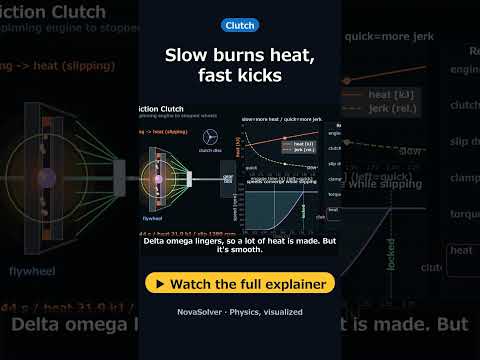
Slow burns heat, fast kicks | How a Clutch works #Shorts
Connecting power with pure friction | How a Clutch works #Shorts
How does a clutch connect engine and wheels? | How a Clutch works #Shorts