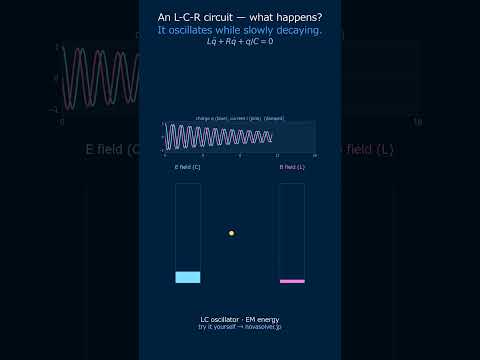
Explore the damped free vibration of a single-degree-of-freedom mass-spring-damper system when it is displaced and released. Adjust the mass, stiffness and damping coefficient to see the undamped natural frequency, damping ratio ζ, damped natural frequency and logarithmic decrement δ update in real time, and watch a waveform whose amplitude decays exponentially.
Parameters
Mass m
kg
Equivalent mass of the vibrating body
Stiffness k
N/m
Restoring stiffness — higher means faster vibration
Damping coefficient c
N·s/m
How strongly a dashpot etc. drains vibrational energy
Evaluation cycles n
cycles
Number of cycles for the amplitude-ratio evaluation
Results
—
Undamped natural freq. (Hz)
—
Damping ratio ζ
—
Damped natural freq. (Hz)
—
Logarithmic decrement δ
—
Amplitude-halving cycles
—
Amplitude ratio after n cycles (%)
—
Mass-spring-damper system and damped vibration — animation
Displace the mass on the spring and release it: it oscillates at the damped natural frequency while the amplitude decays exponentially. The decay envelope (dashed), successive peaks and the logarithmic decrement δ are shown.
Damped free-vibration waveform — displacement vs time
Undamped natural angular frequency ωₙ and damping ratio ζ. m: mass, k: stiffness, c: damping coefficient. The critical damping coefficient is c_c = 2√(mk) and ζ = c/c_c.
Damped natural angular frequency ω_d (valid for the underdamped case ζ < 1) and logarithmic decrement δ. Damping lowers the oscillation frequency slightly, and δ measures how fast the amplitude decays per cycle.
Displacement x(t) of a damped free vibration and the amplitude ratio after n cycles. The envelope e^(−ζωₙt) shrinks exponentially while enclosing the oscillation.
What is the Damped Natural Frequency?
🙋
If you pull a mass on a spring and let go, it wobbles for a while and gradually stops. Is that "gradually stops" part the damping?
🎓
Exactly. In an ideal world with no friction and no air resistance, a mass you displace once would oscillate forever at its natural frequency. But the real world always has damping — air resistance, friction at contact surfaces, internal energy losses in the material, or a dashpot you deliberately added. They drain the vibrational energy bit by bit, so a real free vibration is a decaying oscillation: it rings, but each swing is a little smaller than the last, until it dies away.
🙋
I see. But this "damped natural frequency" — is it something different from the natural frequency?
🎓
Good question. Damping actually does two different things at once, and it is important not to confuse them. First, damping slows the oscillation slightly. The system no longer rings at the ideal undamped natural frequency fₙ but at a slightly lower "damped natural frequency" f_d. In a formula, f_d = fₙ·√(1−ζ²), where ζ is the damping ratio. But for the light damping of most real structures this shift is tiny — at a damping ratio of 5% the frequency drops by only about a tenth of a percent — which is why engineers can usually just use the easy-to-calculate undamped fₙ.
🙋
If the difference is that small, can I just ignore the damped natural frequency?
🎓
For light damping, yes. But as the damping grows the shift becomes large and can no longer be ignored. And at one special value — critical damping, a damping ratio of exactly 1 — the damped natural frequency falls all the way to zero and the system no longer oscillates at all; it just creeps back to its rest position. Push the damping coefficient c on the left up to its maximum and you will see the damping ratio cross 1, the damped natural frequency hit 0 Hz, and the waveform switch to "no oscillation".
🙋
What is the second thing damping does? You said there were two.
🎓
The second one is more visible: damping makes the amplitude decay. The rate of that decay is captured by the logarithmic decrement δ — the natural logarithm of the ratio of two successive peak amplitudes, δ = ln(xₙ/xₙ₊₁). You can read it as "each swing the amplitude is multiplied by e^(−δ)". With the default values (m=10 kg, k=10000 N/m, c=40 N·s/m), δ ≈ 0.398, and after 10 cycles the amplitude has dropped to about 1.9% of its initial value. The exponentially shrinking envelope on the chart above is set exactly by this δ.
🙋
Is the logarithmic decrement just a number you calculate, or is it actually useful somewhere?
🎓
It is extremely useful — δ shines in reverse. Tap a structure once and record the waveform of its free vibration dying away. Measure how fast the peak amplitudes shrink to get δ, and from it work backwards to the damping ratio ζ. That is the "logarithmic-decrement method", one of the simplest and most practical damping-measurement techniques in all of vibration testing. Tap, record, count a few peaks — and you have pulled out damping, an invisible material property.
Frequently Asked Questions
The undamped natural frequency fₙ is the frequency at which an ideal, frictionless system would freely vibrate, given by fₙ = (1/2π)·√(k/m). The damped natural frequency f_d is the frequency at which a real system with damping freely vibrates, and it is slightly lower: f_d = fₙ·√(1−ζ²), where ζ is the damping ratio. The more damping there is, the slower the oscillation, and at ζ = 1 (critical damping) f_d falls to zero and the system no longer oscillates. For light damping (ζ of a few percent) the difference between f_d and fₙ is tiny, so the undamped formula is usually good enough in practice.
The logarithmic decrement δ is the natural logarithm of the ratio of two successive peak amplitudes of a damped free vibration: δ = ln(xₙ/xₙ₊₁) = 2πζ/√(1−ζ²). It is a dimensionless measure of how fast the amplitude decays per cycle — the larger δ, the faster the vibration dies away. Its great practical value is in reverse: tap a structure once, record the decaying free vibration, measure how fast the peak amplitudes shrink to get δ, and from it recover the damping ratio ζ. This is the logarithmic-decrement method, one of the most basic experimental techniques for measuring damping.
When the damping ratio ζ reaches 1 the system is critically damped: it does not oscillate and returns to its rest position in the shortest possible time, with the damped natural frequency f_d equal to zero. When ζ exceeds 1 the system is over-damped and returns even more slowly, still without oscillating. The critical damping coefficient is c_c = 2·√(m·k), so the damping ratio can be written ζ = c/c_c. Door closers, car suspensions and instrument pointers are usually designed slightly below critical damping (ζ ≈ 0.6–0.8) so they settle quickly without overshoot.
Most real structures have a very small damping ratio, ζ = 0.01–0.05, and then the correction factor √(1−ζ²) in f_d = fₙ·√(1−ζ²) is almost exactly 1. Even at ζ = 0.05 the frequency drops by only about 0.1%, smaller than typical measurement error. So for natural-frequency calculations engineers use the easy undamped formula fₙ = (1/2π)·√(k/m), which is simple and does not even require knowing the damping. For heavily damped isolation systems, vibration-control designs, or cases where ζ approaches 1, the damped natural frequency drop is no longer negligible and f_d must be treated correctly.
Real-World Applications
Experimental modal analysis and impact testing: To study the dynamics of bridges, buildings or machine parts, engineers strike the structure once with an impact hammer, record the free vibration, and obtain the logarithmic decrement δ from how fast the peak amplitudes decay — then compute the damping ratio ζ. This is the logarithmic-decrement method, a standard time-domain damping measurement that complements the frequency-domain half-power bandwidth method. For a structure with a sharp, isolated mode, a single tap and a handful of peaks are enough, which makes it the most convenient technique in the field.
Vibration-control and isolation design: When constrained-layer damping treatments, dynamic absorbers or anti-vibration rubber are added, engineers check whether damping increased as intended by how quickly the free vibration settles. Record the impact response before and after: if the amplitude decays faster and the logarithmic decrement δ has grown, the treatment is working. If the vibration still rings on and on, the damper position or damping level needs to be revisited.
Mechanisms designed for near-critical damping: Door closers, automotive shock absorbers, analogue instrument pointers and hard-disk head mechanisms must settle quickly without overshoot, so they are designed slightly below critical damping (damping ratio ζ ≈ 0.6–0.8). Too little damping and the system overshoots and rings; too much and the return is slow. Move the damping coefficient in this tool and you will see the damped natural frequency fall toward zero as the damping ratio approaches 1.
Machine condition monitoring and fault diagnosis: In rotating machinery and structures, loose bolts, cracks and changes in support stiffness alter the damping characteristics. Periodically taking impact responses and tracking the damping ratio from the logarithmic decrement lets a sudden change in damping be caught as an early sign of structural degradation. Changes in damping often appear more sensitively than shifts in natural frequency, which makes them a valued parameter for predictive maintenance.
Common Misconceptions and Pitfalls
The most common error is confusing the damped and undamped natural frequencies. The two are linked by f_d = fₙ·√(1−ζ²), but for light damping (ζ of a few percent) the correction factor √(1−ζ²) is so close to 1 that the difference is tiny, and in practice engineers often do not distinguish them and simply use the undamped fₙ. For heavily damped isolation systems or cases where ζ approaches 1, however, the difference cannot be ignored and the damped natural frequency must be treated properly. A subtler trap: what you observe in a free vibration is the damped natural frequency f_d. The frequency obtained from the spacing of peaks in an impact test is f_d, not fₙ itself, so when damping is large you must correct it back to fₙ using ζ.
Next, measuring the logarithmic decrement from just a single adjacent pair of peaks. δ is defined as δ = ln(xₙ/xₙ₊₁) over one cycle of amplitude ratio, but in real measurements taking it from one pair of peaks is sensitive to noise and gives large errors. More accurately, use two peaks n cycles apart and δ = (1/n)·ln(x₀/xₙ). The smaller the damping, the smaller the amplitude drop per cycle and the more easily it is buried in noise, so the standard practice is to use peaks far enough apart, or to fit a straight line through several peaks on a logarithmic axis. A damping ratio derived from a single pair of peaks is often far from the true value.
Finally, assuming damping always lowers "the" natural frequency. It is true that the damped natural frequency f_d is lower than the undamped natural frequency fₙ, but that drop comes from the √(1−ζ²) term and for light damping is effectively negligible. Meanwhile, the resonant frequency of a forced vibration is shifted by yet another, different amount due to damping. The damped natural frequency of free vibration, the resonant frequency of forced vibration, and the undamped natural frequency are strictly three distinct quantities, and confusing them when damping is large leads to design mistakes. This tool deals with the damped natural frequency of free vibration — keep it distinct from forced-excitation resonance.
How to Use
Enter mass in kg (typical range 0.5–50 kg for mechanical systems)
Set spring stiffness in N/m (common values: 1000–100000 N/m for industrial dampers)
Specify damping coefficient c in N·s/m (0 = undamped; increase for faster energy dissipation)
Define number of cycles to observe (typically 5–20 cycles to see amplitude decay)
Click Simulate to compute undamped frequency, damping ratio ζ, damped frequency, logarithmic decrement, and amplitude reduction over your cycle count
Worked Example
Consider a shock absorber assembly: mass = 2.5 kg, stiffness k = 8000 N/m, damping c = 120 N·s/m. Undamped natural frequency = √(8000/2.5)/(2π) = 9.0 Hz. Damping ratio ζ = 120/(2√(2.5×8000)) = 0.267 (underdamped). Damped natural frequency = 9.0×√(1−0.267²) = 8.7 Hz. Logarithmic decrement δ = 2πζ/√(1−ζ²) = 1.78. After 6 cycles, amplitude reduces to 3.1% of initial displacement, representing rapid energy absorption typical of automotive suspensions.
Practical Notes
Damping ratio ζ < 1 (underdamped): oscillates with decaying amplitude—used in seismic isolators and vibration absorbers
ζ = 1 (critically damped): fastest return to equilibrium without overshoot—optimal for precision instruments and door closers
ζ > 1 (overdamped): slow creep to rest—acceptable in heavy machinery where response time is not critical
Logarithmic decrement directly governs how many cycles are needed to attenuate vibration to safe levels; halving the damping coefficient roughly doubles the cycles required for 50% amplitude reduction
🎬 Watch it in motion
LC Circuit | energy ping-pongs between C and L #Shorts