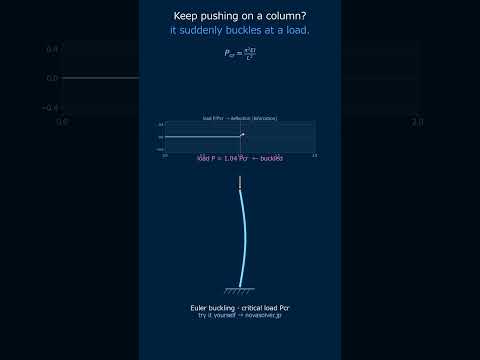
Calculate critical buckling stress and the k-factor for thin plates in real time. Adjust aspect ratio, thickness and boundary conditions (SSSS k=4, SSCC k≈5.4, CCCC k≈10.1) to visualize buckled mode shapes.
What exactly is "buckling" for a plate? Is it just bending?
🎓
It's a specific, sudden failure mode. Basically, when a thin plate is compressed, it can snap sideways into a wavy shape before the material itself yields. It's like pushing on an empty soda can—it collapses suddenly. In this simulator, you're analyzing the critical stress where that snap happens. Try reducing the thickness (t) slider to see how the critical stress plummets.
🙋
Wait, really? So the boundary conditions (like SSSS or CCCC) change that stress a lot? How?
🎓
Absolutely. Think of the edges: "S" means simply supported (like a hinge), and "C" means clamped (fully fixed). The more edges you clamp, the harder it is for the plate to start its wavy buckling shape. For instance, a CCCC plate (all edges clamped) can be over 2.5 times stronger than an SSSS plate. Use the boundary condition selector in the tool to see the k-factor and critical stress jump.
🙋
What's the "m" in the k-factor equation? And why does the aspect ratio (a/b) matter?
🎓
Great question. 'm' is the number of half-waves in the buckling shape along the loading direction. The plate "chooses" the 'm' that gives the lowest buckling stress. The aspect ratio is crucial: a long, skinny plate (high a/b) buckles in many small waves, while a square plate might buckle in one big wave. Adjust the width (a) and height (b) sliders independently and watch how the k-factor and the visualized buckling mode change.
Physical Model & Key Equations
The core of plate buckling analysis is the critical buckling stress formula, derived from elastic stability theory. It predicts the compressive stress at which a perfectly flat plate becomes unstable and buckles.
The buckling coefficient $k$ is not a constant. For a plate simply supported on all four edges (SSSS), it is calculated based on the number of half-waves $m$ that minimizes the stress.
$$k = \left(\frac{mb}{a}+ \frac{a}{mb}\right)^2$$
Where:
$a$ = Plate length (unloaded edge) [mm].
$b$ = Plate width (loaded edge) [mm].
$m$ = Integer number of half-waves in the buckling mode along length 'a'.
The physical meaning: This equation finds the most "energetically favorable" wavy pattern for the plate to buckle into. The minimum $k$ value for common boundary conditions (like 4 for SSSS) is a key result used in design codes.
Frequently Asked Questions
The buckling coefficient k depends on the plate's aspect ratio and the buckling mode number m. When the aspect ratio changes, the mode m that gives the minimum critical load switches at integer values, causing the value of k to change discontinuously. This is physically correct behavior.
The value of the buckling coefficient k varies significantly depending on the boundary conditions. For example, compared to simply supported edges, clamped edges constrain the plate's deformation more, resulting in a larger k and a higher critical load for the same plate thickness. You can switch between them in the simulator to compare.
This simulator is based on linear buckling theory for an ideal flat plate. In actual design, it is recommended to use an allowable load with a safety factor applied to account for the effects of initial imperfections, residual stresses, and plastic deformation.
For extremely thin plates, the buckling stress becomes very low, approaching zero in numerical calculations, which may exceed the limits of display precision. Additionally, the effects of actual manufacturing tolerances and small initial deflections become non-negligible. Therefore, it is recommended to use the simulator within a practical range (t/b ≧ 0.01 or so).
Real-World Applications
Ship & Barge Hull Design: The deck and side shells of ships are essentially large, stiffened steel plates under compression from global bending. Engineers use buckling analysis to determine the required spacing of stiffeners (like ribs) to prevent the thin plating from buckling, which is a primary design driver for hull structural weight.
Aircraft Wing Skins: The upper surface of an aircraft wing is in compression during flight. The thin aluminum or composite skin is supported by stringers and ribs. Buckling analysis ensures the skin can carry load without instability, and sometimes post-buckling strength is even utilized in lightweight design.
Bridge Girder Webs: The vertical web of a steel I-girder bridge is a tall, thin plate subjected to shear and compression. To prevent web buckling, engineers design a pattern of vertical stiffeners (and sometimes horizontal stiffeners) based on buckling principles, which you can model by changing boundary conditions to simulate different stiffener support levels.
Storage Tank Walls: Large cylindrical storage tanks for liquids or silos for bulk solids have walls that act as thin plates under internal pressure or external wind loads. Buckling, especially from vacuum or wind, is a critical failure mode that dictates wall thickness and the need for stiffening rings.
Common Misconceptions and Points to Note
First, you might think "buckling occurs = the material fails," but this is not necessarily true. Buckling in thin plates is a phenomenon where large deformation (buckling waves) occurs before reaching the yield stress. Many structures possess "post-buckling strength," allowing them to continue carrying load after buckling. Some designs, like aircraft skin panels, intentionally allow buckling to achieve weight reduction. This simulator calculates only the "critical load" at which buckling begins.
Next, do not misunderstand that the buckling coefficient k is "determined solely by boundary conditions". While the minimum value for SSSS is indeed 4, k becomes larger than 4 when the aspect ratio (a/b) is 1.5 or 2.5, right? In design, it's crucial to correctly select k based on the actual panel shape, not just this minimum value. For example, for an SSSS panel with a/b=1.5, k is approximately 4.34.
Finally, note that this calculation assumes a "perfectly flat plate" and "ideal boundary conditions". Real parts have initial imperfections and residual stresses, and edge fixity is rarely "perfectly fixed" or "perfectly pinned." For instance, even if "CCCC" is specified on a drawing, the actual restraint from welding or riveting tends to be lower. Therefore, in practice, steps like applying a safety factor or verifying with more detailed FEM analysis are essential.