NovaSolver›Railroad CWR Track Buckling (Sun Kink) Simulator Back
Railway Engineering
Railroad CWR Track Buckling (Sun Kink) Simulator
Real-time evaluation of "sun kink" — the lateral buckling that can hit continuously welded rail (CWR) on hot summer days. Adjust the rail temperature, neutral temperature, ballast resistance and curve radius to see the compressive force, critical buckling load, safety factor and maximum allowable rail temperature, ready for use in maintenance planning and slow-order decisions.
Parameters
Rail temperature
°C
In direct sun the rail head can reach 60 °C or more
Neutral temperature T_neutral
°C
Stress-free temperature set during installation / destressing
CWR length
m
Rail section
Sets the cross-section area A and second moment I
Sleeper type
Concrete sleepers carry more lateral load (factor 1.0)
Ballast resistance k_ballast
N/m
Lateral resistance from the ballast (depends on tamping)
Curve radius R
m
Straighter track buckles more readily; effect fades for R ≫ 500 m
Lateral train load
kN
Reference value — used in the lateral deflection estimate
Results
—
Temperature diff. ΔT (K)
—
Thermal stress σ (MPa)
—
Compressive force (kN, 2 rails)
—
Critical buckling P_cr (kN)
—
Safety factor
—
Max allowable temp (°C)
—
Top-view track — sun-kink visualisation
1-km-scale plan view of the track. Larger ΔT makes the rails wave laterally more strongly. Background dots show ballast and a train marker rolls over the wave.
Thermal stress σ and critical buckling load P_cr. α: coefficient of thermal expansion (steel 1.1×10⁻⁵ /K), E: Young's modulus (210 GPa), I: second moment of the rail section, k_ballast: lateral support stiffness from the ballast.
Compressive force (both rails) and maximum allowable rail temperature. A: rail cross-section area. A safety factor SF = P_cr / F_comp below 1.0 means immediate buckling risk; below 1.5 needs monitoring.
Sun Kink and CWR Thermal Stress in Railway Track
🙋
I've seen the news say "the track went all wavy in the heat" — does that actually happen? Rail looks indestructible.
🎓
It really does. Railway people call it a sun kink, and it shows up on CWR — Continuous Welded Rail — which is what almost every modern main line uses. The rail is welded into pieces hundreds of metres or even kilometres long. There are no expansion gaps the way there were on old 25-metre jointed rail, so when the steel heats up it has nowhere to grow. Huge compressive forces build up inside the rail instead, and once they pass a threshold the rail snaps sideways into a wavy "S" shape.
🙋
So the energy gets bottled up inside. How big are these forces, actually? It sounds like a lot.
🎓
It's a lot. The coefficient of thermal expansion of steel α is 1.1×10⁻⁵ /K and the Young's modulus E is 210 GPa. Fully restrained you get σ = E·α·ΔT, which is about 2.3 MPa of compressive stress for every 1 K of warming. On a UIC60 rail (7670 mm² section) that's roughly 18 kN per rail per K, so 35 kN per K for both rails together. If the rail was set at 25 °C and the head reaches 55 °C on a hot afternoon, ΔT = 30 K and the track ends up with 1060 kN — about 108 tonnes-force — pushing along every metre of its length. Drag the "Rail temperature" slider from 25 to 55 °C and watch the compressive-force card jump from zero to nearly 1000 kN.
🙋
108 tonnes! And basically the only thing stopping it moving is the friction in the ballast. How do you make it less likely to buckle?
🎓
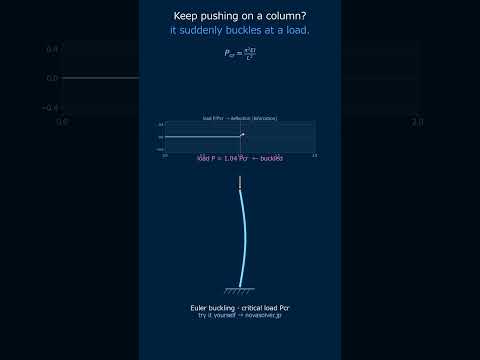
Good question. The critical buckling load is roughly P_cr ≈ 2·√(2·E·I·k_ballast), where k_ballast is the lateral stiffness the ballast gives the rail. So two main levers. First, lower F — pick a higher neutral temperature so summer ΔT is small, and on hot days slow trains down or even spray water on the rail. Second, raise P_cr — use concrete sleepers, tamp the ballast properly, build up the shoulder ballast at the side of the formation. Switch the "Sleeper" dropdown from concrete to wood and you'll see P_cr drop by about 25%, and the safety factor crash.
🙋
It really looks just like the mechanical buckling formula. Does the curve radius matter though?
🎓
Yes — and counter-intuitively, straight track and gentle curves are the most dangerous. Sharp curves need a slightly higher load to trip the "outward bow" buckling mode. In this tool I use a simple correction curvatureFactor = 1 − 500/R, so R = 5000 m gives 0.9 while R = 500 m gives 0 (no preferred buckling mode). In practice the FRA and JR focus their summer monitoring on straight and very gentle curves (R ≥ 2000 m). Famous sun-kink derailments — Florida 2002 Amtrak Crescent City, Washington 2012, Texas 2019 freight — all happened on essentially straight track.
🙋
The "Max allowable temperature" card is shown too. Does it mean "below this you're safe"?
🎓
No — that is just the SF = 1.0 boundary. Real operators issue slow orders well below it. The US rule of thumb is "neutral + 25 °F (≈14 K)" for considering a slow order, "+ 36 °F (≈20 K)" for mandatory. With the default settings, T_max comes out around 64.9 °C, but on the ground the maintenance team is already on alert once the rail passes 50 °C. The numerical critical point and the operational margin are two different things.
Frequently Asked Questions
For a fully restrained continuous welded rail (CWR), the thermal stress from a temperature change ΔT is σ = E·α·ΔT. For steel rail, E ≈ 210 GPa and α ≈ 1.1×10⁻⁵ /K, so every 1 K rise produces about 2.3 MPa of compressive stress. For example, a rail with neutral temperature 25 °C that heats up to 55 °C has ΔT = 30 K and σ ≈ 69 MPa; on a UIC60 section (7670 mm²) this is 530 kN per rail, or about 1060 kN for both rails accumulated along the entire welded length.
CWR has no expansion gaps at joints, so the rail cannot grow when it heats up. Instead, a large compressive force builds up along its full length. Once this force exceeds the lateral resistance offered by the ballast (and the sleepers), the rail snaps sideways into an S- or bow-shape over tens of metres. The US FRA identifies sun kinks as the leading cause of buckling-related derailments — Florida 2002, Washington 2012 and Texas 2019 are well-known examples. Japanese operators run slow orders and water spraying on hot days for the same reason.
Four practical countermeasures: (1) set the stress-free (neutral) temperature higher than the local average — about 25–35 °C in Japan, 35–40 °C in the southern US — so the summer ΔT stays small; (2) raise the lateral resistance k_ballast with concrete sleepers and a full shoulder-ballast profile; (3) monitor straight and very gentle curves (R > 1500 m) closely because they buckle more easily than sharp curves; (4) issue slow orders and run a temperature-monitoring network for early detection on hot days.
The neutral temperature T_neutral is the reference temperature at which the rail carries no thermal stress. The rail is heated (or stretched) to this temperature and clamped during installation or re-welding, which minimises the stress swing between summer and winter. AREMA (US) targets about 30 °F below the local high; UIC (Europe) targets the annual mean +10 °C; Japanese conventional lines aim for around 25 °C and Shinkansen lines are tuned site by site. After years of ballast creep and rail replacements, T_neutral drifts and the rail must be destressed — otherwise unexpected buckling (summer) or tensile fracture (winter) becomes possible.
Real-World Applications
FRA and AREMA guidance in the US: The Federal Railroad Administration launched its Track Buckling Research Program in 2003, and the AREMA Manual for Railway Engineering Chapter 5 codifies CWR management — neutral-temperature targets, summer slow orders, and the periodicity of destressing work. The numbers this tool returns can feed directly into those procedures. The 2002 Amtrak Crescent City accident in Florida was traced to a long-term drift of the neutral temperature, exactly the scenario where a 5–10 °C error pushes the SF below 1.0.
European UIC and Eurocode standards: UIC and Eurocode EN 13803 set neutral-temperature targets by region (21–23 °C for central Europe, 28–32 °C for the south), a minimum shoulder-ballast width (30–40 cm) and a minimum lateral resistance (8–12 kN/m per rail on concrete sleepers). On the Spanish AVE and French TGV high-speed lines, rail-temperature sensors at each kilometre run effectively the same calculation in real time and flag low-margin sections.
Japanese conventional and Shinkansen lines: JR companies maintain the neutral temperature of long-welded rail (LR) near 25 °C and rely on summer slow orders and emergency water spraying when rail heads heat up. The Shinkansen combines PC sleepers with slab track to deliver very high effective k_ballast, structurally suppressing buckling risk. Sections that swing temperature quickly — coastal stretches of the Tokaido line, long-tunnel mouths on the Sanyo line — receive extra monitoring.
Maintenance planning and destressing: After a few years of service, ballast creep, joint replacements and tiny thermal creep cycles push the neutral temperature ±5–10 °C off its design value. Destressing (relieving and re-clamping the rail) corrects this, and the force-vs-ΔT plot from this tool can back-calculate the target re-weld temperature. Maintenance teams measure rail temperature with sensors before summer, list sections whose SF would drop below 1.5, and prioritise destressing accordingly — a workflow that is common worldwide.
Common Misconceptions and Pitfalls
The first trap is assuming "rail temperature equals air temperature". In direct sun, the steel rail head can be 15–25 °C above ambient because of solar radiation and the dark surface emissivity. With air at 35 °C, rail temperatures of 55–60 °C are routine. The "Rail temperature" input here must come from a rail-head sensor or infrared thermometer — never from a weather-service air temperature. Several FRA sun-kink case reports involved decisions taken from air temperatures alone.
Second, "P_cr is 1060 kN so we're absolutely safe". The critical load here uses a Meier-Kerr-style simplified formula and does not account for initial lateral imperfections (even a few millimetres matter), combined train lateral loads, or long-term ballast creep under cyclic loading. The FRA Track Safety Standards typically require an SF of 1.5–2.0, meaning the usable margin is roughly half of the calculated P_cr. A green safety-factor card (≥ 1.5) is necessary but not sufficient — track inspectors apply additional empirical rules.
Finally, "with dataloggers and AI we can stop tamping so often" — a dangerous over-confidence. Temperature sensors and AI-based risk scoring are advancing fast, but the underlying remedies — tamping (compacting ballast) and destressing (re-setting the neutral temperature) — remain physical maintenance work. Reacting to a sensor warning is by definition after the fact, and the kink may already be forming. Use this tool for design review and maintenance planning, and combine operational decisions with measured rail temperatures plus the eye of an experienced track inspector.
How to Use
Enter rail temperature in °C (typical range 0–60°C for ambient conditions).
Set neutral temperature (stress-free laying temperature, typically 15–25°C for North American CWR).
Input rail segment length in meters between anchors or switches (typical 100–500 m for CWR sections).
Specify ballast lateral resistance in Newtons per meter of track (typical 8,000–15,000 N/m for well-tamped ballast, 5,000–8,000 N/m for degraded ballast).
Run simulation to compute compressive force, Euler critical buckling load, and safety factor against lateral sun kink.
Worked Example
CWR section: 132 kg/m rail (E = 210 GPa, I = 3,055 cm⁴), neutral temperature 20°C, rail at 55°C, 250 m segment, ballast resistance 10,000 N/m. Temperature differential ΔT = 35 K generates compressive thermal stress σ ≈ 77 MPa (α = 11.5 µm/m·K). Combined compressive force ≈ 2,850 kN (both rails). Euler critical buckling P_cr ≈ 3,200 kN; safety factor ≈ 1.12. Maximum allowable temperature before instability ≈ 62°C under these ballast conditions.
Practical Notes
Sun kink risk peaks in late spring/summer; monitor curves and low-rail sections where lateral restraint is weakest.
Ballast degradation (fouling, settlement) drops lateral resistance 30–50%; preventive tamping before heat waves is critical.