NovaSolver›Sodium-Ion Battery (NIB) Performance Simulator Back
Next-Gen Battery
Sodium-Ion Battery (NIB) Performance Simulator
Combine Prussian-blue, layered-oxide or polyanion cathodes with hard-carbon or Na-alloy anodes and watch the Na-ion cell's gravimetric and volumetric energy density, USD/kWh cell cost and LCOS update in real time. Compare against the Li-ion baseline to pick a chemistry that fits stationary ESS or low-speed EVs.
Parameters
Cathode material
Sets specific capacity, density and cost factor
Anode material
Hard carbon is the current industry standard
Nominal voltage V_cell
V
Average discharge voltage of the Na-ion cell
Cell capacity C
Ah
Target cycle life N
cycles
Cycles to end-of-life (e.g. 80 % SoH)
Depth of discharge DoD
%
Sodium feedstock price
USD/t
Soda-ash basis. Lithium carbonate is typically $15,000-30,000/t
Results
—
Cell energy (Wh)
—
Gravimetric (Wh/kg)
—
Volumetric (Wh/L)
—
Cell cost (USD/kWh)
—
LCOS (USD/kWh/cycle)
—
Cost improvement vs Li-ion (%)
—
Na-ion cell cross-section with Na⁺ migration
Layer view of the PBA cathode / electrolyte / hard-carbon anode stack with Na⁺ migrating to the cathode during discharge. A Li-ion baseline cell is shown on the right for direct visual comparison.
Na-ion vs Li-ion — energy density, cost, cycle life
V_cell: nominal voltage [V], C: cell capacity [Ah], m_cell: cell mass [kg], N_cycles: cycles to end of life, DoD: depth of discharge (0-1). LCOS units are USD/kWh per cycle.
q_cat and q_an are the cathode and anode specific capacities [mAh/g]. The factor 2.5 lumps electrolyte, separator, current collectors and packaging into the cell mass.
Sodium-Ion Batteries (NIB) — Trade-offs vs Li-Ion and Cost Economics
🙋
I keep hearing about "sodium-ion batteries". How are they really different from Li-ion? Is it just swapping Li for Na?
🎓
The mechanism is the same rocking-chair: ions leave the cathode on charge, swim through the electrolyte and slot into the anode, then back again on discharge. But once you swap Li⁺ for Na⁺, a lot of knock-on effects appear. The biggest one is feedstock cost. Lithium carbonate goes for $15,000-30,000 per tonne; soda ash (sodium carbonate) sells for $250-400 per tonne. Literally 1/50 to 1/100 the price, and sodium is dissolved in every ocean. Geopolitically, Li sits in a few hands (Chile, Australia, China), while Na is everywhere.
🙋
So why aren't EVs running on Na-ion? Why not just replace lithium everywhere?
🎓
That's the fundamental constraint. The Na⁺ radius is 1.02 A, about 34 % larger than Li⁺ (0.76 A). Bigger ion means different behaviour inside the electrodes and a different voltage. Take the graphite anode: in Li-ion it runs at almost its theoretical 372 mAh/g, but Na⁺ barely fits between graphite layers. You have to switch to hard carbon (disordered turbostratic carbon), and even then you get 250-320 mAh/g. The cell voltage averages around 3.1 V versus 3.7 V for Li-ion. The arithmetic ends at 100-160 Wh/kg at the cell level, well short of Li-ion's 250 Wh/kg. For an EV that means 1.5x to 2x the battery weight for the same range.
🙋
Then where does Na-ion actually win?
🎓
Where weight and volume matter less than price, safety and abundance. The number-one target is stationary ESS — grid-scale storage paired with solar or wind. The cells sit on a slab; weight is a non-issue. Only $/kWh and lifetime matter. Plug the default chemistry (PBA + hard carbon) into this tool and you get $42/kWh BOM cost with an LCOS of $0.0175/kWh/cycle. Compare that to Li-ion at $130/kWh and $0.026/kWh/cycle and Na-ion wins by a wide margin in ESS. Low-speed EVs (China's A00 segment, e-scooters) are the other natural fit. CATL, BYD and HiNa Battery all began volume Na-ion production in 2024.
🙋
You mentioned "0 V storage" in the description — isn't that something Li-ion can do too?
🎓
This is actually Na-ion's hidden killer feature. If you fully discharge a Li-ion cell, the copper current collector dissolves into the electrolyte, risking shorts and fires — so 0 V is a hard no. That is why aviation transport rules cap state-of-charge at 30 %. Na-ion uses aluminium on both sides (Na does not alloy with Al), so the cell can be fully discharged to 0 V for shipping and storage. The safety upside is enormous: warehousing, ocean freight, strategic stockpiling all become easier. CATL announced its "Naxtra" Na-ion line in 2024 targeting $40/kWh with hard carbon and PBA. HiNa Battery (China), Faradion (UK, now Reliance) and Natron Energy (US) have each entered commercial production.
Frequently Asked Questions
Both use the same rocking-chair principle (an ion shuttles between cathode and anode every cycle), but the shuttle is Na+ instead of Li+. Sodium is 1,000 times more abundant in the crust than lithium, costs less than 1/30 as much and carries no geopolitical concentration risk. The price is a larger ionic radius (1.02 A vs 0.76 A for Li+), so Na+ does not intercalate well into graphite and hard carbon (disordered carbon) is used instead. Cell-level energy density is 100-160 Wh/kg versus 200-270 Wh/kg for Li-ion, but the lower cost, wider temperature range and 0 V storage capability make NIBs a strong fit for stationary ESS and low-speed EVs.
Na+ is too large to slip between graphite layers (about 0.335 nm). Li+ intercalates to form LiC6, but no thermodynamically stable NaCn compound exists, so graphite delivers only 30-35 mAh/g with Na+. Hard carbon has a turbostratic structure with nanopores; Na+ is stored by a combined intercalation-and-adsorption mechanism that reaches 250-350 mAh/g. Na-Si and Na-Ti alloys promise more than 800 mAh/g in theory, but their volume swing of over 200 % during cycling makes cycle life difficult to achieve.
PBAs such as Na_xMnFe(CN)6 have an open cubic framework with large interstitial cavities, so Na+ moves in and out easily. They tolerate 5 C charging, can be synthesised from cheap precursors in aqueous solution and reach 150-170 mAh/g in theory (about 120 mAh/g used in this tool). The challenges are managing crystal water, oxidation in air and concerns about the cyanide ligand. HiNa Battery, Natron Energy and CATL are leading the commercial push.
In the short term, lower energy density makes NIB a poor fit for weight-and-volume-constrained applications like long-range EVs. For stationary ESS (grid storage with solar or wind), however, this tool reports $42-70/kWh BOM cost, more than 50 % below the $130/kWh figure typical for Li-ion. Add 0 V storage (cells can be fully discharged for transport, easing hazmat rules), -40 degC operation and freedom from lithium and cobalt geopolitical risk, and the LCOS falls below $0.02/kWh/cycle, beating Li-ion over a 10-20 year service life.
Real-world applications
Grid-scale stationary storage (ESS): Storing surplus solar and wind output is the headline market for Na-ion. The cells sit on a concrete pad, so weight is irrelevant; only $/kWh and lifetime count. CATL has already rolled Na-ion cells into part of its EnerC container line in 2024, and HiNa Battery has been running a 1 MWh-class Na-ion ESS in Datong, China since 2023, targeting under $50/kWh. Over 10-20 years of operation the LCOS undercuts Li-ion comfortably.
Low-speed EVs, e-scooters and three-wheelers: China's A00 segment (city EVs with 200-300 km range and top speed near 100 km/h) is a perfect match. Derivatives of the BYD Seagull, plus Chery and JAC models, have already been announced with Na-ion packs. The extra weight is acceptable for short urban ranges, and the price can come down below $5,000. India and South-East Asia's 2- and 3-wheel EV market is another natural fit.
UPS and base-station backup: Telecom base stations and data-centre backup demand instantaneous discharge and long calendar life rather than high energy density. Natron Energy aims its PBA-based Na-ion cells squarely at this segment, claiming over 25,000 cycles and second-scale discharge response. The lead-acid replacement market alone is estimated at more than $10 B.
Emergency and cold-climate storage: Na-ion operates from -40 degC to +60 degC (Li-ion loses half its capacity at -20 degC). Polar telecom sites, remote mountain stations, mission-critical emergency power, and even space and lunar-base studies are exploring Na-ion. Combined with 0 V storage for indefinite stockpiling, it is increasingly considered for municipal disaster reserves and military energy stores.
Common misconceptions and pitfalls
First, "sodium is cheap, so sodium-ion cells must be cheap" is too simple. Yes, the soda-ash feedstock is 1/50 to 1/100 the price of lithium carbonate, but Na itself is only a few percent of the cell BOM. The real cost drivers are the synthesis of the electrode active material (PBA or layered oxide), the new electrolyte chemistry, and amortisation of the production line. This tool's default of $42/kWh assumes 10 GWh-class annual output. At prototype scale you will see $80-120/kWh, on par with Li-ion. Plan for the gap until scale takes over.
Second, "hard carbon is just cheap pyrolysed biomass". You can indeed make it from phenolic resin, coconut shell or pitch, but Na-ion-grade hard carbon needs very tight control of heat-treatment temperature (1100-1400 degC), atmosphere and activation to balance capacity with first-cycle coulombic efficiency (80-90 %). BTR, Kuraray and JFE produce it at $15-25/kg today, well above $5-10/kg for Li-ion graphite. This tool keeps Hard Carbon at a cost factor of 1.0, but expect downside as the supply chain scales.
Third, "PBA contains cyanide, therefore it is dangerous". Yes, Na_xMnFe(CN)6 carries CN ligands, but they are tightly bound in an Fe-Mn complex and do not release free cyanide (the blue pigment Prussian blue has been a paint for centuries). PBAs are actually thermally very stable, with far less thermal-runaway risk than Li-ion NCA or LCO. Natron Energy's PBA cells passed UL9540A with no fire propagation, and that safety profile is a major Na-ion selling point. The real production challenge is water management: crystal water trapped in the lattice will steal capacity, so the drying step is critical.
How to Use
Select cathode chemistry: Prussian-blue (3.0–3.5 V, lower cost), layered-oxide (3.5–4.0 V, higher energy density), or polyanion (3.8–4.2 V, best cycle life).
Choose anode material: hard-carbon (0.2 V vs Na/Na+, ~300 mAh/g) or Na-alloy (0.5 V, ~800 mAh/g but lower cycle count).
Input nominal cell voltage (V), capacity (Ah), cycle count target, and depth-of-discharge (%), then run simulation to compute gravimetric/volumetric energy, cell cost, and LCOS (levelized cost of storage).
Worked Example
Prussian-blue cathode + hard-carbon anode: 3.2 V nominal, 5 Ah cell, 3000 cycles at 80% DoD. Cell energy = 16 Wh; gravimetric = 180 Wh/kg (assuming 89 g cell mass); volumetric = 150 Wh/L (106 mL). Raw material cost ~USD 45/kWh; pack-level LCOS = USD 0.018/kWh/cycle. Cost advantage vs Li-ion 18650: ~35% lower USD/kWh, offsetting Na-ion's ~15% lower energy density.
Practical Notes
Prussian-blue NIBs excel in stationary energy storage (grid-scale, 2–10 year payback); lower voltage suits cost-sensitive EV segments where range trade-off is acceptable.
Hard-carbon anodes dominate NIB cells because Na-metal dendrite suppression requires >300 mAh/g insertion capacity; Na-alloy anodes enable compact modules but suffer capacity fade after 500–1000 cycles.
At 80% DoD and 3000 cycles, NIB LCOS approaches USD 0.015–0.025/kWh/cycle; Li-ion (FePO₄) at same duty = USD 0.025–0.035, making NIB competitive for long-duration storage despite lower round-trip efficiency (88–92% vs Li-ion 94–97%).
🎬 Watch it in motion
Chemistry Becomes Power | How a Battery Works
Why 3.7 V reads as 3.4 V | How a Battery works #Shorts
Why voltage sags under heavy load | How a Battery works #Shorts
Why two metals make electricity | How a Battery works #Shorts
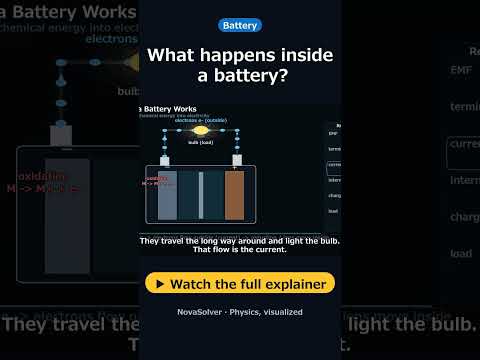
What happens inside a battery? | How a Battery works #Shorts