NovaSolver›Solid-State Battery Energy Density Simulator Back
Energy Storage
Solid-State Battery Energy Density Simulator
A design tool for solid-state batteries (SSBs), the key technology for next-generation electric vehicles and consumer electronics. Choose a cathode chemistry, a Li-metal/Si-C anode and a sulfide/oxide/polymer electrolyte, adjust loading and layer thicknesses, and read off gravimetric (Wh/kg) and volumetric (Wh/L) energy density in real time against the Li-ion baseline of 250 Wh/kg and 600 Wh/L.
Parameters
Cathode material
Sets specific capacity (mAh/g) and density (g/cm³)
Anode material
Li metal has a theoretical capacity of 3860 mAh/g
Electrolyte
Sulfide = high conductivity, oxide = high stability
Average voltage V
V
Cathode loading
mg/cm²
Active-material mass per unit area
Cathode thickness t_c
μm
Anode thickness t_a
μm
Electrolyte thickness t_e
μm
Thinner = higher density but greater short-circuit risk
Packaging mass fraction
Case, tabs, cooling and BMS mass share
Results
—
Cathode areal capacity (mAh/cm²)
—
Cell areal energy (mWh/cm²)
—
Gravimetric (Wh/kg)
—
Volumetric (Wh/L)
—
Power density (W/kg)
—
Improvement vs Li-ion (%)
—
SSB cell cross section with Li+ transport
Multilayer cell: Al current collector / cathode / solid electrolyte / Li-metal anode / Cu current collector. During discharge Li+ ions move anode → electrolyte → cathode.
Approximate power density (W/kg). σ_ion: electrolyte ionic conductivity (mS/cm). Sulfide (high) → polymer (low) shifts this by orders of magnitude.
Designing energy density for solid-state batteries
🙋
Everyone's talking about solid-state batteries lately. What actually changes compared with a regular lithium-ion cell?
🎓
In a sentence: the electrolyte goes from liquid to solid. That sounds small, but it pulls two big levers. First, today's Li-ion uses a flammable organic liquid, so you spend a lot of pack weight on cooling, vents and structural safety. Switch to a solid electrolyte (sulfide LGPS, oxide LLZO, polymer PEO) and most of that hardware goes away. Second — and this is the real prize — a solid electrolyte lets you use a lithium-metal anode instead of graphite. That's where the energy density jump actually comes from.
🙋
Lithium metal? Is that really that different from graphite?
🎓
Massively. Graphite stores 372 mAh per gram; lithium metal stores 3860. Roughly ten times. Try switching the anode dropdown on the left from "Li metal" to "graphite" and watch what happens — the default NCA + Li metal cell hits about 489 Wh/kg, but with graphite it drops to around 300. That gap is exactly why people call SSBs a next-generation battery. Toyota's plan to ship an SSB-equipped EV around 2027 targets this same Li-metal configuration.
🙋
But wasn't lithium-metal anode the chemistry that caused fires in old batteries? Why is it safe now?
🎓
Good catch. Primary Li-metal cells in the 1980s really did fail — during charging, lithium grows as needle-like dendrites that punch through the separator and short the cell. The industry gave up on Li metal and switched to graphite. The whole bet on SSBs is that a solid electrolyte is mechanically tough enough to stop those dendrites. That's still the biggest unsolved problem: raising the critical current density (CCD), keeping uniform stack pressure, and "anode-free" designs that pre-place only a thin Li seed are all active research directions.
🙋
There are three electrolyte choices here — sulfide, oxide, polymer. Which one is best?
🎓
There's no universal winner; it's a triangle. Sulfide (LGPS) matches liquid electrolytes at 25 mS/cm and is soft enough to form good interfaces under stack pressure — the Toyota/Idemitsu/Mitsui Kinzoku camp. Downside: it reacts with water and releases toxic H2S, so you need a dry room. Oxide (LLZO) is chemically rock-solid and friendly to Li metal, but conductivity is 100× lower. Polymer (PEO) is the easiest to roll into thin films, but needs 60-80°C to conduct. Switch the electrolyte selector and you'll see the "Power density" stat move by an order of magnitude. EV pouches → sulfide. Stationary storage → oxide. Polymer is already running in Bollore's electric buses in Paris.
🙋
And "packaging mass fraction"? It affects the result quite a lot.
🎓
It's the share of total mass that isn't active material — cell case, current-collector tabs, module spacers, cooling plates, BMS PCB. A lab coin cell can stay under 18%; an automotive module bloats to 30-40%. That's why every "500 Wh/kg achieved!" press release needs an asterisk: it's almost always measured on a coin cell with active mass only. The tool defaults to 0.18, but for an EV pack-level estimate try 0.30-0.35 instead. The whole commercial argument for SSBs is that they can run this fraction lower than Li-ion because they need less cooling and safety hardware.
Frequently asked questions
The biggest reason is that lithium-metal anodes become usable. Li metal has a theoretical capacity of 3860 mAh/g, about ten times the 372 mAh/g of graphite, so the anode layer can be made much lighter and thinner for the same cathode capacity. A solid electrolyte is also non-flammable, which removes the separator, liquid electrolyte and most of the cooling/safety hardware, and lowers the packaging mass fraction. Cell-level energies of 500-700 Wh/kg are realistic targets, and even the default conditions in this tool (NCA + Li metal + sulfide LGPS) give roughly 489 Wh/kg.
Sulfides such as LGPS (Li10GeP2S12) reach 25 mS/cm, on par with liquid electrolytes, and are soft enough that pressed stacks give good interfaces. Toyota, Idemitsu and Mitsui Kinzoku are scaling them up. Oxides such as LLZO (Li7La3Zr2O12) sit around 0.2 mS/cm but are chemically very stable and tolerate direct contact with Li metal. Polymer electrolytes (PEO-based) are the lowest at 0.01 mS/cm and need to run at 60-80°C, but film processing is the most mature - Bollore has been using them in electric buses since 2014. Switch the electrolyte selector in this tool and you will see the power density estimate change by orders of magnitude.
It is the fraction of total cell mass taken up by everything that is not active material: cell case (pouch or can), current-collector tabs, module spacers, cooling plates, BMS PCB and so on. Lab coin cells can keep it under 20%, but an automotive module is typically 30-40%. Solid-state cells can lower this fraction relative to Li-ion because they need less cooling and safety hardware, which is one of their key commercial advantages. The default in this tool is 0.18 (small-cell assumption); raising it to 0.30 reduces gravimetric density by roughly 15%, and 0.25-0.35 is the realistic range for EV pack-level estimates.
Three barriers remain. (1) Interface impedance: solid-solid contact is intrinsically smaller than solid-liquid contact and degrades further with cycle-induced volume change; pressed stacks and buffer layers are the main countermeasures. (2) Lithium dendrites: during charging Li metal can grow as needles that pierce the electrolyte and short the cell - raising the critical current density (CCD) and applying uniform stack pressure is the key. (3) Manufacturing: sulfide chemistries release toxic H2S on exposure to moisture and need dry-room or glovebox processing, which is capital-intensive. TDK, Murata, QuantumScape, Solid Power and others are targeting EV-grade production in 2027-2030.
Real-world applications
Extending EV range: Today's Li-ion EVs typically run 400-600 km on a charge. A 1.5-2× jump in gravimetric energy density would push the same pack to 600-1000 km without adding weight. Toyota plans an SSB-equipped EV on a dedicated BEV platform in 2027-2028, with Nissan, BMW and Mercedes-Benz aiming around 2030. In China, NIO, CATL and BYD are ramping SSB R&D investment quickly.
Consumer electronics and small drones: Thin-film SSBs are already shipping in commercial form. Cymbet and ST Microelectronics provide 0.1-1 mAh on-board cells for medical implants and IoT nodes. In wearables the size of an Apple Watch, the combination of non-flammability and a higher volumetric density (800-1200 Wh/L) is the main pull. Long-endurance drones with tight mass budgets are another early adopter.
Stationary storage and grid services: For grid balancing, safety, cycle life and cost matter more than peak energy density. Oxide-electrolyte SSBs (LLZO) with 10,000+ cycle life and near-zero flammability are being targeted at data-center UPS and microgrid applications. Bollore's LMP polymer cells have been running Paris electric buses (Bluebus) since 2014, the longest commercial SSB deployment to date.
Aerospace and electric aviation: Practical eVTOL aircraft need around 400 Wh/kg at the cell level, which today's Li-ion cannot deliver. If SSBs hit 500+ Wh/kg, the duration of vehicles from Joby Aviation, Lilium and other electric-air-mobility startups grows dramatically. NASA's SABERS program is targeting flight-grade SSBs for electric aircraft in the 2030s.
Common misconceptions and pitfalls
The most dangerous trap is treating coin-cell results as pack-level performance. The "500 Wh/kg!" numbers in papers and press releases are usually measured on small CR2032 coin cells discharged at tens of microamps and divided by active mass only. Real EV deployment must also include (1) 30-40% packaging mass fraction, (2) module and cooling hardware, (3) C/3 or faster discharge (high rates cut density), and (4) cycle-life reserve. The 489 Wh/kg default in this tool would correspond to roughly 300-350 Wh/kg at pack level once those factors are folded in.
Second, thinner electrolyte is not automatically better. Taking the solid electrolyte from 25 μm down to 5 μm boosts volumetric density on paper, but it brings (1) loss of mechanical strength and higher pinhole risk, (2) much higher dendrite-penetration probability, and (3) thicknesses comparable to or below the active particle size (10-20 μm), causing non-uniform contact and current hot-spots. Practical safe ranges are 20-50 μm for sulfide, 20-100 μm for oxide, and 50-200 μm for polymer. "Demonstrated 5 μm in a lab" and "20 μm in a saleable cell" are not the same number.
Finally, the cliché that solid-state cells charge slowly is outdated. Oxide and polymer chemistries are limited, yes, but sulfide LGPS matches liquid electrolyte conductivity at 25 mS/cm and, with a properly engineered interface, can handle 10C discharge (six minutes to empty). Leave the electrolyte selector on "sulfide" here and the power density easily passes 1000 W/kg. Toyota disclosed in 2023 a sulfide-based SSB capable of charging from 0 to 80% in ten minutes, which puts fast-charge well within reach for solid-state architectures.
How to Use
Set cell voltage (2.5–4.5 V) matching your cathode chemistry: NMC811 typically operates 2.7–4.3 V, LFP 2.5–3.65 V.
Input cathode loading (2–8 mg/cm²) and thickness (50–150 µm); higher loading increases areal capacity but risks lithium-ion transport bottlenecks.
Specify anode thickness (25–100 µm for lithium metal or silicon composite); thinner anodes reduce dead volume, improving volumetric energy density.
Observe real-time outputs: areal capacity, cell areal energy, gravimetric and volumetric densities, and power density relative to conventional Li-ion (280 Wh/kg baseline).
Worked Example
NMC811 solid-state cell with 4.2 V, 6 mg/cm² cathode loading, 100 µm cathode thickness, and 50 µm lithium-metal anode: areal capacity = 6 mAh/cm², cell areal energy ≈ 25 mWh/cm². Assuming 95 g/cm² cell stack mass and 0.85 cm³ volume, gravimetric density reaches 520 Wh/kg and volumetric 750 Wh/L—a 85% improvement over conventional Li-ion. Power density at 2C discharge rate yields 180 W/kg.
Lithium-metal anode thickness below 30 µm increases dendrite nucleation probability and cycle-life loss; 50–80 µm is industry consensus for automotive applications.
Volumetric density is critical for space-constrained EV packs; solid-state batteries eliminate liquid electrolyte volume, gaining 15–25% density advantage over pouch cells.
Gravimetric targets of 500+ Wh/kg enable 600+ mile EV range; validate against mechanical stability and ionic resistance at your selected parameters.
🎬 Watch it in motion
Chemistry Becomes Power | How a Battery Works
Why 3.7 V reads as 3.4 V | How a Battery works #Shorts
Why voltage sags under heavy load | How a Battery works #Shorts
Why two metals make electricity | How a Battery works #Shorts
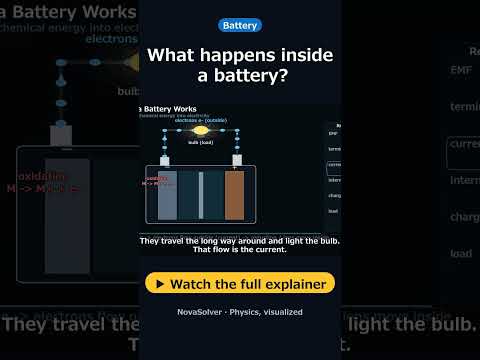
What happens inside a battery? | How a Battery works #Shorts