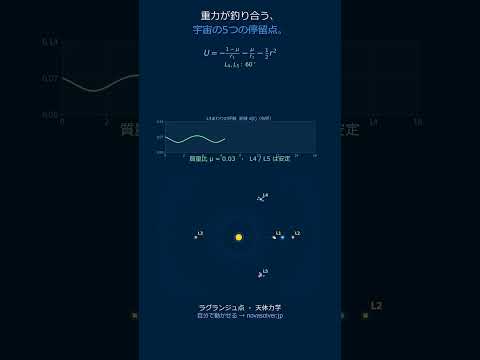
Animate planetary and comet orbits based on gravitational force in real time. Change eccentricity and semi-major axis to experience Kepler's three laws interactively.
💬 Kepler's Laws and Universal Gravitation — The Truth Behind the Universe's 'Curved Orbits'
🙋
Why do planets orbit in ellipses instead of circles? If they're pulled by gravity, you'd think they'd go in circles.
🎓
That's the fascinating part of celestial mechanics. A planet follows a circular orbit only when it has just the right speed; otherwise, it traces an ellipse. As it gets closer to the Sun, gravity accelerates it, and as it moves away, it decelerates—this balance naturally creates an ellipse. Kepler discovered this as his First Law in the 17th century from Tycho Brahe's observational data: planets move in elliptical orbits.
🙋
When I increase the eccentricity in the simulator, the planet speeds up a lot near the perihelion (closest point). Is that Kepler's Second Law?
🎓
Exactly! That's the law of equal areas. The line segment connecting the Sun and the planet sweeps out equal areas in equal times. So the planet moves faster at perihelion and slower at aphelion. This is essentially a restatement of conservation of angular momentum ($L = mr^2\dot{\theta} = \mathrm{const}$), which Newton derived from his theory of universal gravitation. If you switch to the 'Second Law tab', you'll see that the sectors swept in equal time have the same area.
🙋
I tried the Halley's Comet preset, and it spends most of its time far out, then whips through the inner solar system at incredible speed.
🎓
That's because e = 0.967, an extremely elongated ellipse. Halley's Comet has a perihelion distance of about 0.59 AU (inside Venus's orbit) and an aphelion of about 35 AU (beyond Neptune). At perihelion, it passes at over 250,000 km/h, but near aphelion it appears almost stationary. Its period is about 75–76 years; it last approached in 1986, so the next time will be around 2061.
🙋
What is the vis-viva equation? The 'Vis-viva Curve' tab caught my eye.
🎓
It's the equation $v^2 = GM(2/r - 1/a)$, which lets you calculate the speed at any point on an orbit from r (current distance) and a (semi-major axis). You can see that when r is small (perihelion), v is large, and when r is large (aphelion), v is small. The graph has distance r on the x-axis and speed v on the y-axis, and the curve takes a hyperbolic shape. This equation is fundamental for calculating rocket orbit transfers (Hohmann transfers).
🙋
How are these laws used when launching artificial satellites?
🎓
For transferring from launch to geostationary orbit (GEO, about 36,000 km), the standard method is the Hohmann transfer. First, you inject into low Earth orbit (LEO). Then you accelerate at perigee (first delta-V) to enter an elliptical transfer orbit. At the apogee of that transfer orbit (GEO altitude), you accelerate again (second delta-V) to circularize. These two burns are the most fuel-efficient. In this simulator, you can start with e=0, increase e to extend the apogee, and get a feel for the transfer orbit.
Frequently Asked Questions
What is Kepler's First Law?
It states that 'planets move in elliptical orbits with the Sun at one focus.' Kepler published this in 1609, and later Newton proved it mathematically from the inverse-square law of universal gravitation. A special case is the circular orbit (e=0). The Moon's orbit around Earth and artificial satellite orbits are also elliptical if perturbations are ignored.
Explain Kepler's Third Law with a concrete example.
Earth: a=1 AU → T=1 year. Mars: a=1.52 AU → T=1.52^(3/2)≈1.87 years. Jupiter: a=5.2 AU → T=5.2^(3/2)≈11.9 years. These match observed values very closely. Outside the solar system, GM differs, so you use T = 2π√(a³/GM). With Newtonian mechanics, this relationship also allows us to calculate the masses of other stars.
How do you calculate escape velocity?
To completely escape a celestial body's gravity, set a → ∞ in the vis-viva equation, giving v_escape = √(2GM/r). At Earth's surface (r=6371 km), escape velocity is about 11.2 km/s; on the Moon, it's about 2.4 km/s. a = ∞ corresponds to a parabolic orbit (e=1), and e>1 gives a hyperbolic orbit (the Voyager probes used this to leave the solar system).
What is the numerical integration accuracy of this simulator?
We use the Verlet integration method (a type of leapfrog method). This method has lower computational cost than 4th-order Runge-Kutta and better energy conservation, making it suitable for orbital mechanics simulations. However, if dt is too large, the orbit will gradually drift. Increasing the speed multiplier increases dt per frame, reducing accuracy. For e ≥ 0.9, adaptive integration that reduces dt near perihelion is ideally needed.
How is this knowledge used in actual space exploration?
It's used in trajectory design for planetary probes (flybys and gravity assists), satellite orbit maintenance, and space debris tracking. Precise orbital calculations are essential for missions like the Hubble Space Telescope repair and ISS cargo spacecraft docking. Swing-by (gravity assist) calculations use planets as virtual 'gravity sources' to design orbital energy changes.
What is Orbital Mechanics Simulator?
Orbital Mechanics Simulator is a fundamental topic in engineering and applied physics. This interactive simulator lets you explore the key behaviors and relationships by directly manipulating parameters and observing real-time results.
By combining numerical computation with visual feedback, the simulator bridges the gap between abstract theory and physical intuition — making it an effective learning tool for students and a rapid-verification tool for practicing engineers.
Physical Model & Key Equations
The simulator is based on the governing equations behind Orbital Mechanics Simulator. Understanding these equations is key to interpreting the results correctly.
$$$","$$$
Each parameter in the equations corresponds to a slider in the control panel. Moving a slider changes the equation's solution in real time, helping you build a direct connection between mathematical expressions and physical behavior.
Real-World Applications
Engineering Design: The concepts behind Orbital Mechanics Simulator are applied across mechanical, structural, electrical, and fluid engineering disciplines. This tool provides a quick way to estimate design parameters and sensitivity before committing to full CAE analysis.
Education & Research: Widely used in engineering curricula to connect theory with numerical computation. Also serves as a first-pass validation tool in research settings.
CAE Workflow Integration: Before running finite element (FEM) or computational fluid dynamics (CFD) simulations, engineers use simplified models like this to establish physical scale, identify dominant parameters, and define realistic boundary conditions.
Common Misconceptions and Points of Caution
Model assumptions: The mathematical model used here relies on simplifying assumptions such as linearity, homogeneity, and isotropy. Always verify that your real system satisfies these assumptions before applying results directly to design decisions.
Units and scale: Many calculation errors arise from unit conversion mistakes or order-of-magnitude errors. Pay close attention to the units shown next to each parameter input.
Validating results: Always sanity-check simulator output against physical intuition or hand calculations. If a result seems unexpected, review your input parameters or verify with an independent method.