ML Adaptive Mesh Refinement
Theoretical Foundations of ML-Driven Adaptive Meshing
Which Part of the Adaptive Loop Gets Replaced by Learning
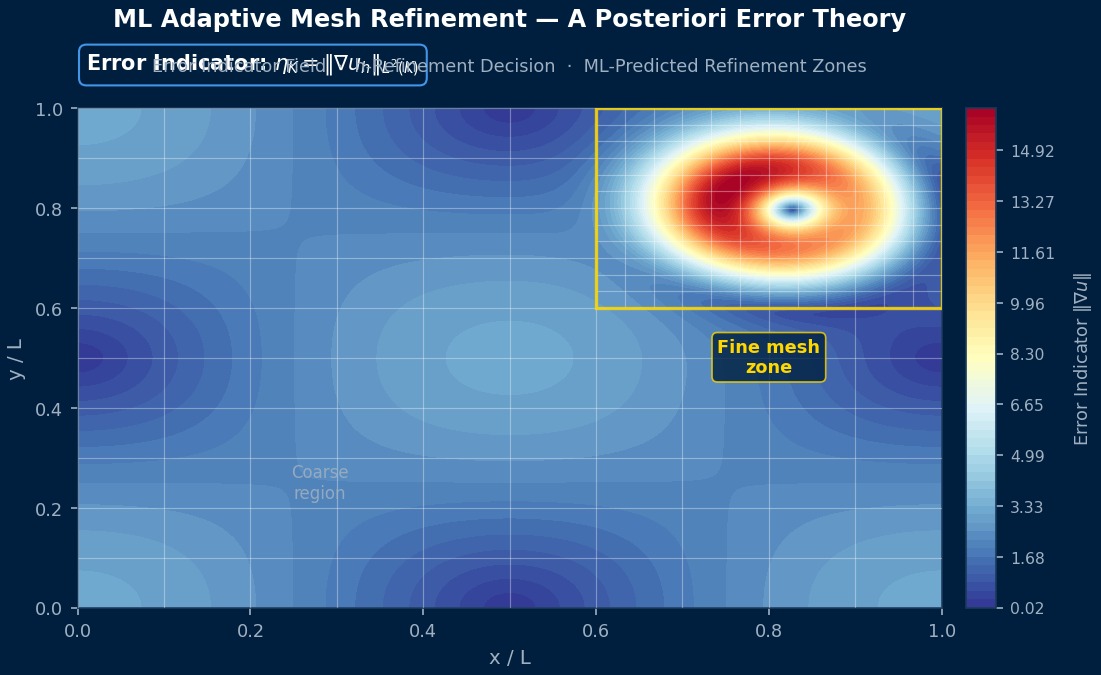
Classical adaptive mesh refinement (AMR) is an iteration of SOLVE → ESTIMATE (error estimation) → MARK (selecting the elements to refine) → REFINE (see h-refinement for the basics). Machine learning enters at three main points.
| Approach | What is learned | Aim |
|---|---|---|
| ① Learning the error indicator | Regression from local features to element error (targets: the true error against a fine reference solution, or a DWR indicator) | Replace expensive error estimation (adjoint analysis and the like) with cheap inference |
| ② Direct prediction of the size field | Geometry and boundary conditions to the optimal mesh-size distribution | Produce a good mesh on the first attempt, with no iteration |
| ③ Reinforcement learning of the refinement policy | The MARK strategy itself (state = solution and mesh, action = refine/coarsen) | Acquire the long-horizon optimal refinement order under "error × cost" |
Why This Particular Task Suits Learning
Error indicators already have a theory behind them. Is there really any point in going out of your way to replace them with a learned model?
There are two reasons. First, cost — goal-oriented error estimation (DWR) requires solving one more adjoint problem, and that is as expensive as the primal solve. A learned model infers in milliseconds. Second, making craft knowledge explicit — a good mesh in practice is built from a veteran's rules of thumb (on this kind of geometry, refine here), and theoretical indicators alone cannot reproduce them. The past analyses accumulated in an organization (geometry, mesh, result) are precisely the training data for those rules of thumb. So ML-AMR is less a replacement for theory than value in two directions: distilling an expensive theoretical indicator, and turning tacit knowledge into data.
How to Represent a Mesh — a Graph Is the Natural Choice
Because both the element count and the connectivity vary, a graph neural network (GNN) is a more natural representation than an MLP over a fixed-length vector. Take nodes or elements as graph nodes and adjacency as edges, attach local features (solution gradient, an approximation of the Hessian, element shape, distance from the boundary, material-interface flags), and aggregate neighbourhood information by message passing. CNN-based approaches (turning the solution field into an image and emitting a size field) are convenient on structured 2-D grids, but GNN-based methods have become mainstream for scaling to unstructured 3-D practice.
Designing the Learning Problem
Building the Training Data (Approaches ① and ②)
- Design the problem set — prepare several hundred problems that randomize the geometry, loads and material properties of the target class (the distribution design follows the same discipline as surrogates in general)
- Generate the "ground truth" — solve each problem on an excessively fine reference mesh and take as the target either the local error distribution against the coarse-mesh solution or the final size field of a converged adaptive history
- Extract the features — build them only from quantities computable from the coarse-mesh solution (never mix information unavailable at inference time into the training features)
- Train and calibrate — for regression on an error indicator, getting the ranking (which element is worst) right matters more than the absolute value. Include rank correlation among the validation metrics
The Reinforcement Learning Formulation (Approach ③)
State = the current mesh and solution, action = refine/keep/coarsen per element, reward = error reduction minus the increase in computational cost. With that formulation the policy learned answers "in what order should elements be refined to reach the target accuracy at minimum total cost". What distinguishes it from the regression approach is that it handles sequential decisions (early refinement changes the quality of later solutions), but stabilizing training and designing the reward (how to measure the true error) are costly, so a staged view — research leads, practice starts from the regression approach — is the realistic one.
Designing the Limits of Generalization
What ML-AMR is worth is decided by how far it can move away from the problem class it was trained on. Design choices that help generalization are ① non-dimensionalized features (a normalized gradient rather than the absolute value of the solution), ② locality (narrow the receptive field of the graph to reduce dependence on the global geometry), and ③ splitting models by physics class (separate models for structural, thermal and fluid). Conversely, "one model for all physics and all geometries" is too much to ask of the current state of the art; the rule of thumb is that the narrower the class, the more easily you reach usable accuracy.
Bringing It Into Practice
The Realistic Form of Deployment Is "Initial-Mesh Recommendation"
Practical value arrives sooner from making the first mesh smarter than from a fully automatic learned adaptive loop. Predict a size field from the geometry and the analysis conditions and hand it to the mesher's size control — that alone cuts the back-and-forth of "too coarse, re-run" and "needlessly fine, wait for it". If the predicted size field is treated strictly as an initial guess and the final check is a classical convergence study, a mistake by the ML model never turns directly into a quality incident.
The Principle of Quality Assurance — Verification Stays Classical
Even with ML-AMR, the principle is that solution quality is assured by classical verification, namely a mesh convergence check (GCI and the like). The learned model is a tool for finding a good mesh quickly, not a proof that the mesh is good. What a review should ask is unchanged: how much does the result move if this mesh is refined one level further? The way you answer that question does not depend on whether ML was involved.
How to Measure the Benefit
Measure the benefit of adoption as "the total cost of reaching the same accuracy". ① Compare the cell counts at which the error in the quantity of interest is at the same level (ML-recommended mesh versus a uniform or hand-built mesh), ② the reduction in adaptive iterations (solver runs), ③ the engineer's mesh-building hours. Include the failures (geometries where the refinement came out strange) in the report and write down the range of applicability. A conditional claim such as "30% fewer cells on average, but thin-walled rib geometry is out of scope" is the form a credible adoption report takes.
Tools and the State of Implementation
The Commercial and Research Landscape
| Category | Status |
|---|---|
| AI features in commercial CAE | Vendors are expanding solution-prediction AI (Ansys SimAI, Altair physicsAI and others) and meshing assistance. "Analysis conditions to a recommended mesh" is an area where productization is progressing, so the feature set has to be checked version by version |
| Automation on the mesher side | Geometry-recognition-based automatic size control (feature detection) is already mature. ML-based methods are being integrated on top of it as a superset |
| Research implementations | Several open implementations of GNN-based error estimation and RL refinement exist (on research ecosystems such as FEniCS/Firedrake and deal.II). They make a starting point for retraining on your own data |
| In-house builds | If (geometry, mesh, result) triples from past analyses have accumulated, size-field regression can be built with a standard GNN or CNN. Preparing the data is the real work |
Start by Auditing Your Own Data Assets
The first task in adopting ML-AMR is not model selection but taking stock of past analysis data. ① Are the finally adopted meshes (the craftsman's answer) still stored, linked to the geometry and the conditions? ② Which jobs were carried through to a convergence check — that is, which are "quality assured"? ③ Is the format machine-readable? Only ② can serve as training data: use past meshes that were never convergence-checked and you will learn their habits (over- and under-refinement) along with everything else. The general ML rule that data governance sets the ceiling on model performance holds here too.
Research Frontiers
Progress in Reinforcement Learning AMR
Work is advancing on formulations that treat per-element refinement in a multi-agent fashion, on goal-oriented RL with the error in the quantity of interest as the reward, and on generalizing policies across geometries. Numerical experiments increasingly report cost efficiency exceeding classical (gradient-based) indicators, but extending to anisotropic refinement (directional refinement of the kind a boundary layer needs) and recovering the training cost remain the main obstacles to practical use.
Differentiable Meshing and End-to-End Learning
Research has appeared that makes the operations of mesh generation and refinement differentiable, so that mesh operations are learned by gradients taken directly from the error in the final solution (a branch of differentiable simulation). r-refinement (node movement) is a continuous operation and therefore a particularly good fit, and fusions of neural networks with Movement-type methods, which optimize the mesh together with the solution, have been reported. A fully end-to-end scheme including the discrete operations of h-refinement is still at the research stage.
Division of Labour With Operator Learning — and Fusion Into It
As operator learning such as FNO advances in the direction of "predicting the solution itself", ML-AMR occupies the complementary position of "predicting the discretization needed to solve accurately". Mutual use has begun in fused form: using a coarse prediction from operator learning to estimate where the error will be large and refine ahead of time, or conversely using solutions on an already-adapted mesh as training data for operator learning. As the middle layer of a two-tier arrangement — "predict where prediction suffices, and solve on a good mesh where a guarantee is required" — the role of ML-AMR looks set to keep growing.
Troubleshooting
Symptoms, Causes, and Fixes
| Symptom | Likely cause | Fix |
|---|---|---|
| Refines a new geometry in an obviously unnatural way | Geometric features outside the training distribution | Fall back via out-of-distribution detection (feature reconstruction error and the like). Add the geometry class to the training set |
| Results are worse than a classical error indicator | Quality of the targets (meshes with no convergence check); too few features | Restrict the training data to quality-assured jobs. Diagnose with rank correlation |
| The mesher produces poor-quality elements from the predicted size field | Abrupt changes in the size field (no gradient limit) | Make a growth-rate limit (neighbour ratio 1.2 to 1.5) on the size field a mandatory post-process |
| RL training is unstable; the policy degenerates | The scale of the reward and the balance of the cost term | Normalize the reward; initialize by imitation learning from a classical-indicator policy |
| No benefit in anisotropic regions such as boundary layers | Only an isotropic size field is being learned | Extend the output to an anisotropic metric (size per direction), or manage boundary layers separately with rules |
| The reported benefit is not accepted in review | Deficiencies in the comparison conditions | Re-evaluate at a common accuracy criterion, over several geometries, failures included (see "How to Measure the Benefit" above) |
The Adoption Decision in One Line
Should my group be taking on ML-driven adaptive meshing?
The criterion is "how many analyses of the same type do you run per year". A group that runs a large volume of routine analysis with many geometry variants (bracket strength, enclosure thermal, duct pressure loss) already has past data that can serve as targets, and the saving multiplies by the number of jobs — the return on investment is unambiguous. If you only do a handful of one-off analyses a year, putting classical adaptive features and mesh guidelines in place comes first. ML-AMR is a technology for "turning meshing know-how into a data asset", so it shines where the asset turns over. That is the same adoption principle as transfer learning — common to CAE × ML.
Related: h-refinement (classical), convergence verification with GCI, the ML × meshing article index.
detail
error