Mesh Quality Prediction Model
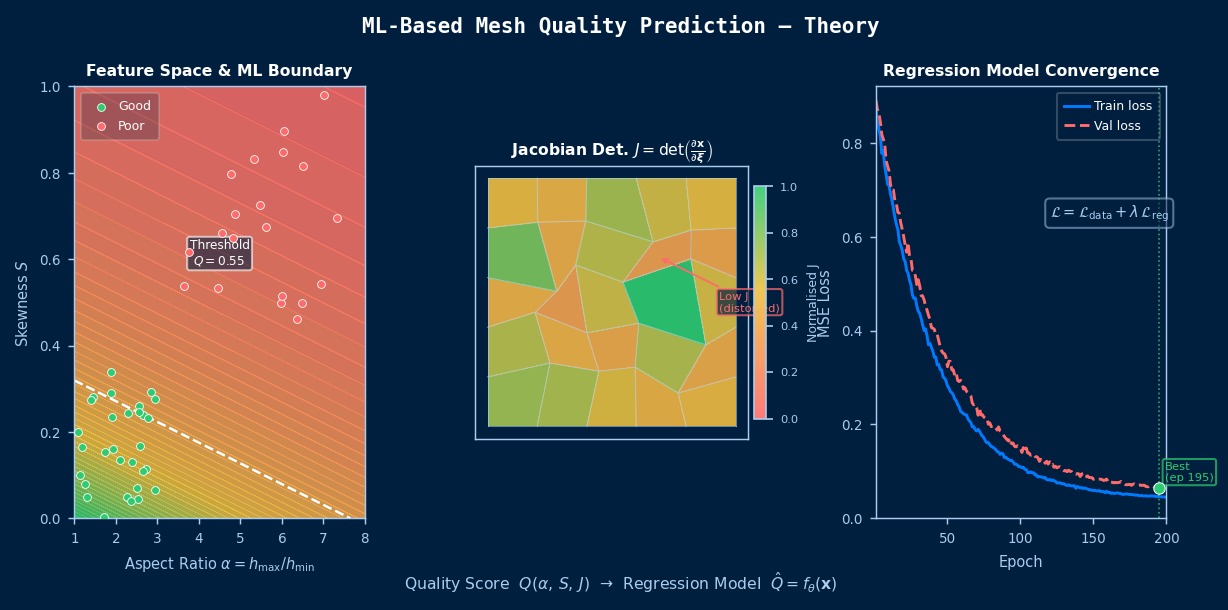
Overview
Professor! Today let us talk about the mesh quality prediction model, right? What is it about?
Mesh Quality Prediction: Theoretical Foundations
A method to predict mesh quality metrics (such as aspect ratio, skewness, etc.) in advance using ML to prevent the generation of poor-quality meshes. It performs automatic detection of quality defects and provides correction suggestions.
Governing Equations
Expressing this as an equation looks like this.
Hmm, just the equation alone doesn't really click for me... What does it represent?
Aspect Ratio and Skewness:
Your explanation is easy to understand! My confusion about aspect ratio and skewness has cleared up.
Theoretical Foundation
I've heard of "theoretical foundation," but I might not fully understand it...
The mesh quality prediction model is an important method aiming for the fusion of data-driven approaches and physics-based modeling. While computational cost is a major bottleneck in conventional CAE analysis, introducing a mesh quality prediction model can significantly improve the trade-off between computational efficiency and prediction accuracy. The mathematical foundation of this method is based on function approximation theory and statistical learning theory, with theoretical research challenges including guarantees of generalization performance and rigorous analysis of convergence. Particularly, dealing with the "curse of dimensionality" when the input dimension is high is a key practical issue, and approaches like dimensionality reduction and leveraging sparsity are important.
Application Conditions and Assumptions
Professor, please tell me about "Application Conditions and Assumptions"!
When using this method, it is necessary to consider in advance the quality and quantity of input data, the range where the model's assumptions hold, and computational resource constraints. Verification against known analytical solutions or benchmark problems is essential for confirming physical validity. Based on theoretical error evaluation, appropriately judge the balance between required accuracy and computational cost.
Details of Mathematical Formulation
Next is "Details of Mathematical Formulation"! What kind of content is this?
Shows the basic mathematical framework for applying machine learning models to CAE.
Loss Function Composition
What does "loss function composition" specifically mean?
The loss function in AI×CAE is composed as a weighted sum of a data-driven term and a physics constraint term:
Here, $\mathcal{L}_{\text{data}}$ is the squared error with observed data, $\mathcal{L}_{\text{physics}}$ is the residual of the governing equations, and $\mathcal{L}_{\text{reg}}$ is the regularization term. Adjusting the weight parameters $\lambda$ greatly affects learning stability and accuracy.
Generalization Performance and Extrapolation Problem
Please tell me about "Generalization Performance and the Extrapolation Problem"!
The biggest challenge for surrogate models is prediction accuracy outside the range of training data (extrapolation region). Incorporating physical laws can improve extrapolation performance, but complete guarantees are difficult.
Curse of Dimensionality
Please tell me about the "Curse of Dimensionality"!
When the dimension of the input parameter space is high, the required number of samples increases exponentially. Efficient sample placement through Active Learning or Latin Hypercube Sampling (LHS) is extremely important.
Assumption Conditions and Application Limits
If you use it without knowing the prerequisites, what kind of failures can occur?
- The training data sufficiently represents the physics of the analysis target.
- The relationship between input parameters and output is smooth (if there are discontinuities, domain partitioning is necessary).
- Reducing computational cost is the main objective, and conventional solvers should be used in conjunction for final verification requiring high accuracy.
- If the quality of training data (mesh-converged, V&V completed) is insufficient, the model's reliability decreases.
Ah, I see! So that's how the mechanism of training data representing the analysis target works.
Dimensionless Parameters and Dominant Scales
I've heard of "Dimensionless Parameters and Dominant Scales," but I might not fully understand it...
Understanding the dimensionless parameters governing the physical phenomenon being analyzed is the foundation for appropriate model selection and parameter setting.
- Peclet Number Pe: Relative importance of convection and diffusion. Pe >> 1 indicates convection-dominated (stabilization methods required).
- Reynolds Number Re: Ratio of inertial forces to viscous forces. A fundamental parameter for fluid problems.
- Biot Number Bi: Ratio of internal conduction to surface convection. For Bi < 0.1, the lumped capacitance method can be applied.
- Courant Number CFL: Indicator of numerical stability. For explicit methods, CFL ≤ 1 is required.
Ah, I see! So that's how the mechanism of the physical phenomenon being analyzed works.
Verification via Dimensional Analysis
Please tell me about "Verification via Dimensional Analysis"!
Dimensional analysis based on Buckingham's Π theorem is effective for order-of-magnitude estimation of analysis results. Using characteristic length $L$, characteristic velocity $U$, and characteristic time $T = L/U$, estimate the order of each physical quantity in advance to confirm the validity of the analysis results.
Classification of Boundary Conditions and Mathematical Characteristics
I've heard that if you get the boundary conditions wrong, everything fails...
| Type | Mathematical Expression | Physical Meaning | Example |
|---|---|---|---|
| Dirichlet Condition | $u = u_0$ on $\Gamma_D$ | Specification of variable value | Fixed wall, specified temperature |
| Neumann Condition | $\partial u/\partial n = g$ on $\Gamma_N$ | Specification of gradient (flux) | Heat flux, force |
| Robin Condition | $\alpha u + \beta \partial u/\partial n = h$ | Linear combination of variable and gradient | Convective heat transfer |
| Periodic Boundary Condition | $u(x) = u(x+L)$ | Spatial periodicity | Unit cell analysis |
Choosing appropriate boundary conditions is directly linked to solution uniqueness and physical validity. Insufficient boundary conditions lead to an ill-posed problem, while excessive boundary conditions create contradictions.
I've grasped the overall picture of the mesh quality prediction model! I'll try to be mindful of it in my practical work starting tomorrow.
Yeah, you're on the right track! Actually getting your hands dirty is the best way to learn. If you have any questions, feel free to ask anytime.
The "Physical Meaning" of Mesh Quality Metrics — Why Aspect Ratio Ruins Solution Accuracy
Mesh quality metrics (aspect ratio, Jacobian, skewness, etc.) are numerical values theoretically derived from finite element method error analysis. For example, when the aspect ratio (longest side/shortest side) becomes large, the element's shape function becomes biased in a specific direction, worsening the condition number of the stiffness matrix and making the solution of the simultaneous equations unstable. Theoretically, an aspect ratio ≤ 3 is recommended for many solvers, but in boundary layer meshes (near walls in fluid analysis), aspect ratios of 100 or more are intentionally allowed — because if the flow is physically parallel to the wall, the problem degenerates and computation succeeds even with low quality. When ML discriminates "poor-quality meshes," whether it can learn such "physical context-dependence" tests the true value of the algorithm.
Computational Methods for Mesh Quality Prediction
Explains numerical methods and algorithms for implementing the mesh quality prediction model.
Now I understand what my senior meant when they said, "Make sure you do the mesh quality prediction model properly."
Discretization and Calculation Procedure
How do you actually solve this equation on a computer?
As data preprocessing, normalization/standardization of input features is important. Since CAE data have vastly different scales for each physical quantity, it's necessary to appropriately choose methods like Min-Max normalization or Z-score normalization. In selecting the learning algorithm, choose an appropriate method according to data volume, dimensionality, and degree of nonlinearity.
Implementation Considerations
What is the most important thing to be careful about when using the mesh quality prediction model in practical work?
Implementation using the Python ecosystem (scikit-learn, PyTorch, TensorFlow) is common. Keys to implementation are learning acceleration via GPU parallelization, automatic hyperparameter tuning, and preventing overfitting through cross-validation. Using the HDF5 format is recommended for efficient I/O processing of large-scale CAE data.
Verification Methods
Professor, please tell me about "Verification Methods"!
It's important to use k-fold cross-validation, Leave-One-Out method, and holdout method appropriately for the purpose, and to evaluate prediction performance multidimensionally using coefficient of determination R², RMSE, MAE, and maximum error.
Now I understand what my senior meant when they said, "Make sure you do cross-validation properly."
Code Quality and Reproducibility
What is the most important thing to be careful about when using the mesh quality prediction model in practical work?
Ensure code quality and experiment reproducibility by introducing version control (Git), automated testing (pytest), and CI/CD pipelines. Strictly enforce dependency library version pinning (requirements.txt) to make rebuilding the computational environment easy. Fixing random seeds to ensure result reproducibility is also an important implementation practice.
Ah, I see! So that's how version control works.
Details of Implementation Algorithms
The implementation algorithm applies various regression and classification techniques. Key approaches include Gradient Boosting (XGBoost, LightGBM) for robust predictions, Neural Networks (Deep Learning) for capturing highly nonlinear relationships, and Ensemble Methods combining multiple models for improved stability and generalization.
This is really comprehensive! I think I have a much better understanding of the mesh quality prediction model now.
Excellent! The key is to maintain a balance between theoretical understanding and practical implementation. Always verify your results against classical analytical solutions and ensure the data quality before training any model.