PINN Fundamentals — Troubleshooting
By Sitemap
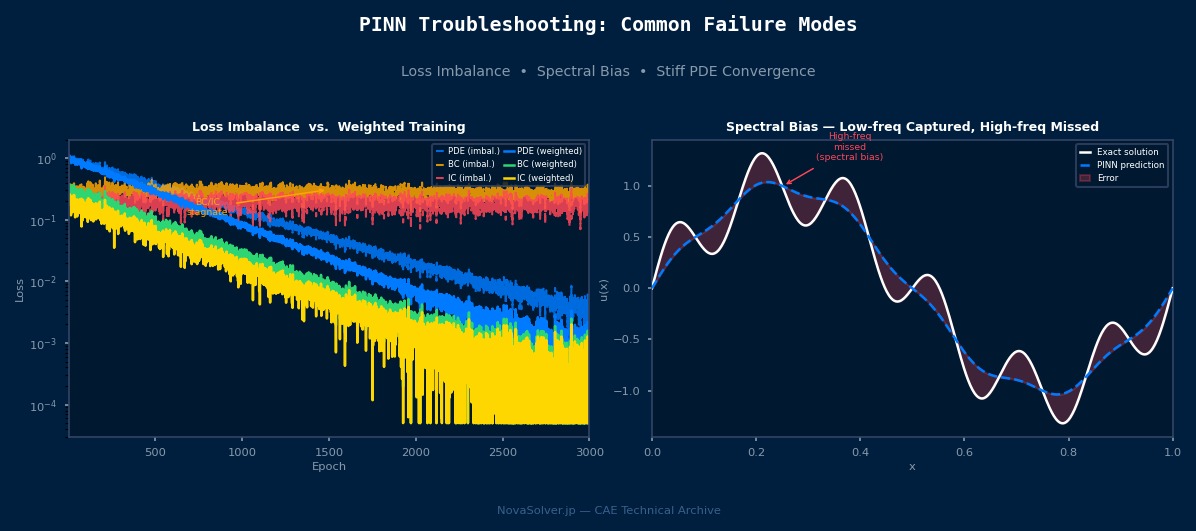
My Pinn Fundamentals simulation is giving me unexpected results — convergence issues, maybe. How do I diagnose this systematically?
Pinn Fundamentals troubleshooting follows patterns once you know what to look for. Most issues fall into three buckets: convergence failures, accuracy problems, and result misinterpretation. Let me give you a systematic diagnostic framework rather than a list of random fixes.
That framing helps. Before we dive in — what's the single most common mistake engineers make with Pinn Fundamentals?
Honestly, it's skipping the sanity checks. Engineers set up a Pinn Fundamentals model, it converges, and they trust the result without verifying it against a hand calculation or a known benchmark. The solver gives you an answer regardless of whether your model is physically correct. Always run a simplified version first.
Let's start with the physics. What's the governing equation for Pinn Fundamentals?
Pinn Fundamentals in AI-assisted CAE replaces or augments the traditional PDE solver with learned models — neural networks trained on simulation data, physics residuals, or both. The fundamental equation is:
Each term carries a specific physical meaning. Misidentifying the balance of forces, fluxes, or rates is the most common source of modelling error. Always trace units and dimensional consistency before checking any numerical results.
I see. And how does this equation get discretised for actual computation?
The continuous form is approximated over a mesh of elements or cells. For Pinn Fundamentals, the key discretisation choices are the spatial approximation order (linear, quadratic, higher), the temporal integration scheme if the problem is transient, and the boundary condition enforcement strategy. Each choice has accuracy and cost implications.
Pinn Fundamentals in AI-assisted CAE replaces or augments the traditional PDE solver with learned models — neural networks trained on simulation data, physics residuals, or both. The derivation involves:
When a Pinn Fundamentals simulation fails or produces unexpected results, follow this sequence:
My Pinn Fundamentals model converges but the results look wrong. How do I tell the difference between a solver issue and a modelling issue?
If it converges, it's almost always a modelling issue. Run a benchmark first — apply known loading to a simple geometry and compare against the analytical solution. If the benchmark passes, the physics model is correct. Then apply the benchmark procedure (same element type, same material model) to the real geometry and add complexity incrementally until results degrade.
How do I actually set this up in a real CAE tool? What are the key settings I should pay attention to?
The workflow for Pinn Fundamentals in modern CAE tools follows a fairly standard pattern: geometry import → mesh generation → physics setup → solver run → result extraction. Let me walk through the key decision points at each stage.
Typical software workflow for Pinn Fundamentals:
How do I know if my Pinn Fundamentals results are actually correct? What benchmarks should I use?
Start with published benchmarks from recognised sources — NAFEMS, ASME, and the FEA community have documented test cases with reference solutions. The NAFEMS Round Robin tests and the LE-series benchmarks are the standard starting point for structural analysis. For CFD, the NASA Turbulence Modelling Resource provides validated test cases.
Recommended validation approach for Pinn Fundamentals:
What's a realistic accuracy target for Pinn Fundamentals in engineering practice?
For stress analysis: within 5–10% of test data for simple geometries, 10–15% for complex assemblies with contact and welds. For CFD: drag coefficient within 5%, pressure drop within 10%, temperature within 5°C. For dynamics: frequency within 3%, mode shape MAC > 0.9. These are practical engineering targets, not research-grade accuracy.
As Pinn Fundamentals models grow in size and complexity, computational performance becomes a primary concern:
My Pinn Fundamentals model takes 8 hours to run. What's the fastest way to speed it up without compromising accuracy?
First check if you actually need all that fidelity. Often a 2D model or a reduced submodel gives 90% of the information at 5% of the cost. If you need the full 3D model: (1) increase element order rather than refining — quadratic elements give more accuracy per DOF than refining linear elements; (2) enable HPC parallelism — going from 4 to 32 cores typically gives 6–8× speedup; (3) use in-core direct solvers if RAM permits — they're often 3× faster than iterative solvers for structural problems under $10^7$ DOF.
The real value of Pinn Fundamentals analysis comes from integration with the design-engineering workflow:
Where should I go to learn more about Pinn Fundamentals beyond what we've covered?
For theoretical depth: the textbooks by Zienkiewicz & Taylor (FEM), Ferziger & Perić (CFD), or Bathe (FEA) are the standards depending on your domain. For AI-Assisted CAE specifically, the NAFEMS knowledge base and the IACM Computational Mechanics journal are excellent peer-reviewed sources. For practical workflow: the software vendor training courses are surprisingly good — they're designed for engineers, not mathematicians.
Recommended resources for Pinn Fundamentals in AI-Assisted CAE: