Hemodynamic Simulation
Category: 解析 | Integrated 2026-04-06
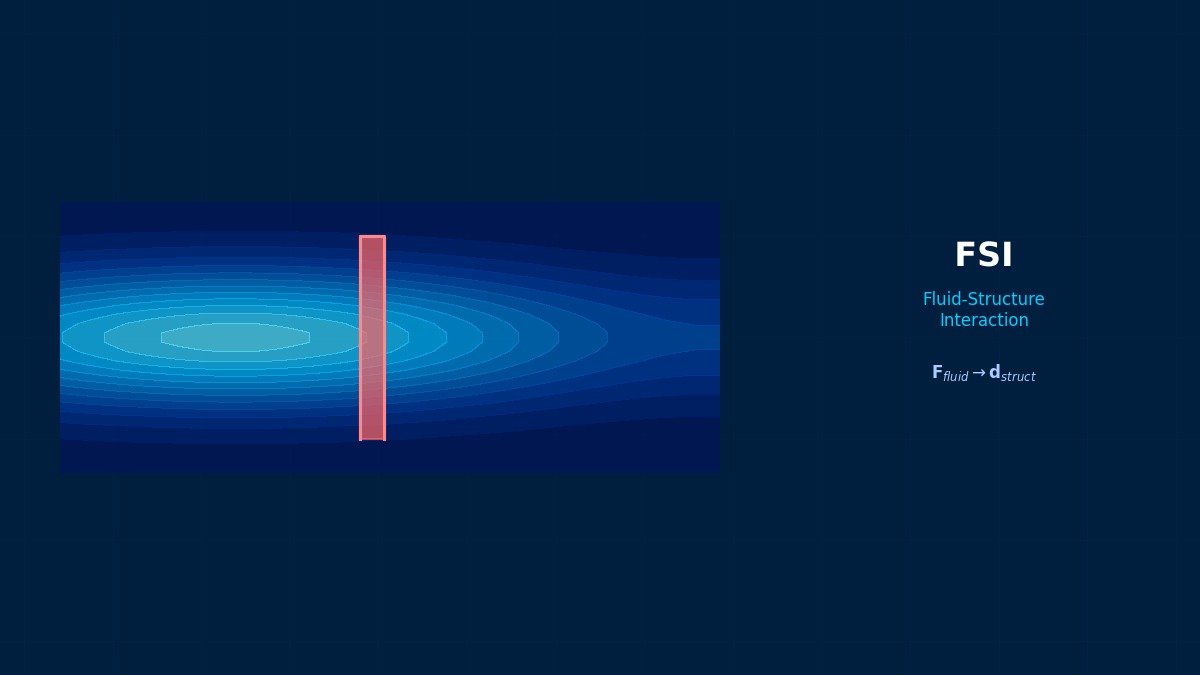
CAE visualization for hemodynamics theory - technical simulation diagram
血行動態シミュレーション

Theory and Physics

Overview of Hemodynamic FSI

🧑‍🎓

In what situations is FSI necessary for blood flow simulation inside blood vessels?


🎓

For evaluating aneurysm rupture risk, predicting restenosis after stent placement, designing coronary artery bypass grafts, etc. Blood vessel walls are elastic bodies and deform radially by 5-10% with pulsation. This wall deformation affects the blood flow pattern, making FSI necessary.


Governing Equations

🧑‍🎓

How is the mechanics of the blood vessel wall modeled?


🎓

The blood vessel wall is treated as a nonlinear hyperelastic material. The Holzapfel-Gasser-Ogden model is widely used.


$$ W = \frac{\mu}{2}(I_1 - 3) + \sum_{i=1}^{2} \frac{k_1}{2k_2} \left[ e^{k_2(\kappa I_1 + (1-3\kappa)I_4^{(i)} - 1)^2} - 1 \right] $$

Here, $\mu$ is the matrix stiffness, $k_1, k_2$ are collagen fiber stiffness parameters, and $I_4^{(i)}$ is the pseudo-invariant in the fiber direction.


🧑‍🎓

Is the fluid side the incompressible Navier-Stokes equations?


🎓

That's correct. It is described in the ALE frame.


$$ \rho_f \left( \frac{\partial \mathbf{u}}{\partial t}\bigg|_{ALE} + ((\mathbf{u} - \mathbf{w}) \cdot \nabla)\mathbf{u} \right) = -\nabla p + \nabla \cdot \boldsymbol{\tau} $$

In large vessels, blood is often approximated as a Newtonian fluid ($\mu \approx 3.5$ mPa·s), but in low shear rate regions, non-Newtonian models like the Carreau-Yasuda model are necessary.


$$ \mu(\dot{\gamma}) = \mu_\infty + (\mu_0 - \mu_\infty)(1 + (\lambda \dot{\gamma})^a)^{(n-1)/a} $$
Coffee Break Casual Talk

Blood is a "Non-Newtonian Fluid" – A Mysterious Liquid Whose Viscosity Changes with Flow Velocity

The fluids first learned in engineering are "Newtonian fluids" like water and air, but blood is completely different. Blood is a non-Newtonian fluid whose viscosity changes with shear rate (the gradient of flow velocity); it has high viscosity at low flow rates and low viscosity at high flow rates. This is because red blood cells overlap each other at low flow rates (forming rouleaux) and disperse/align at high flow rates, reducing resistance. In capillaries (diameter ~8μm), red blood cells (diameter ~7μm) pass through in a single file, and blood behaves almost like a particle march rather than a viscous fluid. When calculating blood flow with CFD, the decision to use a non-Newtonian viscosity model like the Carreau-Yasuda model or simply use a Newtonian approximation (μ≈3.5 mPa·s) depends on the vascular site and flow rate region being analyzed.

Physical Meaning of Each Term
  • Structure-Thermal Coupling Term: Thermal expansion due to temperature changes induces structural deformation, and the deformation affects the temperature field. $\sigma = D(\varepsilon - \alpha \Delta T)$. 【Everyday Example】Railroad tracks expanding in summer, narrowing the gaps – a classic example of temperature rise → Thermal Expansion → stress generation. Warping of electronic circuit boards after soldering is also due to differences in thermal expansion coefficients of different materials. Engine cylinder blocks experience thermal stress from temperature differences between hot and cold parts, potentially leading to cracks.
  • Fluid-Structure Interaction (FSI) Term: Bidirectional interaction where fluid pressure/shear forces deform the structure, and structural deformation changes the fluid domain. 【Everyday Example】Suspension bridge cables vibrating in strong wind (Vortex-Induced Vibration) – wind forces shake the structure, the shaken structure alters the wind flow, further amplifying vibration. Blood flow in the heart and elastic deformation of vessel walls, aircraft wing flutter (aeroelastic instability) are also typical FSI problems. One-way coupling may suffice in some cases, but bidirectional coupling is essential for large deformations.
  • Electromagnetic-Thermal Coupling Term: A feedback loop where Joule heating $Q = J^2/\sigma$ causes temperature rise, and temperature change alters electrical resistance. 【Everyday Example】Nichrome wire in an electric stove heats up (Joule heat) and glows red when current flows – temperature rise changes resistance, altering current distribution. Eddy current heating in IH cooking heaters, increased sag in power lines due to temperature rise are also examples of this coupling.
  • Data Transfer Term: Resolves mesh mismatch between different physical fields via interpolation. 【Everyday Example】When calculating "feels-like temperature" by combining "temperature data" and "wind data" in weather forecasting, interpolation is needed if observation points differ – similarly in CAE coupled analysis, structural mesh and CFD mesh generally don't match, so data transfer (interpolation) accuracy at the interface directly affects result reliability.
Assumptions and Applicability Limits
  • Weak Coupling Assumption (One-way coupling): Valid when one physical field affects the other but the reverse is negligible.
  • Cases requiring Strong Coupling: Large deformations in FSI, strong temperature dependence in electromagnetic-thermal coupling.
  • Time Scale Separation: When characteristic times of each physical field differ greatly, efficiency can be improved via subcycling.
  • Interface Condition Consistency: Ensure energy/momentum conservation at the coupling interface is satisfied numerically.
  • Non-applicable Cases: When three or more physical fields are strongly coupled simultaneously, monolithic methods may be necessary.
Dimensional Analysis and Unit Systems
VariableSI UnitNotes / Conversion Memo
Thermal Expansion Coefficient $\alpha$1/KSteel: ~12×10⁻⁶, Aluminum: ~23×10⁻⁶
Coupling Interface ForceN/m² (Pressure) or N (Concentrated Force)Check force balance between fluid and structure sides.
Data Transfer ErrorDimensionless (%)Interpolation accuracy depends on mesh density ratio. Below 5% is a guideline.

Numerical Methods and Implementation

Stabilized Finite Element Method

🧑‍🎓

I heard SUPG/PSPG stabilization is needed for blood flow CFD. Why?


🎓

Equal-order interpolation (P1-P1) does not satisfy the inf-sup condition, leading to spurious oscillations in pressure. Adding SUPG/PSPG stabilization yields stable solutions.


$$ \sum_e \int_{\Omega_e} \tau_{SUPG} (\mathbf{u} \cdot \nabla \mathbf{w}) \cdot \mathbf{R} \, d\Omega = 0 $$

🎓

Local Reynolds numbers are high near vessel bifurcations and stents, so the design of stabilization parameters directly affects computational stability.


Coupling Algorithm

🧑‍🎓

Is weak coupling sufficient for vascular FSI?


🎓

Blood vessel walls are thin and the added mass effect is significant, so weak coupling tends to diverge easily. Robin-Neumann splitting or Monolithic methods are recommended. Semi-implicit coupling methods using Generalized Robin conditions are gaining attention.


$$ \alpha_f \mathbf{u}_f + \boldsymbol{\sigma}_f \cdot \mathbf{n} = \alpha_f \dot{\mathbf{d}}_s + \boldsymbol{\sigma}_s \cdot \mathbf{n} $$

Image-Based Modeling Workflow

🧑‍🎓

Please explain the workflow from clinical images to mesh creation.


🎓

1. Acquisition of CT angiography or MRA

2. Segmentation (Mimics, ITK-SNAP, 3D Slicer)

3. Surface smoothing and defect repair

4. Volume mesh generation (TetGen, VMTK, ICEM CFD)

5. Boundary layer mesh insertion (VMTK's boundary layer function)

6. Identification of inlet/outlet surfaces and addition of extension tubes


VMTK (Vascular Modeling Toolkit) is a dedicated OSS for blood vessels, capable of integrated processing from centerline extraction to boundary layer meshing.

Coffee Break Casual Talk

The Surprising Reason Why the Lattice Boltzmann Method (LBM) is Suitable for Blood Flow Analysis

The Lattice Boltzmann Method (LBM) has recently gained attention as a numerical method for blood flow analysis. It takes a completely different approach from conventional CFD (finite volume solution of Navier-Stokes equations), treating fluid as a "statistical distribution of virtual particles." Why is it suitable for blood flow? It excels at calculating suspension fluids with complex-shaped particles like red blood cells, and mesh generation is significantly easier compared to conventional methods. For capillary-level calculations, particle-resolved computation tracking individual red blood cells with LBM is possible. A group at Tohoku University performed the world's first LBM calculation of capillary networks (diameter 5-10μm) on the supercomputer "Fugaku," reproducing red blood cell flow in a model exceeding 500 million cells.

Monolithic Method

Solves all physical fields simultaneously as a single system of equations. Stable for strong coupling but complex to implement and memory-intensive.

Partitioned Method (Partitioned Iterative Method)

Solves each physical field independently, exchanging data at the interface. Easy to implement and can utilize existing solvers. Suitable for weak coupling.

Interface Data Transfer

Nearest neighbor (simplest but low accuracy), projection (conservative), RBF interpolation (robust to mesh mismatch). Balance between conservation and accuracy is important.

Sub-iteration

Performs sufficient iterations within each coupling step to ensure interface condition consistency. Residual criteria are scaled based on typical values of each physical field.

Aitken Relaxation

Automatically adjusts the relaxation coefficient for coupling iterations. An adaptive method that prevents divergence from over-relaxation and accelerates convergence.

Stability Condition

Beware of the added mass effect (in fluid-structure coupling when structural density ≈ fluid density). If unstable, apply Robin-type interface conditions or the IQN-ILS method.

Analogy for Aitken Relaxation

Aitken relaxation is like "balancing a seesaw." If one side pushes too hard, the other side flies up, and the recoil causes it to push too hard again – Aitken relaxation automatically adjusts the pushing force to suppress this oscillation. It's an adaptive method that automatically adjusts the next correction amount based on the previous correction when coupling iterations oscillate and fail to converge.

Practical Guide

Boundary Condition Settings

🧑‍🎓

How are the inlet and outlet boundary conditions set?


🎓

Flow rate waveforms obtained from 4D Flow MRI or Doppler echo are set at the inlet. The Womersley solution is often used for the initial profile.


$$ u(r,t) = \sum_{n=0}^{N} \hat{u}_n(r) e^{in\omega t} $$

The larger the Womersley number $\alpha = R\sqrt{\omega/\nu}$ (in the aorta, $\alpha \approx 15$), the flatter the profile becomes.


🧑‍🎓

How is the Windkessel model at the outlet set?


🎓

Use a 3-element Windkessel, setting proximal resistance $R_p$, distal resistance $R_d$, and Compliance $C$. For multiple outlets, flow distribution is based on the cube of the diameter ratio according to Murray's law.


$$ \frac{Q_1}{Q_2} = \left( \frac{D_1}{D_2} \right)^3 $$

Wall Shear Stress Evaluation Metrics

🧑‍🎓

What kind of metrics are looked at in the results?


🎓

Time-Averaged Wall Shear Stress (TAWSS) and Oscillatory Shear Index (OSI) are representative.


$$ \text{TAWSS} = \frac{1}{T} \int_0^T |\boldsymbol{\tau}_w| \, dt $$
$$ \text{OSI} = \frac{1}{2} \left( 1 - \frac{|\int_0^T \boldsymbol{\tau}_w \, dt|}{\int_0^T |\boldsymbol{\tau}_w| \, dt} \right) $$

Areas with low TAWSS (< 0.4 Pa) and high OSI (> 0.3) are considered high risk for atherosclerosis. FDA guidance also recommends these evaluations.

Coffee Break Casual Talk

Identifying "Dangerous Spots" in Cerebral Aneurysms with CFD – The Forefront of Clinical Application

Research is advancing to evaluate the rupture risk of cerebral aneurysms (a cause of subarachnoid hemorrhage) using blood flow simulation. Patient-specific 3D models are created from MRI/CT angiography, and wall shear stress (WSS) is calculated with CFD. In areas with extremely low WSS (below 0.4 Pa is a guideline), endothelial cells are prone to degeneration, increasing the risk of aneurysm wall thinning. In joint research with the University of Tokyo and Keio University Hospital, calculating the "area ratio of low WSS regions" with CFD reportedly enabled pre-discrimination between ruptured and unruptured aneurysms with about 80% accuracy. Blood flow analysis is beginning to provide quantitative evidence for difficult decisions like "should we operate or monitor?"

Analogy for Analysis Flow

Have you ever blown up a balloon? At that moment, a sophisticated fluid-structure interaction is actually occurring. Internal air pressure (fluid) pushes and expands the rubber wall (structure) → the expanded wall changes the internal pressure distribution → the changed pressure further deforms the wall... FSI analysis repeats this catch-and-throw at each computational step.

Pitfalls Beginners Easily Fall Into

"One-way coupling should be enough, right?" – This misjudgment is the most dangerous in coupled analysis. If structural deformation is微小, one-way may indeed suffice. But in cases like heart valve opening/closing where deformation significantly alters the flow path, one-way coupling is completely inadequate. A rule of thumb is "does the deformation exceed 1% of the characteristic length?" If it does, bidirectional coupling is mandatory. If you settle for one-way, the result can be "plausible but actually completely wrong" – this is the scariest pattern.

Way of Thinking About Boundary Conditions

Data exchange at coupling interfaces is like "border control." Each country (physical field) has its own laws (governing equations), but if the exchange of people and goods (force, temperature, displacement) at the border (interface) is not managed accurately, the economies (energy balance) of both countries collapse. Interpolation when meshes don't match is like a "translator" – the smaller the mistranslation (interpolation error), the better the result.

Software Comparison

Comparison of Hemodynamic Analysis Tools

🧑‍🎓

What tools are available for FSI analysis of hemodynamics?


🎓

There is a wide range from dedicated tools to general-purpose solvers.


関連シミュレーター

この分野のインタラクティブシミュレーターで理論を体感しよう

シミュレーター一覧

関連する分野

構造解析電磁界解析熱解析
この記事の評価
ご回答ありがとうございます!
参考に
なった
もっと
詳しく
誤りを
報告
参考になった
0
もっと詳しく
0
誤りを報告
0
Written by NovaSolver Contributors
Anonymous Engineers & AI — サイトマップ
About the Authors
ToolTypeFSI SupportFeatures
SimVascularOSS (Stanford Univ.)CMM MethodDedicated to blood vessels. Integrated pipeline from image → Mesh → FSI.
CRIMSONOSS (Univ. of Michigan)YesDerived from SimVascular. Rich GUI.
ANSYS Fluent