Propeller Cavitation FSI
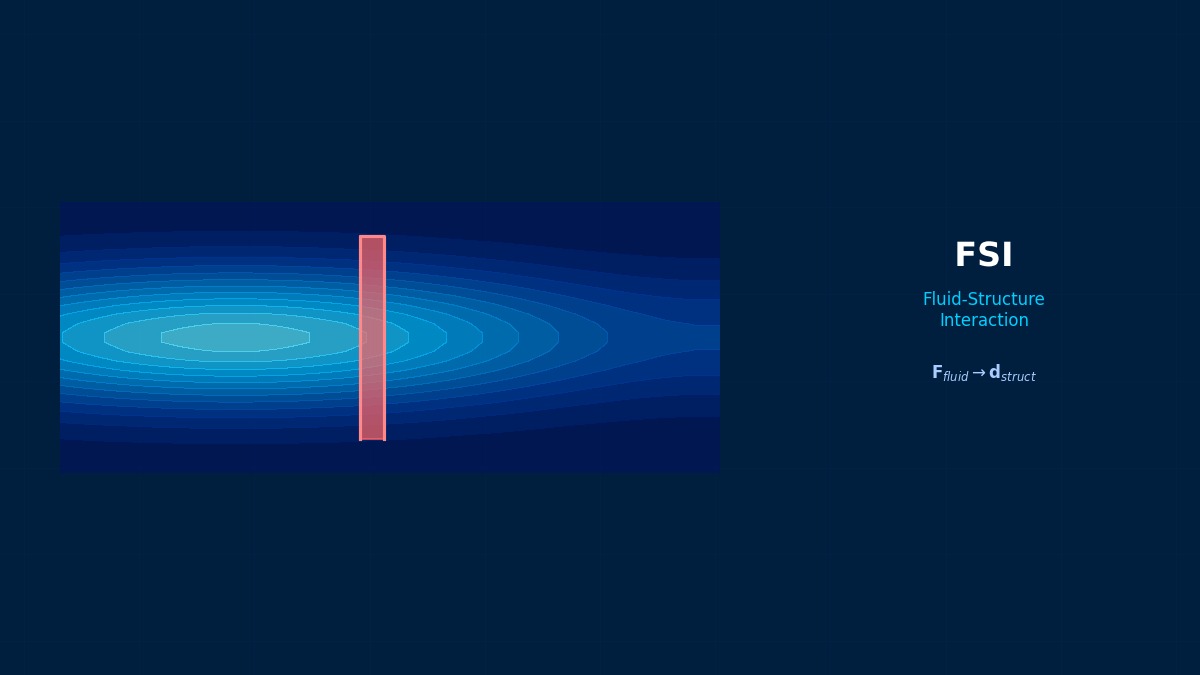
Propeller Cavitation FSI: Theoretical Foundations
Overview of Cavitation FSI
Why is FSI necessary for propeller cavitation?
Cavitation (cavitation phenomenon) causes unsteady pressure fluctuations to act on the propeller blade surface, leading to blade vibration, erosion, and noise. Because the elastic deformation of the blade changes the cavitation pattern, fluid-structure interaction is required.
Governing Equations
What is the mathematical model for cavitation like?
The homogeneous mixture flow model is widely used. It solves the Navier-Stokes equations using the mixture density of the liquid and vapor phases. The cavitation number is,
$p_v$ is the vapor pressure. Phase transition is described by a mass transfer model based on the Rayleigh-Plesset equation. The Schnerr-Sauer model and Zwart-Gerber-Belamri model are representative.
$\alpha$ is the vapor volume fraction, $\dot{m}^+, \dot{m}^-$ are the mass transfer rates for evaporation and condensation.
How is the structural side modeled?
Propeller blades are modeled with shell elements or solid elements. For composite propellers (CFRP, etc.), an anisotropic material model considering the laminate configuration is required. Data transfer at the FSI interface is performed on the wet surface.
Cavitation Number σ—A Single Dimensionless Number Determines Fate
The first thing a propeller designer calculates is the cavitation number σ = (p∞ - pv)/(½ρU²). Bubbles start to form when σ falls below around 1, and when it drops below 0.3, the propeller enters "supercavitation," where the entire surface is enveloped in vapor. Interestingly, torpedoes that deliberately utilize supercavitation (like Russia's "Shkval") have achieved speeds of 340 km/h underwater—over four times the speed of conventional torpedoes. A phenomenon that should be absolutely avoided in civilian vessels becomes a weapon's secret technique depending on how it's used—this reversal of thinking is also the appeal of cavitation theory.
Computational Methods for Propeller Cavitation FSI
FSI Handling for Rotating Bodies
How is FSI for a rotating propeller handled?
Set up the rotating fluid domain using a sliding mesh / rotating reference frame. For FSI coupling, the propeller blade surface is set as the interface, and structural analysis is performed in the rotating coordinate system.
In Ansys Fluent, it is standard to switch from steady-state calculation using MRF (Moving Reference Frame) to unsteady calculation with sliding mesh. Sliding mesh is essential to capture the unsteady nature of cavitation.
Cavitation Model Settings
How are the parameters for the cavitation model set?
For the Schnerr-Sauer model, the bubble number density $n_b$ is the key parameter. The default is $n_b = 10^{13}$ /m³, but tuning based on comparison with experiments is sometimes necessary.
| Parameter | Schnerr-Sauer | Zwart-Gerber-Belamri |
|---|---|---|
| Nucleation density/radius | $n_b = 10^{13}$ /m³ | $R_b = 10^{-6}$ m |
| Evaporation coefficient | 1.0 | $F_{vap} = 50$ |
| Condensation coefficient | 1.0 | $F_{cond} = 0.01$ |
| Saturation vapor pressure | Temperature dependent | Temperature dependent |
What about time step settings?
360 to 720 steps per propeller revolution (0.5° to 1.0°/step) is recommended. Since the cavitation collapse process is extremely fast, CFL < 1 is desirable locally.
BEM and CFD—The "Dual-Wielding" Strategy for Propeller Analysis
Boundary Element Method (BEM) and CFD have long been used together for propeller fluid analysis. BEM, based on potential flow theory, is extremely fast and suitable for sweeping hundreds of conditions in the initial design stage. On the other hand, LES (Large Eddy Simulation) in CFD can capture bubble generation and collapse in cavitation, but takes hundreds of CPU hours per case. In actual ship design, the standard approach is a three-stage process: "rough exploration with BEM → detailed investigation with CFD → verification with tank testing." Recently, hybrid methods using BEM results as initial conditions for CFD are increasing, with cases showing total analysis time reductions of 30-40% compared to conventional methods.
Propeller Cavitation FSI in Practice
Analysis Procedure
What is the practical procedure for propeller cavitation FSI analysis?
1. Obtain CAD data for propeller blade geometry.
2. Generate fluid mesh (rotating domain + stationary domain).
3. Create structural FE model (blade only. Hub is rigid).
4. Verify FSI operation under wet-non-cavitating conditions.
5. Enable cavitation model and perform main calculation.
6. Evaluate thrust/torque coefficients and cavitation pattern.
How fine does the mesh need to be?
A $y^+$ of 1 or less on the blade surface is desirable. Areas around the blade tip and leading edge, which are origins of cavitation, should be refined in particular.
| Region | Element Size Guideline |
|---|---|
| Blade surface boundary layer | $y^+ < 1$, 15+ layers |
| Tip vortex region | Chord length / 100 |
| Wake region | Chord length / 50 |
| Far field | Chord length / 5 |
What benchmark problems are available for verification?
The PPTC propeller (Potsdam Propeller Test Case) is the standard benchmark by ITTC (International Towing Tank Conference). Measured values for cavitation pattern, thrust coefficient $K_T$, and torque coefficient $K_Q$ are publicly available.
Propeller Replacement on Large Tankers—On-site "Sound" Diagnosis
Veteran marine engineers say, "You can tell propeller cavitation by sound." Normally, there is a low, gentle rotation sound, but when cavitation occurs, abnormal noises like "crackling" or "grinding" can be heard from the stern. In reality, for a 300,000-ton VLCC (Very Large Crude Carrier), the propeller diameter can be over 9 meters, with a rotation speed of only about 90 RPM. Even so, if cavitation occurs, erosion holes over 1 cm deep can form on the blade surface in three months. Predicting erosion amount through simulation and optimizing dry-docking timing could lead to cost savings of tens of millions of yen per year.
Propeller Cavitation FSI: Software & Solver Comparison
Tool Comparison
What software can be used for propeller cavitation FSI?
| Tool | Cavitation Model | FSI | Features |
|---|---|---|---|
| Ansys Fluent | Schnerr-Sauer, Zwart | System Coupling | Extensive track record in rotating body FSI |
| STAR-CCM+ | Schnerr-Sauer | Built-in FSI | Polyhedral Mesh. Strong in maritime industry. |
| OpenFOAM (interPhaseChangeFoam) | Merkle, Kunz, etc. | preCICE coupling | OSS. Free customization. |
| FINE/Marine (Cadence) | Merkle | FSI capable | Formerly NUMECA. Dedicated to marine CFD. |
| HydroStar + NASTRAN | BEM (Potential) | Mode superposition | Simplified FSI. Suitable for initial design. |
Related Topics
Experience the theory firsthand with the interactive simulator for this field
All Simulators