Cavitation

Category: 流体解析(CFD) | Integrated 2026-04-06
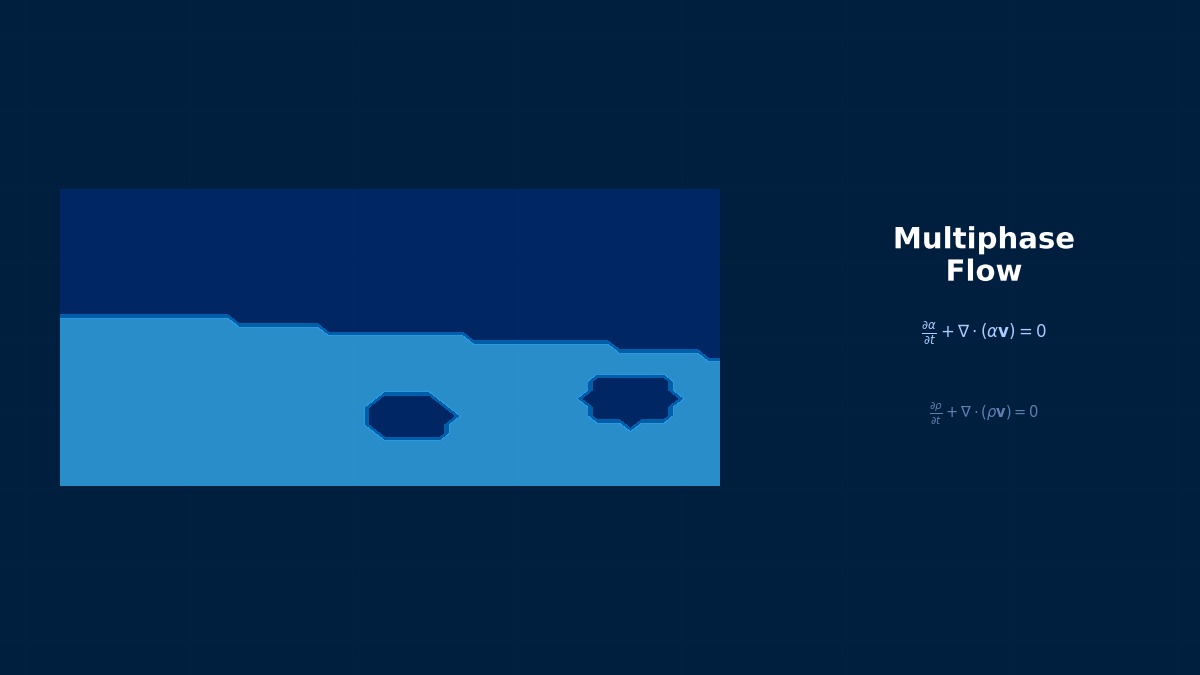
CAE visualization for cavitation theory - technical simulation diagram
キャビテーション

Theory and Physics

Overview

🧑‍🎓

Professor, cavitation is the phenomenon where bubbles form in water, right?


🎓

Cavitation is a phenomenon where vapor cavities (cavities) form in a liquid when the local pressure of the liquid falls below its saturated vapor pressure. It occurs in high-speed flow fields such as pump impellers, ship propellers, and valve constrictions.


🧑‍🎓

Is it different from boiling?


🎓

Boiling is driven by temperature increase, while cavitation is driven by pressure decrease. In cavitation, when bubbles move to a high-pressure region, they collapse rapidly, generating shock waves of thousands of atmospheres and localized high-temperature spots. This causes erosion.


Governing Equations

🧑‍🎓

What models are used in CFD?


🎓

First, the cavitation number is the fundamental parameter.


$$ \sigma = \frac{p_{\infty} - p_v}{\frac{1}{2} \rho_l U_{\infty}^2} $$

🎓

In CFD, the homogeneous mixture model is mainstream, adding source terms to the transport equation for vapor volume fraction $\alpha_v$.


$$ \frac{\partial (\alpha_v \rho_v)}{\partial t} + \nabla \cdot (\alpha_v \rho_v \mathbf{u}) = \dot{m}^+ - \dot{m}^- $$

🧑‍🎓

What types of source term models are there?


🎓

Let's compare typical cavitation models.


ModelBasic ConceptFeatures
Schnerr-SauerBased on Rayleigh-Plesset equationBubble number density $n_0$ is a parameter
Zwart-Gerber-BelamriSimplified RP equationFluent standard, controlled by adjustment coefficients
Singhal (Full Cavitation)Mass transportConsiders non-condensable gas (dissolved air)
KunzBased on artificial compressibilitySuitable for steady-state calculations
🎓

The underlying Rayleigh-Plesset equation describes the growth of a spherical bubble.


$$ R \ddot{R} + \frac{3}{2} \dot{R}^2 = \frac{p_v - p}{\rho_l} - \frac{4 \nu_l \dot{R}}{R} - \frac{2 \sigma_s}{\rho_l R} $$

🎓

The 4th term is viscous damping, the 5th term is surface tension. In CFD models, the evaporation rate is derived from a simplified form ignoring the second-order and viscous terms.


🧑‍🎓

How is the bubble number density $n_0$ determined?


🎓

For general water, $n_0 = 10^{13}$ /m³ is the default value. In the Schnerr-Sauer model, the bubble radius is found using $R_B = \left(\frac{3\alpha_v}{4\pi n_0}\right)^{1/3}$, and the evaporation rate is calculated.


Coffee Break Trivia

Bubbles That Break Propellers—The Moment Cavitation Changed History

In 1893, the British destroyer "Daring" failed to reach its design speed, and mysterious damage kept occurring on its propeller. The phenomenon discovered by Osborne Reynolds and his successors investigating this was "cavitation." When local pressure falls below the vapor pressure of water (2.3 kPa at 20°C), vapor bubbles form, and upon collapse, they generate shock pressures of hundreds of MPa, eroding the propeller material. This discovery led to the definition of the cavitation number σ = (p-pv)/(0.5ρu²), a dimensionless number that forms the foundation of modern hydraulic machinery design.

Physical Meaning of Each Term
  • Temporal term $\partial(\rho\phi)/\partial t$: Imagine the moment you turn on a faucet. At first, water comes out in an unstable, spluttering manner, but after a while, it becomes a steady flow, right? This "during the change" is described by the temporal term. The pulsation of blood flow from a heartbeat, or the flow fluctuation each time an engine valve opens and closes—all are unsteady phenomena. So what is steady-state analysis? It looks only at "after sufficient time has passed and the flow has settled down"—meaning this term is set to zero. Since computational cost is significantly reduced, solving first with a steady-state approach is a basic CFD strategy.
  • Convection term $\nabla \cdot (\rho \mathbf{u} \phi)$: What happens if you drop a leaf into a river? It gets carried downstream by the flow, right? This is "convection"—the effect where fluid motion transports things. Warm air from a heater reaching the far end of a room is also because the "carrier," air, transports heat via convection. Here's the interesting part—this term contains "velocity × velocity," making it nonlinear. That is, as the flow becomes faster, this term rapidly strengthens, making control difficult. This is the root cause of turbulence. A common misconception: "Convection and conduction are similar things" → They are completely different! Convection is carried by flow, conduction is transmitted by molecules. There is an order of magnitude difference in efficiency.
  • Diffusion term $\nabla \cdot (\Gamma \nabla \phi)$: Have you ever put milk in coffee and left it? Even without stirring, after a while, they naturally mix. That's molecular diffusion. Now, next question—honey and water, which flows more easily? Obviously water, right? Honey has high viscosity ($\mu$), so it flows poorly. When viscosity is large, the diffusion term becomes strong, and the fluid moves in a "thick" manner. In low Reynolds number flows (slow, viscous), diffusion is dominant. Conversely, in high Re number flows, convection overwhelms, and diffusion plays a supporting role.
  • Pressure term $-\nabla p$: When you push the plunger of a syringe, liquid shoots out forcefully from the needle tip, right? Why? Because the piston side is high pressure, the needle tip is low pressure—this pressure difference provides the force that pushes the fluid. Dam discharge works on the same principle. On a weather map, where isobars are densely packed? That's right, strong winds blow. "Where there is a pressure difference, flow is generated"—this is the physical meaning of the pressure term in the Navier-Stokes equations. A point of confusion here: The "pressure" in CFD is often gauge pressure, not absolute pressure. If results become strange immediately after switching to compressible analysis, it might be due to confusion between absolute/gauge pressure.
  • Source term $S_\phi$: Heated air rises—why? Because it becomes lighter (lower density) than its surroundings, so it is pushed up by buoyancy. This buoyancy is added to the equation as a source term. Other examples: chemical reaction heat from a gas stove flame, Lorentz force acting on molten metal in a factory's electromagnetic pump... These are all actions that "inject energy or force into the fluid from the outside," expressed by source terms. What happens if you forget a source term? In natural convection analysis, if you forget to include buoyancy, the fluid doesn't move at all—you get a physically impossible result like warm air not rising in a room with the heater on in winter.
Assumptions and Applicability Limits
  • Continuum assumption: Valid for Knudsen number Kn < 0.01 (mean free path of molecules ≪ characteristic length)
  • Newtonian fluid assumption: Shear stress and strain rate have a linear relationship (non-Newtonian fluids require viscosity models)
  • Incompressibility assumption (for Ma < 0.3): Treat density as constant. For Mach numbers above 0.3, consider compressibility effects
  • Boussinesq approximation (Natural Convection): Density variation is considered only in the buoyancy term, using constant density in other terms
  • Non-applicable cases: Rarefied gas (Kn > 0.1), supersonic/hypersonic flow (shock wave capturing required), free surface flow (VOF/Level Set, etc. required)
Dimensional Analysis and Unit Systems
VariableSI UnitNotes / Conversion Memo
Velocity $u$m/sWhen converting from volumetric flow rate for inlet conditions, pay attention to cross-sectional area units
Pressure $p$PaDistinguish between gauge pressure and absolute pressure. Use absolute pressure for compressible analysis
Density $\rho$kg/m³Air: approx. 1.225 kg/m³@20°C, Water: approx. 998 kg/m³@20°C
Viscosity coefficient $\mu$Pa·sBe careful not to confuse with kinematic viscosity coefficient $\nu = \mu/\rho$ [m²/s]
Reynolds number $Re$Dimensionless$Re = \rho u L / \mu$. Indicator for laminar/turbulent transition
CFL numberDimensionless$CFL = u \Delta t / \Delta x$. Directly related to time step stability

Numerical Methods and Implementation

Details of Numerical Methods

🧑‍🎓

What are the numerical key points in cavitation analysis?


🎓

In vapor regions, the speed of sound of the mixture drastically decreases, making compressibility effects significant. The speed of sound for a water/vapor mixture can be much lower than that of pure water (approx. 1500 m/s), sometimes dropping to a few m/s.


🎓

Therefore, the pressure-density coupling is strong, and the Coupled algorithm is recommended for pressure-based solvers. Density-based solvers can sometimes be more stable.


Selection of Turbulence Models

🧑‍🎓

Which turbulence model should I use?


🎓

The standard k-ε model overestimates turbulent viscosity and suppresses the unsteadiness of cavities. The Reboud correction is effective.


$$ \mu_t = f(\rho) C_\mu \frac{k^2}{\varepsilon}, \quad f(\rho) = \rho_v + \frac{(\rho - \rho_v)^n}{(\rho_l - \rho_v)^{n-1}} $$

🎓

With $n \approx 10$, turbulent viscosity in the mixing region is reduced, allowing reproduction of cavity shedding. SST k-ω also shows good results in cavitation analysis.


🎓

To capture the details of unsteady cloud cavitation, DES, DDES, or LES is required.


Solver Settings

ParameterRecommended ValueReason
Pressure-Velocity CouplingCoupledStrong pressure-density coupling
Spatial Discretization2nd order or higherResolution of cavity shape
Interface Courant Number< 0.5Capturing bubble growth/collapse
Reference PressureAbsolute pressure basisFor comparison with vapor pressure

Implementation in OpenFOAM

🧑‍🎓

Which solver is used in OpenFOAM?


🎓

interPhaseChangeFoam is the cavitation-capable VOF solver. Specify the model in constant/transportProperties. You can choose from SchnerrSauer, Kunz, and Merkle.


Settings in Fluent

🧑‍🎓

Please also tell me about the key points on the Fluent side.


🎓

Select VOF or Mixture in the Multiphase Model and enable the Cavitation Model. Zwart-Gerber-Belamri is the default, with evaporation coefficient $F_{evap} = 50$ and condensation coefficient $F_{cond} = 0.01$ as standard values. The asymmetric coefficients reflect that collapse is more rapid than evaporation.


Coffee Break Trivia

Schnerr-Sauer vs Zwart—The Reality of Cavitation Model Selection

In CFD cavitation analysis, the choice of mass transport model is always a topic of discussion. The Schnerr-Sauer model rigorously derives the volume change of a single bubble from the Rayleigh equation and has the advantage of not requiring specification of nucleation density. On the other hand, the Zwart model is the Fluent standard with a wide track record and can reproduce hysteresis behavior through asymmetric evaporation/condensation coefficients (Ce=0.02, Cc=0.01). In pump inducer validation, even with the same mesh, the predicted cavitation inception σ can differ by more than 20% between the two models, making it dangerous to choose a model without matching experimental values.

Upwind Scheme

1st order upwind: Large numerical diffusion but stable. 2nd order upwind: Improved accuracy but risk of oscillation. Essential for high Reynolds number flows.

Central Differencing

2nd order accuracy, but numerical oscillations occur for Pe number > 2. Suitable for low Reynolds number diffusion-dominated flows.

TVD Schemes (MUSCL, QUICK, etc.)

Suppress numerical oscillations while maintaining high accuracy through limiter functions. Effective for capturing shock waves and steep gradients.

Finite Volume Method vs Finite Element Method

FVM: Naturally satisfies conservation laws. Mainstream in CFD. FEM: Advantageous for complex shapes and multiphysics. Mesh-free methods like SPH are also developing.

CFL Condition (Courant Number)

Explicit methods: CFL ≤ 1 is the stability condition. Implicit methods: Stable even for CFL > 1, but affects accuracy and iteration count. LES: CFL ≈ 1 is recommended. Physical meaning: Information should not travel more than one cell per timestep.

Residual Monitoring

Convergence is judged when the residuals for the continuity equation, momentum, and energy drop by 3-4 orders of magnitude. The mass conservation residual is particularly important.

Relaxation Factors

Pressure: 0.2~0.3, Velocity: 0.5~0.7 are typical initial values. If diverging, lower the relaxation factors. After convergence, increase to accelerate.

Internal Iterations for Unsteady Calculations

Iterate within each timestep until a steady solution converges. Internal iteration count: 5~20 times is a guideline. If residuals fluctuate between timesteps, review the timestep size.

Analogy for the SIMPLE Method

The SIMPLE method is an "alternating adjustment" technique. First, velocity is tentatively determined (predictor step), then pressure is corrected so that mass conservation is satisfied with that velocity (corrector step), and velocity is revised using the corrected pressure—this catchball is repeated to approach the correct solution. It resembles two people leveling a shelf: one adjusts the height, the other balances it, and they repeat this alternately.

Analogy for the Upwind Scheme

The upwind scheme is a method that "stands in the river flow and prioritizes upstream information." A person in the river cannot tell where the water comes from by looking downstream—it's a discretization method that reflects the physics that upstream information determines downstream. Accuracy is 1st order, but it is highly stable because it correctly captures flow direction.

Practical Guide

Practical Guide

🧑‍🎓

Please tell me the practical procedure for cavitation analysis.


🎓

Let me explain using a pump impeller analysis as an example.


🎓

1. Single-phase steady-state analysis: Fully converge the flow field without cavitation

2. Vapor pressure setting: Accurate saturated vapor pressure at operating temperature (3170 Pa for water at 25°C)

3. Enable cavitation: Restart from the single-phase solution and enable the model

4. Gradual reduction of NPSH: Lower the inlet pressure to induce cavitation


関連シミュレーター

この分野のインタラクティブシミュレーターで理論を体感しよう

シミュレーター一覧

関連する分野

熱解析V&V・品質保証構造解析
この記事の評価
ご回答ありがとうございます!
参考に
なった
もっと
詳しく
誤りを
報告
参考になった
0
もっと詳しく
0
誤りを報告
0
Written by NovaSolver Contributors
Anonymous Engineers & AI — サイトマップ
About the Authors