Thermal Residual Stress Analysis — Residual Stress Prediction in Welding, Casting, and Quenching
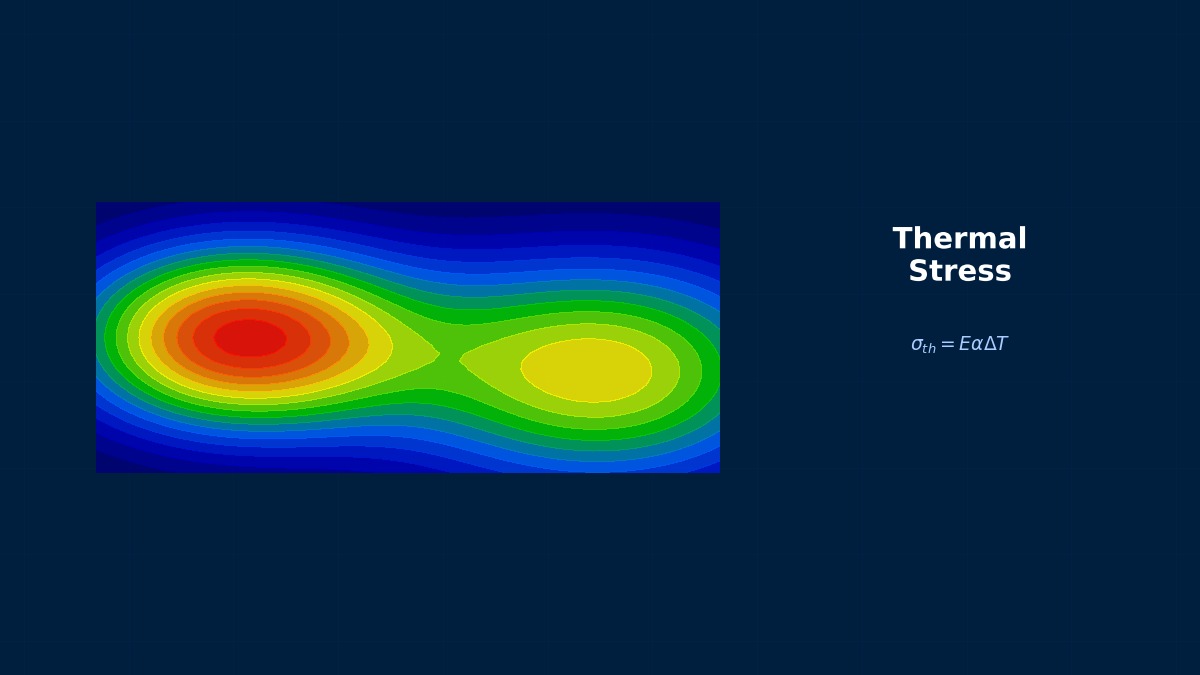
Thermal Residual Stress: Theoretical Foundations
What are Residual Stresses?
Professor, what exactly are residual stresses? It seems a bit strange that stresses exist even without any external force applied...
That's a good question. Residual stress refers to a self-equilibrating stress field that exists inside a component when the external load is zero. Taking welding as an example, when the weld bead cools, it is constrained by the surrounding base metal and cannot shrink freely. As a result, tensile residual stresses close to the yield stress remain near the weld line, while compressive residual stresses develop in areas further away.
Close to the yield stress... that's quite significant. Does that actually cause problems?
It's a major problem. In practice, it's particularly important from three perspectives:
- Reduction in Fatigue Life: Tensile residual stresses act as mean stress, accelerating fatigue crack initiation. This is the main reason why the fatigue strength of welded joints can be less than half that of the base metal.
- Stress Corrosion Cracking (SCC): The occurrence of SCC in stainless steel weldments in chloride environments is due to the combination of tensile residual stress + corrosive environment.
- Deterioration of Dimensional Accuracy: Residual stresses in castings can be released during machining, sometimes preventing dimensions from staying within ±0.1mm.
So, CAE analysis that can predict residual stresses is extremely valuable.
Exactly. Measuring welding residual stresses requires methods like X-ray diffraction or hole drilling, which are costly and time-consuming. With CAE, you can run parametric studies for dozens of cases with different welding conditions, allowing you to determine the optimal welding sequence and heat input conditions at the design stage.
Governing Equations
Thermal residual stress analysis is formulated as a coupled problem of the transient heat conduction equation and the elastoplastic constitutive equation.
Heat Conduction Equation (Energy Conservation Law):
$$\rho c_p \frac{\partial T}{\partial t} = \nabla \cdot (k \nabla T) + Q_{\text{source}}$$Here, $\rho$ is density, $c_p$ is specific heat, $k$ is thermal conductivity, and $Q_{\text{source}}$ is an internal heat source such as welding heat input. For welding, $Q_{\text{source}}$ is represented using a moving heat source model (e.g., Goldak double ellipsoid).
Total Strain Decomposition:
$$\varepsilon^{\text{total}} = \varepsilon^{e} + \varepsilon^{p} + \varepsilon^{th} + \varepsilon^{tr}$$Here, $\varepsilon^{e}$ is elastic strain, $\varepsilon^{p}$ is plastic strain, $\varepsilon^{th} = \alpha \Delta T$ is thermal strain, and $\varepsilon^{tr}$ is transformation strain. In steel welding, $\varepsilon^{tr}$ represents the volume expansion (about 1%) due to martensitic transformation.
Elastoplastic Constitutive Law (J2 Flow Theory):
$$\sigma = \mathbf{D}^{ep} : (\varepsilon^{\text{total}} - \varepsilon^{th} - \varepsilon^{tr})$$So the strain is decomposed into four parts. Is the transformation strain $\varepsilon^{tr}$ the volume change when the microstructure changes during quenching?
Yes, that understanding is correct. For example, in carbon steel, when austenite transforms to martensite, the volume expands by about 1%. This expansion, when constrained by the surroundings, generates compressive residual stress. Conversely, in welding, thermal contraction during cooling is dominant, leading to tensile residual stress. In other words, the balance between "thermal contraction vs. transformation expansion" determines the final residual stress distribution.
Phase Transformation and Volume Change
When considering phase transformations in steel, the following additional models are required:
| Transformation | Temperature Range | Volume Change | Effect on Residual Stress |
|---|---|---|---|
| Austenite → Martensite | $M_s$ to $M_f$ (approx. 300–100°C) | +1.0–1.4% | Contributes in compressive direction |
| Austenite → Bainite | Approx. 350–550°C | +0.5–1.0% | Slightly compressive direction |
| Austenite → Pearlite | Approx. 550–700°C | +0.3–0.8% | Slightly compressive direction |
So, if everything becomes martensite during quenching, the surface gets compressive residual stress, which is actually beneficial for fatigue?
Sharp observation. Indeed, intentionally introducing compressive residual stress on the surface through shot peening or carburizing quenching is based on exactly that principle. However, if the surface is in compression, the interior will be in tension (due to self-equilibrium), so the risk of internal-origin cracking remains. In CAE analysis, it's important to see the overall stress distribution picture.
Computational Methods for Thermal Residual Stress
Analysis Procedure Using FEM
Thermal residual stress analysis is typically performed using the following two-step sequentially coupled analysis:
- Step 1: Transient Thermal Analysis — Determine the temperature history $T(x,t)$ using a moving heat source model.
- Step 2: Elastoplastic Structural Analysis — Input the temperature history as a load to determine stress, strain, and deformation.
Why "sequential" coupling? Wouldn't fully coupled analysis, solving heat and structure simultaneously, be more accurate?
Good question. Theoretically, fully coupled is more accurate, but in welding or quenching, the influence of structural deformation on the temperature field is very small (thermoelastic effect is on the order of a few °C). On the other hand, computational cost increases 3–5 times with fully coupled analysis. Therefore, in practice, sequentially coupled analysis provides sufficient accuracy, and over 95% of welding simulation papers use sequentially coupled analysis.
Welding Moving Heat Source Model (Goldak Double Ellipsoid):
$$Q(x,y,z) = \frac{6\sqrt{3} f_f \eta P}{\pi \sqrt{\pi} a b c_f} \exp\left(-3\frac{x^2}{a^2} - 3\frac{y^2}{b^2} - 3\frac{z^2}{c_f^2}\right)$$Here, $\eta$ is arc efficiency (TIG: 0.6–0.8, MIG: 0.7–0.9), $P = VI$ is arc power, and $a, b, c_f$ are ellipsoid radius parameters.
Element Technology and Time Integration
| Parameter | Recommended Setting | Reason |
|---|---|---|
| Element Type | Second-order hexahedron (HEX20/C3D20) | High accuracy in capturing temperature gradients |
| Mesh near Weld Line | 1–2mm | Make it as fine as the HAZ width |
| Time Increment | 0.1–1.0 seconds (during welding) | Corresponds to welding speed. Ensure the heat source movement per increment is less than the element size. |
| Time Integration | Backward Euler (Implicit method) | Unconditionally stable. Stable even with large time increments. |
| Material Data | Temperature-dependent (20°C to melting point) | All $E(T)$, $\sigma_y(T)$, $\alpha(T)$, $k(T)$ are necessary. |
Thermal Residual Stress in Practice
Modeling Welding Residual Stresses
When actually analyzing welding residual stresses in Abaqus, are there any initial pitfalls to watch out for?
There sure are. Let me give you the top 3 common failures in practice:
- Material data only at room temperature: In welding, temperatures rise near the melting point, so temperature dependence of Young's modulus, yield stress, and coefficient of thermal expansion is essential. Using only room temperature data can overestimate residual stresses by 2–3 times.
- Forgot to model the molten pool: The region above the melting point has its stress reset to zero (molten state). Ignoring this leads to non-physical stresses. In Abaqus, set
*ANNEAL TEMPERATURE. - Mesh is too coarse: If the weld bead width is 8mm but the mesh is 10mm, it's useless. You need at least 3–4 elements within the HAZ to capture temperature gradients.
Casting & Quenching Residual Stresses
How are casting residual stresses different from welding?
They differ in two major ways. First, in casting, the entire part cools from a high temperature, so the difference in cooling rates between thick and thin sections is the main cause of residual stress. It's not localized heat input like in welding. Second, cast iron or aluminum casting alloys have solidification shrinkage. The volume change from liquid to solid (about 3% shrinkage for cast iron) is added, so mold restraint conditions must also be considered.
What about quenching? That's the one where you plunge it into water, right?
Quenching is one of the most challenging areas in residual stress analysis. Rapid cooling causes the surface to transform to martensite first and expand, while the interior is still austenite. This time lag causes complex stress reversals. For assessing the risk of quench cracking, a phase transformation model linked with CCT diagrams (Continuous Cooling Transformation diagrams) is essential.
Comparison with Actual Measurements
| Measurement Method | Measurement Depth | Accuracy | Application |
|---|---|---|---|
| X-ray Diffraction | Surface to tens of µm | ±20 MPa | Standard method for surface residual stress |
| Hole Drilling (ASTM E837) | 0–2mm | ±30 MPa | Obtaining depth-wise distribution |
| Neutron Diffraction | Internal (up to tens of mm) | ±10 MPa | Non-destructive measurement of internal volume (facility-limited) |
| Inherent Strain Method (Sectioning) | Full cross-section | Section average | Destructive but highly reliable |
Thermal Residual Stress: Software & Solver Comparison
| Software | Moving Heat Source | Phase Transformation | Welding-Specific Features | Characteristics |
|---|---|---|---|---|
| Abaqus | DFLUX/FILM | User Subroutine | None (General-purpose) | High flexibility but complex setup |
| Simufact Welding | Built-in | Built-in (CCT-linked) | Welding Pass Definition GUI | Welding-specialized. Easy setup. |
| SYSWELD | Built-in | Built-in (Johnson-Mehl-Avrami) | Welding & Heat Treatment Specialized | Industry-standard welding analysis tool |
| Ansys Mechanical | ACT Plugin | User-defined | Welding Wizard | Easy integration with structural analysis |
| DEFORM-HT | — | Built-in (CCT/TTT) | Quenching & Carburizing Specialized | Industry standard for forging & heat treatment |
Advanced Technologies
Are there any recent trends?
There are three hot topics:
- Residual Stress Prediction for Additive Manufacturing (AM): Sequentially analyzing the melting and solidification of thousands of layers in laser powder bed fusion. Since computational cost is enormous, fast methods based on the inherent strain method are gaining attention.
- Machine Learning Surrogate Models: Approximating the relationship between welding conditions (current, speed, interpass temperature) and residual stress using neural networks, enabling real-time prediction.
- Digital Twin Integration: Feeding real-time measured data from welding robots (current/voltage waveforms) back to the CAE model to estimate residual stresses during manufacturing.
Thermal Residual Stress: Common Issues & Debugging
Professor, when you get stuck in residual stress analysis, what should you check first?
Let me teach you the golden rules of debugging:
- Check the thermal analysis first: Does the molten pool size match actual measurements? Is the peak temperature near the melting point? If this is off, proceeding to structural analysis is pointless.
- Free expansion test: Verify that the displacement from $\alpha \Delta T$ in a single unconstrained element matches hand calculations. This can detect unit errors in material data.
- Check reaction forces: Are the total reaction forces after cooling completion close to zero? If large reaction forces remain, there's likely a mistake in the constraint conditions.
- Is it exceeding yield stress?: If residual stress exceeds 1.5 times $\sigma_y(T_{\text{room}})$, suspect the material model or transformation model.
| Symptom | Cause | Countermeasure |
|---|---|---|
| Molten pool is larger than measured | Inappropriate heat input parameters (a,b,c) | Compare with macro cross-section photos and adjust molten pool shape |
| Residual stress is more than 2x yield stress | Lack of temperature-dependent material data | Incorporate yield stress reduction in high-temperature region (above 800°C) |
| Does not converge (nonlinear iteration diverges) | Time increment is too large | Make it finer during welding, e.g., 0.1–0.5 seconds |
| Deformation is asymmetric | Mesh asymmetry | Create a symmetric mesh centered on the weld line |
Related Topics
Experience the theory firsthand with the interactive simulator for this field
Thermal Stress Simulator