熱機械疲労(TMF)解析

Category: 連成解析 > 熱-構造連成 | 更新 2026-04-12
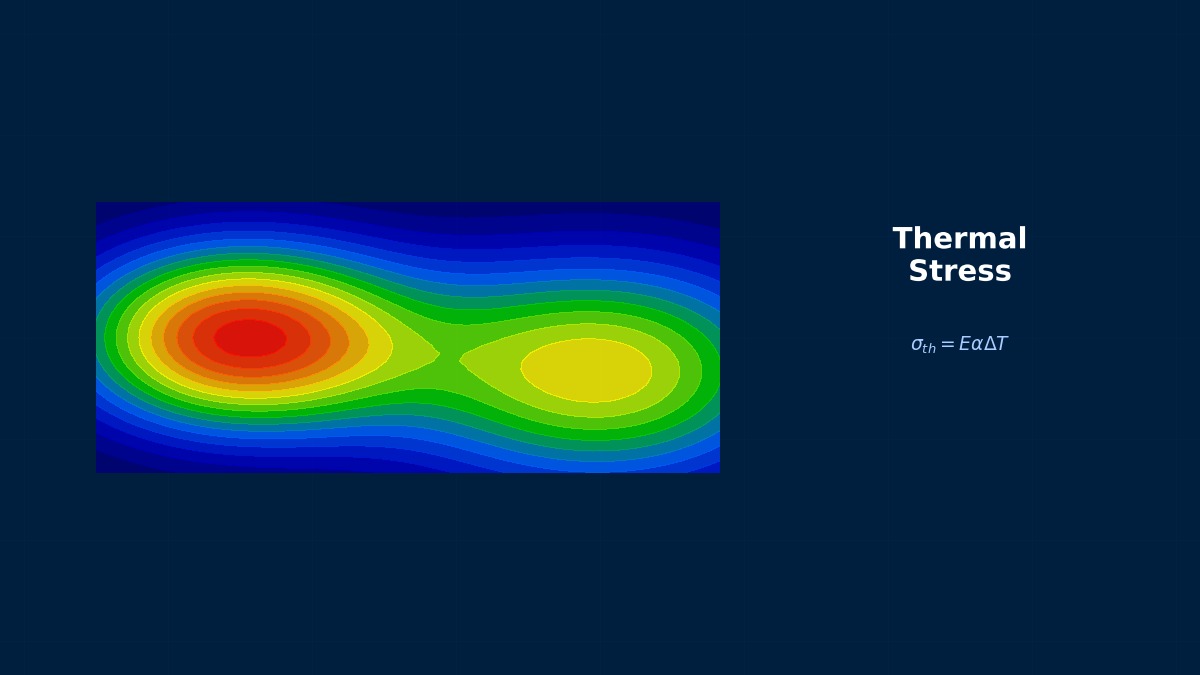
Thermo-mechanical fatigue hysteresis loop showing in-phase and out-of-phase strain-temperature paths
熱機械疲労(TMF)解析 — 温度と機械ひずみの位相関係がき裂の発生モードを支配する

Theory and Physics

What is TMF?

🧑‍🎓

Professor, how is TMF different from ordinary fatigue? I kind of understand that it involves both "thermal" and "mechanical" aspects, but...

🎓

Good question. Conventional fatigue tests—like repeated tension-compression—are conducted at constant room temperature. This is called Isothermal Fatigue. On the other hand, in TMF, temperature cycles and mechanical loads act simultaneously. Imagine a gas turbine blade.

🧑‍🎓

Those vanes inside jet engines, right? The ones that get extremely hot.

🎓

Correct. During startup, they are rapidly heated from room temperature to 1000–1200°C, while simultaneously experiencing tensile loads from centrifugal force due to rotation. Upon shutdown, they cool down and the load is removed. This cycle repeats thousands of times. The problem is that when temperature changes, the material's yield stress, elastic modulus, and creep characteristics all change. Predicting lifespan based solely on room-temperature fatigue data can sometimes be off by an order of magnitude or more compared to reality.

🧑‍🎓

What, off by an order of magnitude? That's definitely not good...

🎓

That's why an independent evaluation system like TMF is necessary. Typical components where TMF is a concern include:

  • Gas Turbine Blades/Vanes: 0–1200°C during start-stop cycles.
  • Automotive Engine Exhaust Manifolds: 200–900°C from cold start → high-temperature steady state → cooling.
  • Power Generation Steam Turbine Rotors: Temperature difference between surface and interior during startup thermal transients.
  • Brake Discs: Repeated frictional heating during braking and cooling.
  • Nuclear Piping Thermal Stripping: Temperature fluctuations due to mixing of fluids at different temperatures.

In-phase and Out-of-phase

🧑‍🎓

When I look at TMF textbooks, I see terms like "IP" and "OP." What are those?

🎓

This is one of the most important concepts in TMF. The phase relationship between temperature and mechanical strain fundamentally changes the failure mode.

  • In-phase (IP, same phase): Tensile strain is maximum when temperature is also highest. The combination of high temperature and tension makes creep damage dominant. Cracks often propagate internally along grain boundaries.
  • Out-of-phase (OP, opposite phase): Compressive strain is maximum when temperature is highest. An oxide layer forms at high temperature, and when it cools and shifts to tension, the oxide layer cracks, initiating surface cracks. Oxidation damage is dominant.
🧑‍🎓

So even with the same material and same strain range, just changing the phase alters the crack morphology?

🎓

Exactly. For example, in the nickel-based superalloy IN738LC, with the same mechanical strain range of 0.6%, the lifespan under IP-TMF can be 2 to 5 times longer than under OP-TMF. In IP, creep voids accumulate at grain boundaries leading to slow failure, whereas in OP, the oxidation-crack opening cycle progresses rapidly. In actual components, the phase is not always exactly 0° (IP) or 180° (OP); intermediate angles are also common. This is called a Diamond cycle.

🧑‍🎓

In an actual gas turbine blade, which parts experience IP and which experience OP?

🎓

Good observation. The blade's leading edge is directly exposed to hot gas during startup, heating up first while the interior of the airfoil is still cool. Therefore, the leading edge tends to experience compressive strain + high temperature → OP-TMF conditions. On the other hand, the disk bore (inner diameter) experiences tensile strain from centrifugal force synchronized with temperature rise during steady-state operation, leading to IP-TMF conditions. In other words, IP and OP coexist within the same engine.

Superposition of Damage Mechanisms

🧑‍🎓

With ordinary fatigue, it's a simple story of cracks forming under cyclic loading, but TMF is more complex, right?

🎓

In TMF, at least three damage mechanisms proceed simultaneously:

  1. Pure Fatigue Damage (Fatigue): Dislocation accumulation due to cyclic mechanical strain → crack nucleation. Same mechanism as Low-Cycle Fatigue (LCF), but the material's cyclic response changes with temperature.
  2. Oxidation Damage (Oxidation): Surface oxide layer growth during high-temperature hold, cracking of the oxide layer due to strain incompatibility during cooling. In Ni-based alloys, if protective films like Al₂O₃ or Cr₂O₃ are destroyed, oxidation accelerates.
  3. Creep Damage (Creep): Grain boundary sliding and void diffusion progress under high temperature and tensile stress. Damage accumulates during long holds, leading to intergranular cracking.

These three don't simply add up linearly; they interact. If creep voids gather at grain boundaries embrittled by oxidation, failure progresses much faster than individually.

Governing Equations and Strain Decomposition

🧑‍🎓

What equations are used for TMF life prediction?

🎓

Everything in TMF starts with strain decomposition. Subtract the thermal strain $\varepsilon_{th}$ from the total strain $\varepsilon_{total}$ to extract the mechanical strain directly linked to life:

$$ \varepsilon_{mech}(t) = \varepsilon_{total}(t) - \varepsilon_{th}(t) = \varepsilon_{total}(t) - \int_{T_0}^{T(t)} \alpha(T')\,dT' $$
🎓

Here, $\alpha(T)$ is the temperature-dependent coefficient of thermal expansion. Mechanical strain is further divided into elastic and inelastic components:

$$ \varepsilon_{mech} = \varepsilon_{el} + \varepsilon_{pl} + \varepsilon_{cr} $$
🧑‍🎓

So it's divided into three: elastic, plastic, and creep. And how is life determined?

🎓

The most basic approach is the modified Manson-Coffin equation. It's the temperature-dependent version of the isothermal fatigue Manson-Coffin equation:

$$ \frac{\Delta\varepsilon_{mech}}{2} = \frac{\sigma'_f(T)}{E(T)}\,(2N_f)^{b(T)} + \varepsilon'_f(T)\,(2N_f)^{c(T)} $$
🎓

The meaning of each parameter is as follows:

  • $\sigma'_f(T)$: Temperature-dependent fatigue strength coefficient
  • $b(T)$: Fatigue strength exponent (typically $-0.05$ to $-0.12$)
  • $\varepsilon'_f(T)$: Fatigue ductility coefficient
  • $c(T)$: Fatigue ductility exponent (typically $-0.5$ to $-0.7$)
  • $E(T)$: Temperature-dependent Young's modulus

However, this equation alone cannot account for the effects of oxidation or creep. This is the major limitation of the modified Manson-Coffin equation.

Neu-Sehitoglu Model

🧑‍🎓

Is there a more precise model that includes both oxidation and creep?

🎓

The Neu-Sehitoglu model is considered the gold standard for TMF life prediction. Proposed by Neu and Sehitoglu at the University of Illinois in 1989. It separates damage into three mechanisms and calculates each independently and sums them:

$$ \frac{1}{N_f} = \frac{1}{N_f^{fat}} + \frac{1}{N_f^{ox}} + \frac{1}{N_f^{cr}} $$
🎓

Let's look at each term.

1. Fatigue term $N_f^{fat}$: Essentially the modified Manson-Coffin equation. Often uses material parameters at the maximum temperature $T_{max}$.

2. Oxidation term $N_f^{ox}$: Considers oxide layer growth rate and crack opening timing. Oxide layer thickness $h_{ox}$ grows according to the parabolic law:

$$ h_{ox} = \sqrt{D_{ox}\,t_{eff}} \quad,\quad D_{ox} = D_0 \exp\!\left(-\frac{Q_{ox}}{RT}\right) $$
🎓

Here, $Q_{ox}$ is the activation energy for oxidation, $D_0$ is the frequency factor, and $R$ is the gas constant. Oxidation damage is particularly large under OP conditions—because the oxide layer grows at high temperature and cracks during cooling under tension.

3. Creep term $N_f^{cr}$: Integrates creep strain accumulation during high-temperature hold. Assuming Norton's law:

$$ \dot{\varepsilon}_{cr} = A\,\sigma^n\,\exp\!\left(-\frac{Q_{cr}}{RT}\right) $$
🎓

Creep damage becomes severe under IP conditions. This is because temperature is highest when tensile strain is maximum, accelerating creep deformation. Thus, the Neu-Sehitoglu model naturally reproduces the experimental fact that creep term dominates in IP, oxidation term dominates in OP. This is something a single equation (modified Manson-Coffin) could not achieve.

🧑‍🎓

I see... because damage is separated and added, the dominant term automatically changes between IP and OP. That's clever!

Physical Meaning and Unit System of Each Term
ParameterSI UnitTypical Value (Ni-based Superalloy)
$\sigma'_f$ Fatigue Strength CoefficientMPa1200–2000 MPa
$b$ Fatigue Strength ExponentDimensionless$-0.06$ to $-0.10$
$\varepsilon'_f$ Fatigue Ductility CoefficientDimensionless$0.1$ to $1.0$
$c$ Fatigue Ductility ExponentDimensionless$-0.5$ to $-0.8$
$Q_{ox}$ Activation Energy for OxidationJ/mol150–250 kJ/mol
$Q_{cr}$ Activation Energy for CreepJ/mol250–400 kJ/mol
$n$ Stress Exponent in Norton's LawDimensionless$3$ to $8$
$\alpha$ Coefficient of Thermal Expansion1/K$12$ to $16 \times 10^{-6}$
Difference from SRP Method (Strain Range Partitioning)

The SRP method (Strain Range Partitioning) partitions inelastic strain into four types: PP (plastic-plastic), CC (creep-creep), PC, CP, and fits independent Manson-Coffin relationships to each. Developed at NASA Glenn (formerly Lewis) Research Center and widely used in aerospace. While the Neu-Sehitoglu model separates by damage mechanism (fatigue/oxidation/creep), the SRP method separates by strain generation process—different approaches, but both can handle IP/OP differences. A weakness of SRP is that it requires many material constants, leading to high testing costs.

Coffee Break Trivia Corner

Why TMF Testing Machines Cost "Hundreds of Millions of Yen Each"

Experimental evaluation of TMF requires dedicated testing machines, with prices typically ranging from 100 to 300 million yen per unit. While ordinary fatigue tests are conducted at room temperature, TMF tests require rapidly heating the specimen via high-frequency induction heating while simultaneously applying precise tensile/compressive loads in real-time synchronization. Temperature control accuracy must be within ±2°C, strain control within ±0.001% using high-temperature extensometers—technology that can stably repeat these conditions for hundreds to thousands of cycles is required. In OP-TMF tests simulating aircraft engine turbine blades, lifespan can be 1/5 to 1/10 that of isothermal fatigue. The purpose of TMF analysis is to use simulation to predict results, serving as a substitute for this high-cost test data.

Numerical Methods and Implementation

Temperature-Dependent Constitutive Models

🧑‍🎓

When doing TMF analysis with FEM, what about the material model? Everything changes when temperature changes, right?

🎓

It's fair to say that the success or failure of TMF analysis is largely determined by the accuracy of the constitutive model (material model). The minimum requirements are:

  • Temperature-dependent elastoplastic model: Identify parameters for yield stress, hardening rules (isotropic hardening, kinematic hardening) at multiple temperatures. The Chaboche model (nonlinear kinematic hardening) is effectively the standard for TMF.
  • Creep law: Norton's law or Norton-Bailey time-hardening law. Reproduces the effects of high-temperature holds.
  • Unified Constitutive Model: Bodner-Partom, Walker, Chaboche-Lemaitre, etc. Treats plasticity and creep not separately but as a unified viscoplastic strain. Unified models are ideal for TMF, but parameter identification is challenging.
🧑‍🎓

If parameters are different for each temperature, doesn't the database become enormous?

🎓

Exactly. For example, if the Chaboche model has 8 parameters and they are identified at 6 temperature levels, you need 48 data points. Moreover, cyclic stress-strain tests must be conducted at each temperature. Aircraft engine manufacturers have spent decades building dedicated material databases. This is arguably the biggest barrier to entry for TMF analysis.

FEM-based Thermal-Structural Coupling

🧑‍🎓

With FEM, you calculate temperature and stress simultaneously, right? Is there only one method for coupling?

🎓

There are two main approaches:

1. Sequential Coupling (Weak Coupling): First, perform thermal analysis to obtain the time history of the temperature field, then map it as a thermal load to the structural analysis. This is sufficient for many TMF cases. Because the feedback effect of structural deformation on the temperature field is usually small.

2. Full Coupling (Strong Coupling): Solves thermal and structural problems simultaneously. Necessary when heat generation from plastic work (Taylor-Quinney coefficient) affects the temperature field, or when heat transfer at contact surfaces depends on the deformation state. Brake disc TMF is an example.

🎓

To be more specific about the sequential coupling analysis flow:

  1. Calculate the temperature field time history for startup → steady state → shutdown via heat conduction analysis ($T(\mathbf{x}, t)$)
  2. Transfer the temperature field to the structural mesh.
  3. Apply $\Delta\varepsilon_{th} = \alpha(T)\Delta T$ as a thermal load at each time step.
  4. Execute nonlinear structural analysis (temperature-dependent elastoplastic + creep).
  5. Extract stress-strain-temperature history of the stabilized cycle → input into life prediction model.

Fatigue Post-Processing

🧑‍🎓

Is the part that calculates life from FEM results done inside the FEM solver?

🎓

In practice, it's common to use dedicated fatigue post-processing software. It reads the stress, strain, and temperature time history data output by the FEM solver, calculates TMF life at each node, and displays contour plots. Representative tools:

  • fe-safe (Dassault Systèmes): Tight integration with Abaqus. Has a dedicated TMF module. Supports the Neu-Sehitoglu model.
  • nCode DesignLife (HBK/Siemens): Supports multiple solvers. Allows selection of SWT, SRP, Manson-Coffin, etc.
  • FEMFAT (ECS): Widely adopted by automotive OEMs. Fast processing.

The reason it's not completed within the FEM solver is that fatigue models need frequent updates depending on material, environment, and surface treatment, and dedicated software is better for database management and method switching.

関連シミュレーター

この分野のインタラクティブシミュレーターで理論を体感しよう

S-N曲線シミュレーター Goodman線図ツール 構造系ツール一覧

関連する分野

構造解析熱解析連成解析
この記事の評価
ご回答ありがとうございます!
参考に
なった
もっと
詳しく
誤りを
報告
参考になった
0
もっと詳しく
0
誤りを報告
0
Written by NovaSolver Contributors
Anonymous Engineers & AI — サイトマップ
About the Authors