Thermo-Mechanical Design
Thermo-Mechanical Design: Theoretical Foundations
What is Thermo-Mechanical Design?
Isn't thermo-mechanical design just about calculating thermal stress?
No, evaluating thermal stress is just one small aspect. What's more important is the degradation of dimensional accuracy due to thermal deformation. For example, the stage of a semiconductor lithography system requires 0.1nm accuracy, but a temperature fluctuation of just 0.01°C can cause deformation of several nm.
Several nm from just 0.01°C!? That's already in the realm of temperature management...
Exactly. That's why "thermo-mechanical design" includes everything from the selection of special materials like Invar (Fe-Ni low-expansion alloy, CTE ≈ 1.2×10⁻⁶/K), optimal placement of cooling channels, to the design of constraint conditions. It's not just about calculating $\sigma = E \alpha \Delta T$ and being done.
So it includes everything from material selection to cooling design. Specifically, what industries use it?
These five fields are typical:
- Semiconductor Manufacturing Equipment: Lithography stages, wafer chucks (nm-level accuracy)
- Aircraft Engines: Turbine blades, combustor liners (1600°C environment)
- Electronics: BGA/CSP packages, power modules (temperature cycle reliability)
- Automotive: Exhaust manifolds, brake discs
- Plant Equipment: Steam turbines, pressure vessels (start-stop cycles)
Thermal Deformation and Dimensional Accuracy
Is thermal deformation really that problematic? I have an image that iron is hard and doesn't deform easily.
You can see how scary it is with numbers. For example, if the temperature of a 1m long steel piece (CTE ≈ 12×10⁻⁶/K) rises by 10°C:
0.12mm—it's not a problem for ordinary mechanical design, but it's fatal for machine tools with μm-level machining accuracy. Moreover, because the temperature distribution is not uniform, you get "warping" and "twisting," not just simple expansion. This is the true fear of thermal deformation.
If it expands uniformly, you can compensate, but warping and twisting are troublesome...
Exactly. That's why at the design stage, you need to think from both sides: "how to minimize the non-uniformity of temperature distribution" and "how to withstand the remaining non-uniformity." The former is cooling design, the latter is material selection and constraint design.
Mechanics of CTE Mismatch
CTE mismatch is a problem when different materials are joined, right?
Yes. For example, on an electronic substrate, a silicon chip (CTE ≈ 2.6×10⁻⁶/K) is soldered onto an FR-4 substrate (CTE ≈ 14×10⁻⁶/K). During temperature cycles, the CTE difference directly becomes interfacial shear stress.
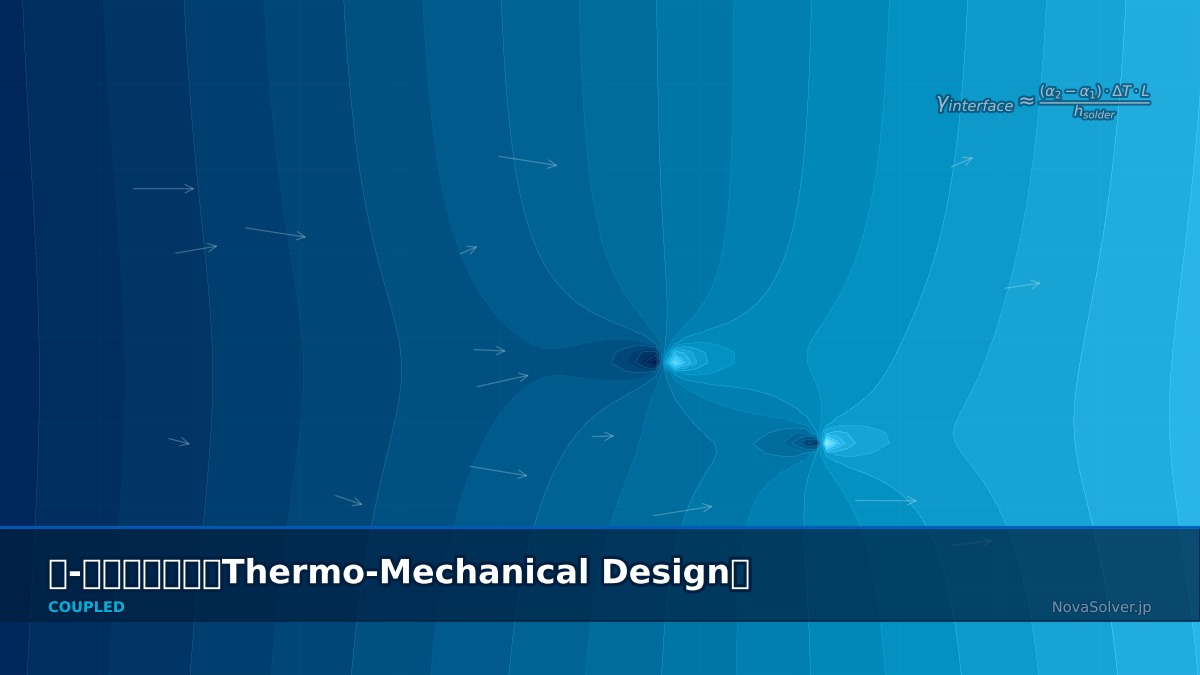
Here $\gamma$ is the shear strain in the solder, $L$ is the half-width of the chip, $h_{solder}$ is the solder height. The larger the CTE difference, the larger the chip, and the thinner the solder, the greater the shear strain. This is the root cause of BGA solder cracks.
There's a temperature cycle test specification for automotive ECUs like "-40°C to +125°C, 1000 cycles," that's exactly evaluating this, right?
Sharp observation. And the same problem exists in turbine blades. TBC (Thermal Barrier Coating, ceramic-based, CTE ≈ 10×10⁻⁶/K) is sprayed onto a Ni superalloy, but the CTE of the Ni superalloy is about 13×10⁻⁶/K. This difference causes TBC delamination during repeated start-stop cycles.
Governing Equations
What about the equations? The thermal and structural equations are coupled, right?
First, the heat conduction equation (transient):
Here $\rho$ is density, $c_p$ is specific heat, $k$ is thermal conductivity, $Q$ is internal heat generation. And the structural equilibrium equation:
The key to coupling is the constitutive law. Elastic strain is found by subtracting thermal strain from total strain:
So you solve for the temperature field, then use that temperature to solve the structure. Once the temperature is determined, the thermal strain is determined, and if there is constraint, thermal stress appears.
That's the basics. However, when material properties like elastic modulus $E(T)$ or yield stress $\sigma_y(T)$ are temperature-dependent, the structural behavior depends on temperature, so even "one-way coupling" accurately reflects temperature effects. Furthermore, when structural deformation changes contact conditions and alters thermal resistance (e.g., contact thermal conductance in bolted joints), bidirectional coupling is needed.
Transient Thermal Stress vs. Steady-State Thermal Stress
Isn't it enough to just look at steady-state thermal stress? Isn't steady-state the most severe condition?
That's a major pitfall. There are many cases where transient stress is greater than steady-state stress. Take a steam turbine rotor as an example. During startup, when hot steam hits the outer surface, the outside heats up quickly but the inside is still cold. At this time, a large temperature gradient occurs with compression on the outside and tension on the inside.
When steady-state is reached, the temperature gradient relaxes and stress decreases. In other words, the transient conditions during startup and shutdown are the most severe. In practice, steam turbine manufacturers always perform transient analysis for each startup pattern (cold start / warm start / hot start) to determine the allowable heating rate (°C/min).
So if you only look at steady-state and judge it's "okay," it might break during startup. Scary...
That's why in thermo-mechanical design, transient analysis of the entire lifecycle (startup → steady-state → shutdown → restart) is essential. This is the point that is fundamentally different from simple "thermal stress calculation."
Semiconductor Lithography Systems — The Battle for 0.01°C
The wafer stage of an EUV lithography system requires nm-level positioning accuracy. Invar alloy or SiC ceramics are used for major structural components because their CTE (coefficient of thermal expansion) is extremely low. Invar's CTE is about 1.2×10⁻⁶/K, one-tenth that of steel. Furthermore, the area around the stage is controlled to within 0.01°C by temperature-regulated air or a He atmosphere, and laser interferometers provide displacement feedback at hundreds of Hz with pm resolution. Even with all this, thermal deformation remains, so FEM is used to predict transient temperature distributions and pre-calculate control correction values. This is the pinnacle of fields where CAE "directly determines product operational accuracy."
Computational Methods for Thermo-Mechanical Design
Coupling Strategy: Weak Coupling vs. Strong Coupling
Do you solve thermal and structural simultaneously? Or separately?
There are three main approaches:
- One-way coupling: Thermal analysis → Transfer temperature to structure → Structural analysis. Used when structural deformation does not affect the temperature field. Sufficient for 80% of practical work.
- Sequentially coupled (Weak coupling): Thermal → Structural → (Update thermal conditions based on structural deformation) → Thermal → ... loop. Used when contact thermal conductance depends on deformation.
- Fully coupled (Strong coupling): Solve thermal and structural simultaneously in one matrix. Used when structural deformation rate contributes to heat generation (plastic working, frictional heating).
One-way works for 80%? When do you use strong coupling then?
A typical example is forging or friction stir welding (FSW). Heat generation from plastic deformation $Q_{plastic} = \eta \cdot \sigma : \dot{\varepsilon}^p$ ($\eta$ is the thermal conversion coefficient of plastic work, typically 0.9) raises temperature, which changes material properties, which changes deformation behavior—a complete feedback loop. Abaqus's `*Coupled Temperature-Displacement` is a representative step that handles this strong coupling.
| Coupling Type | Accuracy | Computational Cost | Typical Applications |
|---|---|---|---|
| One-way | ○ (Sufficient for many cases) | Low | Temperature cycles in electronics, steady-state machinery |
| Sequentially coupled | ◎ | Medium | Contact thermal conductance in bolted joints, gaskets |
| Fully coupled | ◎ | High | Forging, FSW, brake friction, machining |
FEM Formulation
How do you incorporate thermal strain in FEM?
The structural finite element equation is:
Here, the thermal load vector $\{\mathbf{F}_{th}\}$ is obtained from the thermal strain of each element:
$\mathbf{B}$ is the strain-displacement matrix, $\mathbf{D}$ is the elasticity matrix. In other words, through the transformation "temperature difference → thermal strain → equivalent nodal forces," the thermal effect enters the right-hand side of the structural equation in the same form as mechanical loads. This makes implementation easy because it can be solved with the same solver.
I see, you convert the thermal load into an equivalent force and add it to the right-hand side. So you can use the existing structural solver as-is.
Time Integration for Transient Analysis
How do you decide the time step for transient thermal analysis?
Using the backward Euler method for FEM discretization of the heat conduction equation:
$[\mathbf{C}]$ is the heat capacity matrix, $[\mathbf{K}_T]$ is the thermal conductivity matrix. Backward Euler (implicit method) is unconditionally stable, so you can use a large time step, but a sufficiently small time step is needed to capture transient temperature peaks. Guidelines:
- Initial rapid heating: $\Delta t \leq L_e^2 / (6 \kappa)$ ($\kappa = k/(\rho c_p)$ is thermal diffusivity, $L_e$ is minimum element size)
- As it approaches steady-state: Increase $\Delta t$ to improve computational efficiency (automatic time step control)
Fine initially, coarser as it nears steady-state. That's reasonable.
Data Mapping Between Thermal and Structural
What do you do when the meshes for thermal and structural analysis are different?
This is a really important point in practice. Thermal analysis may converge with a coarse mesh, but structural analysis needs a fine mesh at stress concentration areas. When meshes are non-matching, temperature data mapping (transfer) is needed:
- Shape function interpolation: Find which thermal element the structural node lies within and interpolate using shape functions. Most common.
- Nearest neighbor method: Use the value of the nearest node directly. Simple but low accuracy.
- RBF interpolation: Reconstruct a smooth temperature field using radial basis functions. Robust for non-matching meshes.
Related Topics
Experience the theory with interactive simulators in this field
Thermal Stress Simulator All Simulators