Antenna Gain and Directivity — From Radiation Efficiency and Friis Transmission Formula to dBi Conversion
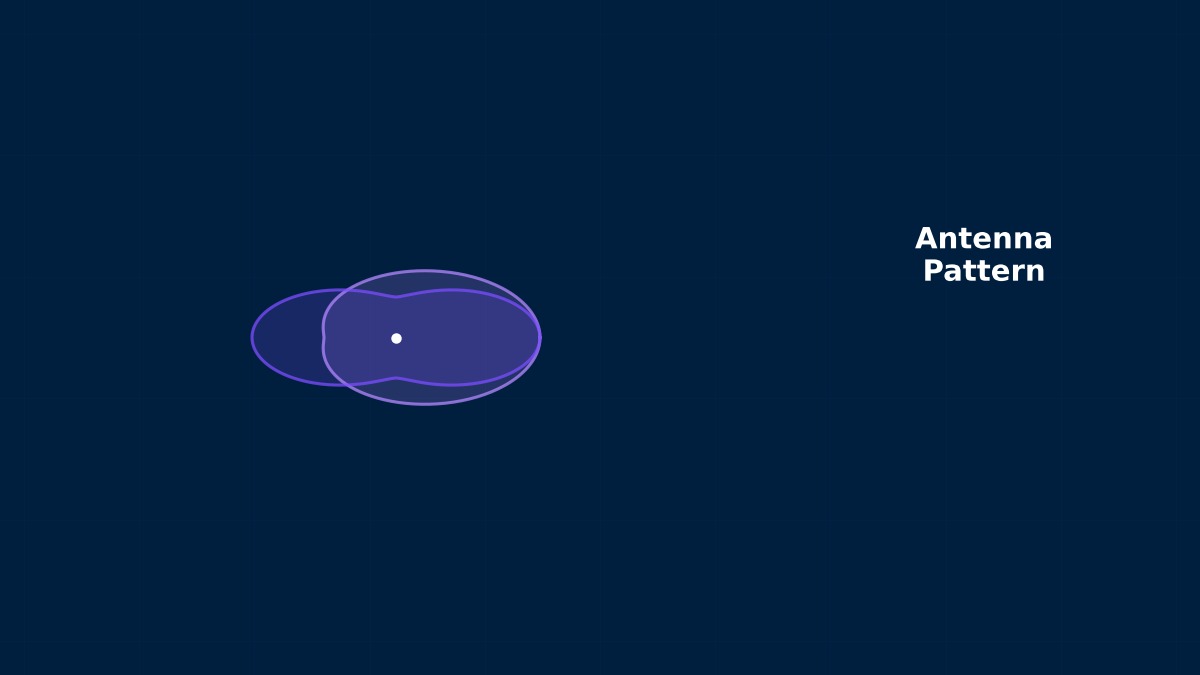
Antenna Gain and Directivity: Theoretical Foundations
Definitions of Gain and Directivity
Professor, aren't gain and directivity the same thing? The textbook says they both represent the "concentration" of an antenna.
Good question. It's true they are both metrics that represent "how much power is concentrated in a specific direction," but there is a critical difference. Directivity $D$ represents only the sharpness of the radiation pattern. On the other hand, Gain $G = \eta D$, where radiation efficiency $\eta$ is multiplied.
Does radiation efficiency $\eta$ mean how much of the input power is actually radiated?
Exactly. $\eta = P_{\text{rad}} / P_{\text{in}}$. If there are conductor losses (copper loss) or dielectric losses, $\eta < 1$ and gain decreases. For example, in small chip antennas, an efficiency of 30% ($\eta = 0.3$) is common, so even if directivity is $D = 5$, the gain is only $G = 0.3 \times 5 = 1.5$.
Oh, so which one can actually be measured?
In actual measurements, only gain can be measured directly. Directivity is calculated from the full-sphere integral of the radiation pattern or obtained via simulation. Efficiency is generally back-calculated from the ratio of gain and directivity: $\eta = G/D$. There is also a method called the Wheeler Cap method, but for now, understanding this relationship is key.
Radiation Intensity and Radiated Power
How is "radiation intensity $U$," which appears in the directivity formula, different from the Poynting vector?
The Poynting vector $\mathbf{S}$ is the power density per unit area [W/m²]. Radiation intensity $U(\theta,\phi)$ is the radiated power per unit solid angle [W/sr], and has the following relationship:
In the far-field, $|\mathbf{S}| \propto 1/r^2$, so $U$ is independent of $r$. That's why $U$ is convenient when discussing an antenna's "radiation pattern."
I see, so it's easier to compare because it doesn't depend on distance. And the directivity formula?
This is the definition formula for directivity $D(\theta,\phi)$:
Here, $P_{\text{rad}} = \oint U \, d\Omega$ is the total radiated power. $4\pi$ is the total solid angle [sr]. In other words, "If it radiated isotropically, the radiation intensity would be $U_{\text{iso}} = P_{\text{rad}}/4\pi$, but the actual antenna radiates with intensity $U(\theta,\phi)$" — the ratio of these is the directivity.
Do we usually only look at the maximum directivity $D_{\max}$?
In practice, yes. Often, simply saying "directivity" or "gain" refers to the maximum value. $D_{\max} = 4\pi U_{\max}/P_{\text{rad}}$. For a half-wave dipole, $D_{\max} \approx 1.64$ (2.15 dBi), and for a λ/4 monopole (with ground plane), $D_{\max} \approx 3.28$ (5.15 dBi).
Effective Aperture Area
The textbook says "gain is related to effective aperture area." Can this be used even for antennas that aren't aperture antennas like parabolic dishes?
Yes, it can. Effective aperture area $A_{\text{eff}}$ is a quantity that can be defined for any antenna, and its relationship with gain is given by this formula:
For a parabolic antenna, $A_{\text{eff}} = \eta_a \cdot A_{\text{physical}}$ ($\eta_a$ is aperture efficiency, the ratio to physical area), which is intuitive. But even for a dipole antenna, it can be calculated as $A_{\text{eff}} = G \lambda^2 / 4\pi \approx 0.13\lambda^2$. Even without a visible "area," it is defined as an equivalent power capture area.
Huh, so even a dipole has an effective aperture area. That's a bit strange...
Actually, it's a result derived from the "reciprocity of antennas." Transmission performance (gain) and reception performance (effective aperture area) are two sides of the same coin for an antenna. This equivalence is the beautiful part of antenna theory.
Friis Transmission Formula
Does the Friis formula tie all of this together? It came up in link design.
Yes. It's the fundamental formula describing power transmission between transmitting and receiving antennas. In free space, the received power can be written as:
$P_t$ is transmit power, $P_r$ is receive power, $G_t, G_r$ are the respective gains, $R$ is distance, and $\lambda$ is wavelength. The $(\lambda/4\pi R)^2$ part is called free-space path loss (FSPL).
For example, how much attenuation would there be when receiving from a 2.4 GHz Wi-Fi router 10 meters away?
$\lambda = c/f = 0.125$ m, so FSPL is $20\log_{10}(4\pi \times 10 / 0.125) \approx 60$ dB. With transmit power of 20 dBm (100 mW) and transmit/receive antenna gains of 2 dBi each, the received power is $20 + 2 + 2 - 60 = -36$ dBm. In reality, attenuation from walls and people is added, so you need to account for a margin in receiver sensitivity.
The Friis formula is used a lot in practice, isn't it? I understand now how the gain value directly affects link design!
dBi and dBd Conversion
I'm confused because data sheets mix "dBi" and "dBd." What's the difference?
The reference is different. dBi uses an isotropic radiator as reference, dBd uses a half-wave dipole as reference. Since a half-wave dipole has a directivity of 2.15 dBi, the conversion is simple:
For example, a "5 dBd" antenna has the same performance as "7.15 dBi." When vendor catalogs mix dBi and dBd, it can cause trouble, so always get in the habit of checking "what is the reference."
"Gain Does Not Arise from Nothing" ── A Perspective from Energy Conservation
It's easy to misunderstand "high-gain antenna = can emit stronger radio waves," but gain is a redistribution of energy, not creation. The power that an isotropic antenna spreads evenly in all directions is simply concentrated in a specific direction by a directive antenna. It's the same principle as focusing light with a flashlight lens. The total radiated power of an antenna with 10 W input remains 10 W (excluding losses). Understanding this "consistency with energy conservation" as a starting point reveals that gain, effective aperture area, and radiation pattern are all different expressions of the same physical phenomenon.
Computational Methods for Antenna Gain and Directivity
Choosing an Electromagnetic Field Analysis Method
I want to find an antenna's gain via simulation. Should I use FEM, FDTD, or MoM?
The basic principle is to choose based on antenna type and purpose. Roughly summarized:
| Method | Good For | Gain Calculation Approach |
|---|---|---|
| MoM (Method of Moments) | Wire antennas, open structures | Current distribution → Direct far-field integration |
| FDTD (Finite-Difference Time-Domain) | Broadband characteristics, complex shapes | Near-field → Far-field transformation (DFT) |
| FEM (Finite Element Method) | Composite structures including dielectrics | Edge element electric field solution → Far-field transformation |
For example, to analyze a smartphone antenna including its housing, FDTD is efficient; for the resonant characteristics of a patch antenna alone, FEM; for wire structures like Yagi antennas, MoM.
Does MoM not require a volume mesh?
MoM discretizes only the conductor surface, so it doesn't need a spatial mesh. However, the matrix becomes a dense matrix (full matrix), so memory usage explodes for large-scale problems. Recently, MLFMM (Multilevel Fast Multipole Method) is mainstream to keep computational complexity at $O(N \log N)$. HFSS and FEKO have MLFMM-equipped MoM solvers.
Far-Field Calculation Methods
Specifically, how do you do the "near-field → far-field transformation" when calculating gain with FDTD?
In FDTD, you set a closed surface (Huygens surface) surrounding the antenna within the computational domain and sample the tangential electric and magnetic fields there. These are converted into equivalent electric and magnetic currents, and then integrated using the free-space Green's function to get the far-field. In mathematical form:
This transformation uses the same principle internally in CST Studio (time-domain solver) and HFSS's FEBI (FEM-BEM integration method). As a result, $U(\theta,\phi)$ is obtained, then integrated over the full sphere to find $P_{\text{rad}}$, and $D$ and $G$ can be calculated.
Absorbing Boundary Conditions and PML
"PML" often comes up in antenna analysis. What is it?
PML (Perfectly Matched Layer) is a "virtual electromagnetic wave absorbing layer" placed at the outer boundary of the computational domain. If electromagnetic waves radiated from the antenna reflect at the boundary, it causes large errors in gain calculation, so a boundary condition that absorbs waves without reflection is needed.
In theory, PML achieves zero reflection for all incident angles and frequencies. However, due to discretization, it's not perfect, so the thickness of the PML layer (typically 8-12 cells) and the profile of the absorption coefficient affect gain accuracy. In practice, the golden rule is not to place the PML too close (keep it at least $\lambda/4$ away from the antenna).
Antenna Gain and Directivity in Practice
Gain Analysis Workflow
I'm simulating an antenna's gain for the first time. What specific steps should I follow?
The basic flow for gain analysis is 5 steps:
- Model Construction: Create antenna geometry in CAD. Clearly define the feed point.
- Analysis Domain / Boundary Setting: Set PML or radiation boundary. Ensure at least $\lambda/4$ distance from antenna to PML.
- Mesh Generation: Aim for $\lambda/20$ or smaller for antenna structure parts, $\lambda/10$ or smaller for air regions.
- Solving / Far-Field Calculation: Frequency sweep or time-domain pulse. Obtain S-parameters and radiation pattern simultaneously.
- Post-Processing: Calculate $D_{\max}$ from the 3D radiation pattern. Check efficiency via $\eta = G/D$.
Gain and $S_{11}$ are different, right? Which should I look at first?
$S_{11}$ (reflection coefficient) is an indicator of impedance matching, showing "how much of the input power enters the antenna without being reflected." $S_{11} = -10$ dB means 90% of the input power enters the antenna. But not all the power that enters is necessarily radiated. Some is lost as heat due to conductor losses.
In practice, first confirm the resonant frequency with $S_{11}$, then evaluate the gain and radiation pattern at that frequency. If $S_{11}$ is good but gain is low, there's an efficiency problem; if gain is high but $S_{11}$ is poor, review the matching circuit design — that's the procedure.
Mesh Strategy for Antenna Analysis
I heard the guideline for mesh size is "$\lambda/20$ or smaller," but if I make the whole model $\lambda/20$, won't the calculation be too heavy?
There's no need to make it uniform everywhere. Make areas with current concentration (feed point, edges, slots) finer, down to $\lambda/30$ ~ $\lambda/50$, while distant air regions can be around $\lambda/6$. This non-uniform mesh is key to antenna analysis.
Ansys HFSS has an adaptive mesh feature that automatically refines the mesh until the change in S-parameters falls below a threshold. CST Studio also has a similar feature.