Radiation Pattern Analysis
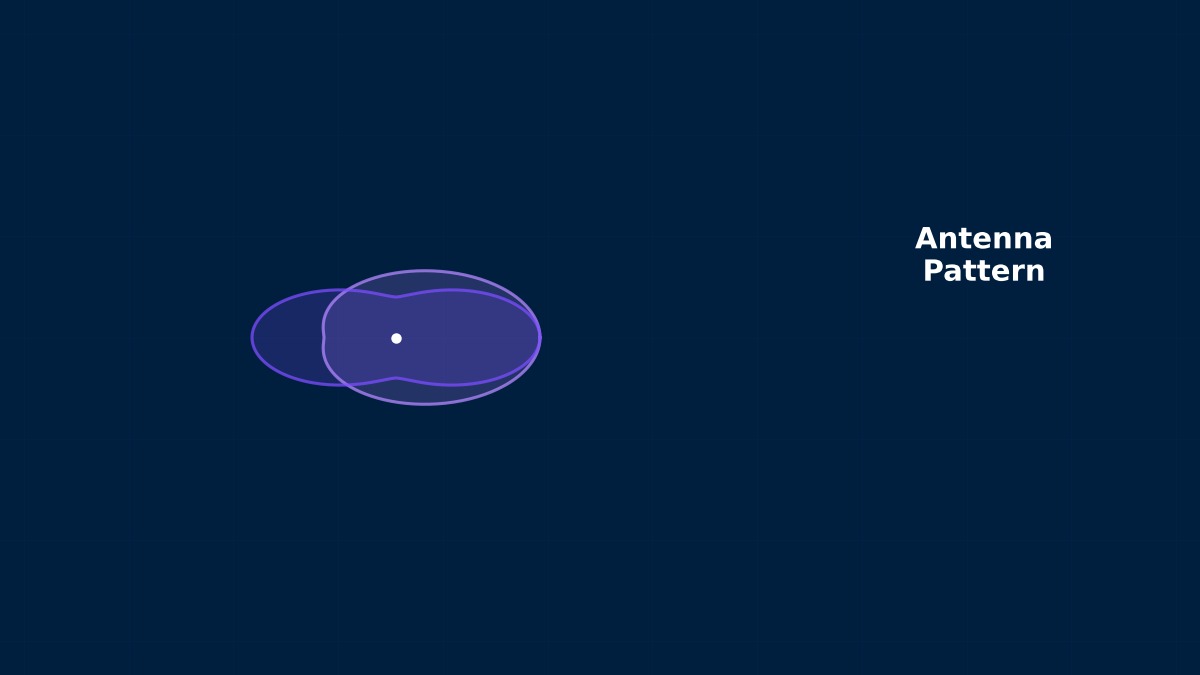
Radiation Pattern: Theoretical Foundations
Overview
I often see 3D plots of radiation patterns, but what exactly do they represent?
It's the angular distribution of electric field strength from the antenna. Roughly speaking, it's a diagram that visually shows "in which direction and how much radio waves are emitted" in a three-dimensional way. You can see at a glance the direction and width of the main lobe, the side lobe level, and the position of null points.
Oh, is it that important in practical work? It seems like just knowing "which way it's pointing" would be enough.
Too naive. For example, in satellite communication parabolic antennas, the side lobe level is sometimes required to be below $-30\,\text{dB}$. High side lobes cause interference with adjacent satellites, and in military radars, if signals leak from side lobes, stealth capability is ruined. The accuracy of FEM analysis directly impacts design quality.
I see... So it's just an angular distribution, but a crucial one. So, what specific physical quantities are used for evaluation?
We mainly discuss using four metrics: Far-field electric field $\mathbf{E}(\theta,\phi)$, Directivity $D$, Gain $G$, and Half-Power Beamwidth HPBW. Let's look at them in order.
Far-Field Electric Field Representation
First, from where is considered "far field"? There's a definition, right?
The boundary of the far field is defined as follows, where $D_{\max}$ is the maximum dimension of the antenna and $\lambda$ is the wavelength:
In regions beyond this distance, the electromagnetic wave approximates a spherical wave, with $\mathbf{E}$ and $\mathbf{H}$ inversely proportional to $r$ and orthogonal to each other. In other words, it becomes a uniform transverse wave with a wave impedance of $\eta_0 \approx 377\,\Omega$.
How is the electric field in the far field written concretely?
Deriving the far-field electric field from the current distribution $\mathbf{J}(\mathbf{r}')$ on the antenna yields the following form:
Simplifying this and writing it with the pattern function $\mathbf{F}(\theta,\phi)$ gives:
The key point is that $\mathbf{F}(\theta,\phi)$ corresponds to the Fourier transform of the current distribution. Therefore, pattern synthesis for array antennas can be viewed as "spatial frequency filtering."
Fourier transform! That's the same concept as signal processing. So, does that mean if the current distribution is rectangular, the pattern becomes something like a sinc function?
Exactly. With a uniform distribution of equal amplitude and phase, the main lobe becomes the narrowest, but the side lobes only drop to about $-13.2\,\text{dB}$. Applying a taper to the current using Taylor or Chebyshev distributions slightly widens the main lobe but can suppress side lobes to $-20$ to $-40\,\text{dB}$.
Radiation Intensity and Directivity
Once the pattern function is understood, the next step is quantifying "how strong it is," right?
Yes. First, define the radiation intensity $U(\theta,\phi)$. This is the radiated power per unit solid angle:
The disappearance of $r$ in the second equality is key. In the far field, $U$ becomes a pure angular function independent of distance. Then, directivity $D$ is the "concentration towards the peak direction" compared to an isotropic radiator:
$P_{\text{rad}}$ is the total power radiated in all directions, right? How is it calculated numerically?
By numerically integrating the Poynting vector over a spherical surface $S$ in the far field. Commercial solvers like HFSS perform near-field to far-field transformation (NFTF) and then integrate using Simpson's rule or Gaussian quadrature on a $(\theta,\phi)$ grid. Typically, a resolution of 1° in $\theta$ and 1° in $\phi$ provides sufficient accuracy.
Gain and HPBW
I understand directivity $D$. But data sheets often list "Gain $G$," right? What's the difference?
Gain $G$ is an actual performance metric that includes antenna losses (conductor loss, dielectric loss, surface wave loss, etc.). Using radiation efficiency $\eta$ ($0 < \eta \leq 1$):
For example, even a parabolic antenna with directivity $D = 30\,\text{dBi}$, if its aperture efficiency (illumination efficiency + spillover loss + surface accuracy loss etc.) is $\eta = 0.55$ ($-2.6\,\text{dB}$), the actual gain becomes $G \approx 27.4\,\text{dBi}$.
How is HPBW (Half-Power Beamwidth) determined?
It's the angular difference between the two points where the power drops by $-3\,\text{dB}$ from the peak power of the main lobe:
For example, the E-plane HPBW of a half-wave dipole antenna is about $78°$. On the other hand, for a 20-wavelength aperture antenna, $\text{HPBW} \approx 51\lambda/(D_{\max}) \approx 2.55°$, becoming very sharp. The sharper the beam, the higher the directivity, allowing energy to be concentrated on distant targets.
Side Lobes and Null Points
A lower side lobe level (SLL) is better, right? Why is it so strictly controlled?
There are several reasons. First, interference avoidance. ITU regulations for satellite communications (e.g., ITU-R S.580) specify side lobe envelopes, and exceeding $G(\theta) \leq 32 - 25\log_{10}\theta$ [dBi] fails certification. Second, clutter suppression. If a weather radar's side lobes pick up ground clutter, rainfall estimation accuracy degrades significantly.
How are null points used?
Null points are directions where radiated power is almost zero. Using a technique called null steering, interference can be eliminated by intentionally steering a null towards the interference source. In 5G base station Massive MIMO, technology to place nulls towards the human body to reduce SAR (Specific Absorption Rate) is also being commercialized.
Why Radiation Patterns are Drawn as "Polar Coordinate Graphs"
Many people wonder why radiation patterns are displayed in polar coordinates (polar plots) rather than Cartesian coordinates when they first see them. While Cartesian coordinates are indeed better for reading numerical values accurately, the strength of polar coordinates lies in the intuitive understanding of "how many dB are emitted in which direction" with the antenna at the center, as a shape. The positions of side lobes, back lobes, and nulls can be grasped instantly, and the ability to immediately judge during design reviews that "this pattern violates the ITU mask" is only possible with polar coordinates. In practice, the standard approach is to use Cartesian coordinates for precise numerical comparison and polar coordinates to confirm the overall shape.
Related Topics
Experience the theory firsthand with the interactive simulator for this field
All Simulators