Electromagnetic Field Analysis of Slot Antennas
Electromagnetic Field Analysis of Slot Antennas: Theoretical Foundations
Babinet's Principle and Complementarity
Does a slot antenna really radiate just by making a hole in a metal plate? It seems counterintuitive somehow...
That's a good question. The key is Babinet's principle. Originally an optics concept stating that "an obstacle of the same shape as a hole in a screen creates the same diffraction pattern," extending this to electromagnetic waves reveals something interesting.
An optics principle applied to antennas? How does that connect?
Consider a slot of length $l$ and width $w$ cut into an infinite perfect conductor plate. Booker showed in 1946 that this slot is the "complement" of a dipole antenna of the same dimensions. Specifically, the slot's electric field distribution corresponds to the dipole's magnetic field distribution, and vice versa.
The E-field and H-field swap...? So what happens to the radiation pattern?
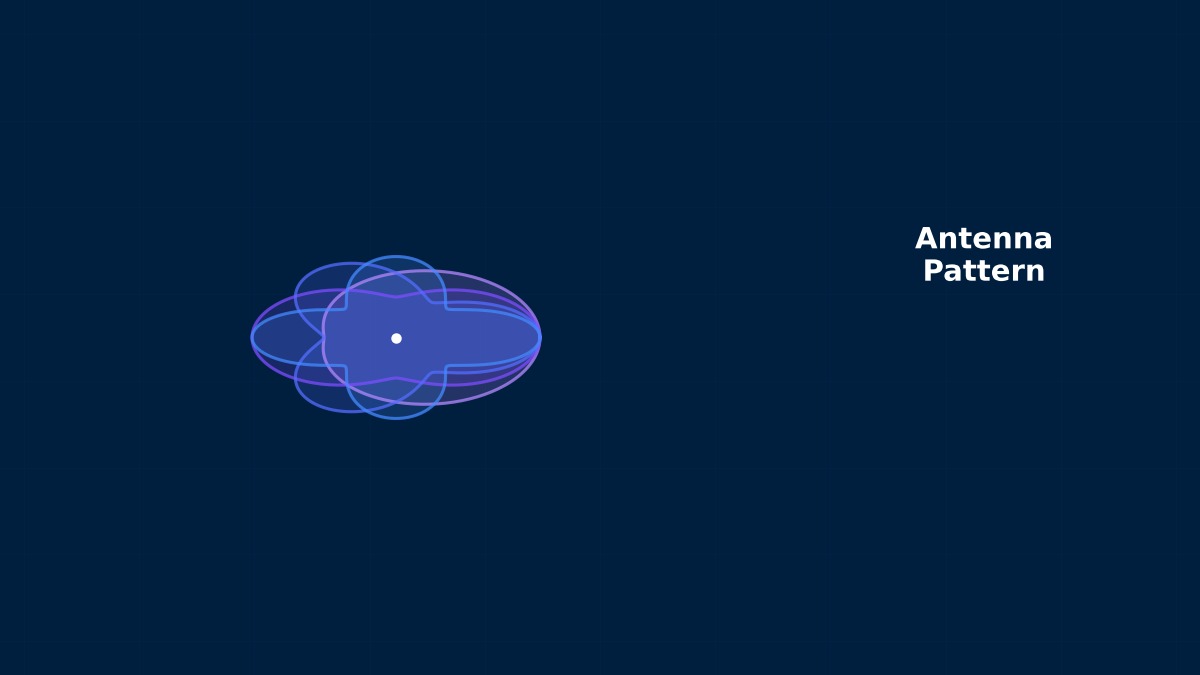
Recall the radiation pattern of a half-wave dipole. It has a figure-eight pattern in the E-plane (electric field direction) and is omnidirectional in the H-plane. For a slot antenna, the E-plane and H-plane are completely swapped. That is, the dipole's E-plane pattern becomes the slot's H-plane pattern. The polarization is also orthogonal—if the dipole is vertically polarized, the slot is horizontally polarized.
I see, the pattern shape is the same but the roles of the electric and magnetic fields are swapped. Very symmetrical...
The electromagnetic version of Babinet's principle was formulated by Booker (1946) and Sommerfeld. A slot cut into an infinite perfect conductor plate and a metal strip (dipole) of the same shape are in a complementary relationship, and the following holds:
Babinet's Principle (Electromagnetic Version)
$$\mathbf{E}_\text{slot}(\theta,\phi) = \pm\,\frac{1}{\eta}\,\mathbf{H}_\text{dipole}(\theta,\phi)$$Here, $\eta = \sqrt{\mu_0/\varepsilon_0} \approx 376.73\;\Omega$ is the free-space impedance. The slot's electric field is proportional to the dipole's magnetic field, and the polarization direction rotates by 90°.
Derivation of Slot Impedance
I understand the pattern swap. So what about the impedance? It seems like it would be a completely different value from the dipole's 73Ω.
Sharp observation. The most important relationship derived from Babinet's principle is this:
Booker's Complementary Impedance Relation
$$Z_\text{slot} \cdot Z_\text{dipole} = \frac{\eta^2}{4}$$$Z_\text{dipole}$ is the input impedance of a dipole of the same dimensions, and $Z_\text{slot}$ is the input impedance of the slot. The resonant impedance of a half-wave dipole is approximately $73 + j42\;\Omega$, so at resonance (ignoring the reactive part and calculating with just the real part):
That is, the input impedance of a half-wave slot is about 486Ω. This is much higher than the dipole's 73Ω. This means matching to a 50Ω system is difficult, and in practice, this is addressed with offset feeding or resonant length adjustment.
486Ω is high! If directly connected to a 50Ω coaxial cable, most would be reflected... How do you achieve matching?
There are three common techniques in practice:
- Offset Feeding: Moving the feed point away from the slot center lowers the impedance as it approaches a voltage node. In waveguide slot arrays, slots are offset from the broadwall center to utilize this.
- Slot Width Adjustment: Changing the width $w$ alters the impedance. Increasing the width broadens the bandwidth but trades off with worse cross-polarization.
- Cavity-Backed Structure: Placing a cavity (hollow space) behind the slot allows for single-sided radiation while adjusting the impedance via cavity dimensions.
Resonant Length and Bandwidth Design
Is the resonant length of a slot the same half-wavelength as a dipole?
Basically, yes. The resonant length of a thin slot on an ideal infinite conductor plate is $l \approx \lambda/2$. But in reality, when implemented on a substrate or cut into a waveguide wall, it is affected by the effective permittivity $\varepsilon_\text{eff}$:
Slot Resonance Condition
$$l_\text{res} \approx \frac{\lambda_0}{2\sqrt{\varepsilon_\text{eff}}} = \frac{c}{2f_r\sqrt{\varepsilon_\text{eff}}}$$Here, $c$ is the speed of light, $f_r$ is the resonant frequency, and $\varepsilon_\text{eff}$ is the effective permittivity.
I see. For example, at 10GHz with $\varepsilon_\text{eff} = 2.2$ (Teflon substrate), what would the resonant length be?
Let's calculate. $\lambda_0 = c/f = 3\times10^8 / 10\times10^9 = 30\;\text{mm}$, so:
$$l_\text{res} = \frac{30}{2\sqrt{2.2}} \approx \frac{30}{2 \times 1.483} \approx 10.1\;\text{mm}$$This is about 33% shorter than the free-space half-wavelength of 15mm. Ignoring this shortening effect in design will cause a significant shift in resonant frequency, so caution is needed.
How is the bandwidth determined?
The bandwidth of a slot is primarily determined by the ratio of slot width $w$ to length $l$, $w/l$. Roughly speaking:
- Narrow slot ($w/l < 0.05$): Bandwidth is on the order of a few percent. Sharp resonance, used when filter characteristics are needed.
- Wide slot ($w/l > 0.1$): Bandwidth expands to 10-20%. Suitable for broadband communication.
- Bow-tie slot: Shape widened in the center, enabling ultra-wideband performance over 40%.
For cavity-backed slots, the cavity depth (typically $\lambda/4$) also affects bandwidth. Deeper cavities widen bandwidth but trade off with a thicker profile.
Radiation Pattern Characteristics
I think a slot on an infinite conductor plate radiates to both sides, but in actual applications, single-sided radiation is more common, right?
Exactly. A slot on an infinite plate radiates equally to the front and back (gain is about $5\;\text{dBi}$, higher than the half-wave dipole's $2.15\;\text{dBi}$). But in practice, single-sided radiation is overwhelmingly desired. The methods used are:
- Cavity-Backing: Covering the back with a cavity, radiating only forward. Standard in radar and phased arrays.
- Waveguide Wall Slot: The waveguide itself acts as a cavity, radiating from the slot to the outside.
- Ground-Plane Substrate Slot: Method of cutting a slot in the ground plane of a microstrip substrate. Widely used in WiFi and IoT antennas.
Waveguide slot arrays use aligned slots to narrow the beam, right? How many are typically aligned?
It depends on the application, but for ship radar, 32-64 slots; for military phased arrays, it can be hundreds to thousands of slots. The key design point is individually adjusting each slot's offset to apply amplitude tapering with Taylor or Chebyshev distributions to suppress sidelobes. This is precisely where CAE comes in, and full-wave analysis including mutual coupling of all slots becomes essential.
Aircraft's "Invisible Antenna" — The Secret of Flush Mounting
Looking closely at a jet airliner's fuselage, the surface is smooth with no protrusions, yet the ATC transponder and weather radar operate. The secret is the slot antenna. A thin slit cut into the metal fuselage functions as a radiator equivalent to a dipole via Babinet's principle, eliminating the need for protruding external antennas. This avoids increased aerodynamic drag and is called "flush mounting," an essential technology for supersonic and stealth aircraft. The design difficulty lies in the fuselage curvature affecting impedance, causing significant deviation from flat-plate theoretical values, making CAE analysis with the actual shape indispensable.
Related Topics
Experience the theory firsthand with the interactive simulator for this field
All Simulators