Charge Distribution Analysis
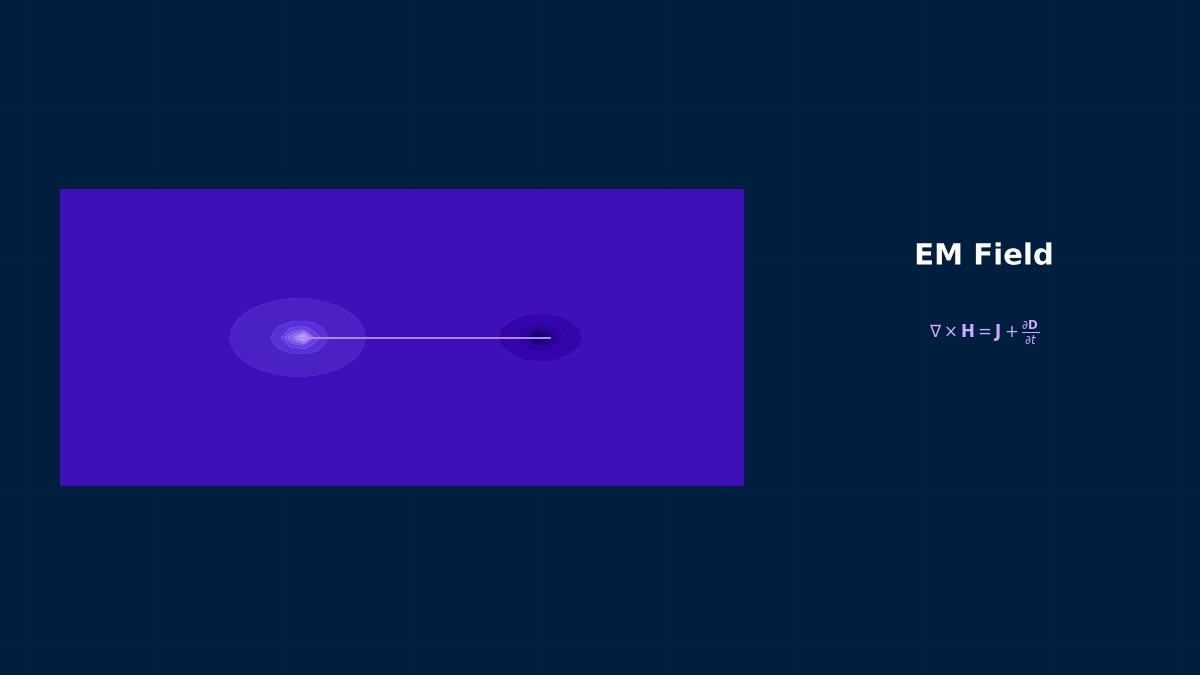
Theory and Physics
Charge Distribution
Professor, how is the charge distribution on a conductor determined?
A conductor is an equipotential body. Charge distributes only on the surface, and the electric field inside is zero. The surface charge density $\sigma_s$ is:
$E_n$: Electric field normal to the surface. Areas with high curvature (sharp points) have higher charge density and electric field.
That's why charge concentrates at the tip of a lightning rod.
Exactly. The surface electric field of a spherical conductor with radius $r$ is $E = V/r$, so a smaller radius results in a stronger electric field.
Space Charge
Charge can also exist inside insulators or gases (space charge):
- Semiconductor doping → Fixed charge from donors/acceptors
- Gas discharge → Mobile charge from ions/electrons
- Trapped charge in insulators → Cause of degradation
Summary
- Charge concentration on conductor surface — High curvature → High charge density
- $\sigma_s = \varepsilon_0 E_n$ — Relationship between surface charge density and normal electric field
- Space charge — Semiconductors, discharge, insulation degradation
Free Charge and Bound Charge—Gauss's Law as a Technique to "See Inside"
Gauss's law ∇·D=ρf, the fundamental equation of electrostatic analysis, is a simple relational expression stating that "the total amount of electric flux D (electric displacement) passing through a closed surface is equal to the free charge ρf inside." Polarization charge (bound charge) inside a dielectric does not appear in the divergence of D; by describing it with electric flux D, the influence of the dielectric can be absorbed into the material constant (relative permittivity ε_r). Thanks to this formulation, computational uniformity is achieved, allowing electrostatic fields to be solved within the same FEM framework for both dielectrics and metals.
Physical Meaning of Each Term
- Electric field term $\nabla \times \mathbf{E} = -\partial \mathbf{B}/\partial t$: Faraday's law of electromagnetic induction. A time-varying magnetic flux density generates an electromotive force. 【Everyday Example】A bicycle dynamo (generator) generates voltage in a nearby coil by rotating a magnet—a direct application of this law that a changing magnetic field induces an electric field. Induction cooking (IH) heaters also use the same principle, where high-frequency magnetic field changes induce eddy currents in the pot bottom, heating it via Joule heat.
- Magnetic field term $\nabla \times \mathbf{H} = \mathbf{J} + \partial \mathbf{D}/\partial t$: Ampère-Maxwell's law. Current and displacement current generate a magnetic field. 【Everyday Example】When current flows through a wire, a magnetic field is created around it—this is Ampère's law. Electromagnets operate on this principle, passing current through a coil to create a strong magnetic field. Smartphone speakers also apply this law: current → magnetic field → force on the diaphragm. At high frequencies (e.g., GHz-band antennas), the displacement current $\partial D/\partial t$ cannot be ignored, describing electromagnetic wave radiation.
- Gauss's Law $\nabla \cdot \mathbf{D} = \rho_v$: Indicates that charge is the divergence source of electric flux. 【Everyday Example】Rubbing hair with a plastic sheet creates static electricity, making hair stand on end—electric field lines radiate from the charged sheet (charge), exerting force on the light hair. In capacitor design, the electric field distribution between electrodes is calculated using this law. ESD (electrostatic discharge) countermeasures are also based on electric field analysis derived from Gauss's law.
- Magnetic flux conservation $\nabla \cdot \mathbf{B} = 0$: Expresses that magnetic monopoles do not exist. 【Everyday Example】Even if you cut a bar magnet in half, you cannot create a magnet with only an N pole or only an S pole—N and S poles always exist as a pair. This means magnetic field lines form "closed loops with no start or end points." In numerical analysis, to satisfy this condition, the formulation using vector potential $\mathbf{B} = \nabla \times \mathbf{A}$ is used, automatically guaranteeing magnetic flux conservation.
Assumptions and Applicability Limits
- Linear material assumption: Permeability and permittivity do not depend on magnetic/electric field strength (nonlinear B-H curve needed in saturation region)
- Quasi-static approximation (low frequency): Displacement current term can be ignored ($\omega \varepsilon \ll \sigma$). Common in eddy current analysis
- 2D assumption (cross-section analysis): Effective when current direction is uniform and edge effects can be ignored
- Isotropic assumption: For anisotropic materials (e.g., rolling direction of silicon steel plates), direction-specific property definitions are needed
- Non-applicable cases: Additional constitutive laws are needed for plasma (ionized gas), superconductors, nonlinear optical materials
Dimensional Analysis and Unit Systems
| Variable | SI Unit | Notes / Conversion Memo |
|---|---|---|
| Magnetic Flux Density $B$ | T (Tesla) | 1T = 1 Wb/m². Permanent magnets: 0.2 to 1.4T |
| Magnetic Field Strength $H$ | A/m | Horizontal axis of B-H curve. Conversion from CGS Oe (Oersted): 1 Oe = 79.577 A/m |
| Current Density $J$ | A/m² | Calculated from conductor cross-sectional area and total current. Note non-uniform distribution due to skin effect |
| Permeability $\mu$ | H/m | $\mu = \mu_0 \mu_r$. In vacuum $\mu_0 = 4\pi \times 10^{-7}$ H/m |
| Electrical Conductivity $\sigma$ | S/m | Copper: approx. 5.96×10⁷ S/m. Decreases with temperature rise |
Numerical Methods and Implementation
Charge Calculation in FEM
After solving for electric potential $\phi$ with FEM, surface charge density on conductors is calculated in post-processing:
Total charge is calculated by surface integration using Gauss's law. BEM (Boundary Element Method) directly treats surface charge density as an unknown, making it particularly suitable for calculating charge distribution.
Summary
FEM for Point Effect—Predicting Corona Discharge Inception Voltage
At electrode edges (sharp points) in high-voltage equipment, electric field concentration is significant, leading to local corona discharge. To predict this corona discharge inception voltage with FEM, extremely fine meshes must be placed at the tip to obtain the maximum electric field strength (Emax) with high accuracy. BEM (Boundary Element Method) automatically satisfies boundary conditions at infinity, so in some cases, such as transmission line electrode design, more accurate electric field calculations can be obtained with BEM than with cylindrical FEM. Accurate calculation of the "electric field concentration factor Kt=Emax/E_mean" is the starting point for corona countermeasure design.
Edge Elements (Nedelec Elements)
Elements specialized for electromagnetic field analysis. Automatically guarantee continuity of tangential components and eliminate spurious modes. Standard for 3D high-frequency analysis.
Nodal Elements
Used for scalar potential formulation. Effective for scalar potential methods in magnetostatics and electrostatic field analysis.
FEM vs BEM (Boundary Element Method)
FEM: Handles nonlinear materials and non-homogeneous media. BEM: Naturally handles infinite domains (open region problems). Hybrid FEM-BEM is also effective.
Nonlinear Convergence (Magnetic Saturation)
Nonlinearity of B-H curve is handled by Newton-Raphson method. Residual criterion: $||R||/||R_0|| < 10^{-4}$ is typical.
Frequency Domain Analysis
Reduced to a steady-state problem by assuming time-harmonic conditions. Requires complex number operations, but wideband characteristics are obtained via time-domain analysis.
Time Domain Time Step
Time step less than 1/20 of the highest frequency component is required. Implicit time integration allows larger steps but requires attention to accuracy.
Choosing Between Frequency Domain and Time Domain
Frequency domain analysis is like "tuning a radio to a specific frequency"—it can efficiently calculate the response at a single frequency. Time domain analysis is like "recording all channels simultaneously"—it can reproduce transient phenomena containing all frequency components, but computational cost is high.
Practical Guide
Practical Applications
Main applications: Electrostatic countermeasures (ESD), anti-static design, semiconductor doping distribution.
Checklist
Related Topics
なった
詳しく
報告