Coulomb's Law
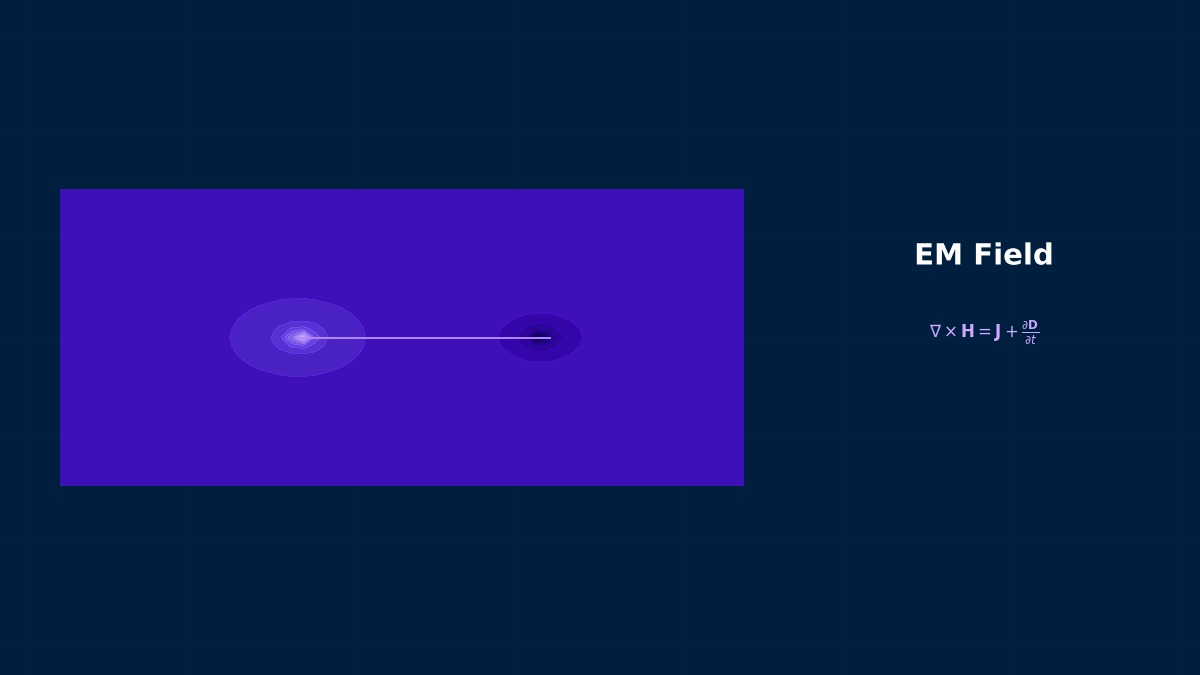
Coulomb's Law: Theoretical Foundations
Coulomb's Law
Professor, Coulomb's Law is the starting point of electromagnetism, right?
It is the most fundamental law describing the force acting between two point charges.
$\varepsilon_0 = 8.854 \times 10^{-12}$ F/m (vacuum permittivity). Like signs cause repulsion, opposite signs cause attraction.
Inversely proportional to the square of the distance... it has the same form as gravity.
Correct. However, the electric force is $10^{36}$ times stronger than gravity. Comparing the electric force and gravity between two electrons, the electric force is overwhelmingly stronger. The reason we don't feel electric forces in daily life is because positive and negative charges almost completely cancel each other out.
Electric Field (Electric Field)
Electric field created by a point charge $q$:
$$ \mathbf{E} = \frac{1}{4\pi\varepsilon_0}\frac{q}{r^2}\hat{\mathbf{r}} $$
The electric field is "force per unit charge". If the electric field is known, the force acting on any charge $Q$ can be calculated as $\mathbf{F} = Q\mathbf{E}$.
Superposition Principle
When multiple charges are present, the total electric field is the vector sum of the fields created by each charge. Linearity holds.
$$ \mathbf{E}_{total} = \sum_i \frac{1}{4\pi\varepsilon_0}\frac{q_i}{r_i^2}\hat{\mathbf{r}}_i $$
For continuous distributions, this is replaced by an integral. This is the foundation for solving electrostatic fields with FEM.
Summary
- $F \propto q_1 q_2 / r^2$ — Inversely proportional to the square of the distance
- Electric field $\mathbf{E}$ — Force per unit charge
- Superposition principle — Linearity is the foundation of FEM
Coffee Break Yomoyama Talk
Coulomb's Torsion Balance—The Astonishing Accuracy of 1785
Coulomb demonstrated the inverse-square law in 1785. The tool he used was a "torsion balance", a device that measures force from the twist angle of a thin metal wire. Using this analog method of reading the force between charged spheres from their minute twist angles, he achieved results of surprisingly high accuracy even compared to modern measuring instruments. At that time, neither Ohm's law nor Ampère's law existed, and even the "strength of electric force" was not quantitatively known. By deriving the inverse-square relationship from meticulous experiments, Coulomb enabled the later theoretical framework of electromagnetism. Behind the $F = kq_1q_2/r^2$ we use so casually in CAE lies such a craftsman-like experiment.
Electric field created by a point charge $q$:
The electric field is "force per unit charge". If the electric field is known, the force acting on any charge $Q$ can be calculated as $\mathbf{F} = Q\mathbf{E}$.
When multiple charges are present, the total electric field is the vector sum of the fields created by each charge. Linearity holds.
For continuous distributions, this is replaced by an integral. This is the foundation for solving electrostatic fields with FEM.
- $F \propto q_1 q_2 / r^2$ — Inversely proportional to the square of the distance
- Electric field $\mathbf{E}$ — Force per unit charge
- Superposition principle — Linearity is the foundation of FEM
Coulomb's Torsion Balance—The Astonishing Accuracy of 1785
Coulomb demonstrated the inverse-square law in 1785. The tool he used was a "torsion balance", a device that measures force from the twist angle of a thin metal wire. Using this analog method of reading the force between charged spheres from their minute twist angles, he achieved results of surprisingly high accuracy even compared to modern measuring instruments. At that time, neither Ohm's law nor Ampère's law existed, and even the "strength of electric force" was not quantitatively known. By deriving the inverse-square relationship from meticulous experiments, Coulomb enabled the later theoretical framework of electromagnetism. Behind the $F = kq_1q_2/r^2$ we use so casually in CAE lies such a craftsman-like experiment.
Computational Methods for Coulomb's Law
FEM for Electrostatic Fields
How do you solve Coulomb's Law with FEM?
Rather than calculating Coulomb's law directly, we reduce it to the Poisson equation.
$\phi$: Electric potential, $\rho_v$: Charge density. Solve for $\phi$ using FEM, then calculate the electric field as $\mathbf{E} = -\nabla\phi$.
So solving the Poisson equation is more efficient.
Direct Coulomb force calculation is $O(N^2)$, but with FEM you only need to solve a sparse matrix. BEM (Boundary Element Method) is also effective for open-space problems.
Summary
- Poisson equation — Differential form of Coulomb's law
- Solve for potential $\phi$ with FEM → $\mathbf{E} = -\nabla\phi$ — Standard method
- BEM — Effective for open-space electrostatic fields
Problems Solvable and Unsolvable with Point Charge Models
The biggest pitfall in the numerical implementation of Coulomb's law is "the vicinity of a point charge". As the distance $r \to 0$, the force diverges to infinity, so in FEM or BEM, charges must be treated as finite-sized charged bodies, or singularity handling must be introduced. A common practical problem is "electric field concentration at the tip of a needle electrode causing simulation divergence". In practice, a trick used is to model the tip as a tiny sphere to avoid the singularity. Even though the theoretical formula is simple, it's interesting that the idealization of a "point charge" cannot be used as-is in numerical implementation.
Experience the theory firsthand with the interactive simulator for this field
All Simulators