Electromagnetic Field Simulation of Dielectric Resonators
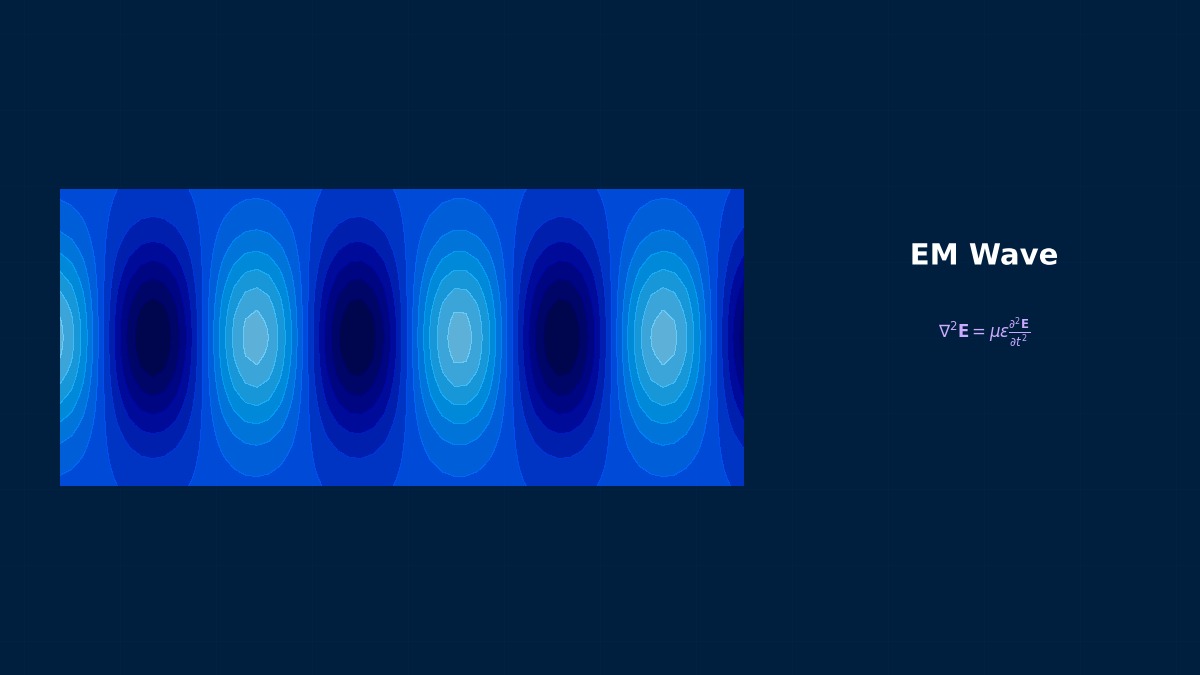
Electromagnetic Field Simulation of Dielectric Resonators: Theoretical Foundations
What is a Dielectric Resonator?
So a dielectric resonator is just a ceramic block that resonates? How is it different from a metal cavity?
Simply put, it's a device where electromagnetic waves are confined and resonate inside a high-permittivity ceramic ($\varepsilon_r = 20 \sim 90$). Unlike a cavity resonator surrounded by metal walls, it uses the permittivity difference between the dielectric and air to cause "internal reflection" of the waves.
Wait, it can be confined even without metal walls?
Yes. It's the same principle of total internal reflection as in optical fibers. The higher the $\varepsilon_r$, the shorter the wavelength becomes—since $\lambda = \lambda_0 / \sqrt{\varepsilon_r}$, the resonator can be made smaller for the same frequency. For example, with a ceramic of $\varepsilon_r = 36$, the size can be about 1/6 that of a metal cavity. They are used for frequency stabilization in filters and oscillators for 5G base stations.
I've heard the Q factor is also high. About how high?
The unloaded Q factor ($Q_u$) is extremely high, ranging from 10,000 to 100,000. Metal cavities are limited to Q factors of a few thousand due to conductor loss, but dielectrics can use low-loss materials with $\tan\delta$ below $10^{-4}$. That's why base station filters can sharply cut off out-of-band signals.
| Item | Dielectric Resonator (DR) | Metal Cavity Resonator |
|---|---|---|
| Resonance Principle | Internal reflection due to permittivity difference | Total reflection at metal walls |
| Typical Qu | 10,000 to 100,000 | 2,000 to 10,000 |
| Size | Small ($\propto 1/\sqrt{\varepsilon_r}$) | Large |
| Frequency Stability | Can achieve $\tau_f \approx 0$ ppm/K | Depends on metal thermal expansion |
| Main Applications | Base station filters, oscillators | Particle accelerators, radar |
Resonant Modes (TE/TM/HE/EH)
Are the resonant modes of a DR different from the TE/TM modes of a cavity resonator?
In metal cavities, pure TE and TM modes exist, but DRs have an open structure, so they become "hybrid modes" where both electric and magnetic field components remain in the axial direction. HE modes are hybrid modes where the magnetic field component is dominant, and EH modes are where the electric field component is dominant.
Which mode is commonly used in filter design?
The most widely used is the TE01δ mode. It is the lowest-order mode that has no axial (z-direction) electric field component $E_z$, and the electric field is distributed in the circumferential direction. The subscript $\delta$ indicates that the axial confinement is incomplete—meaning the electromagnetic field slightly leaks outside the dielectric. It has the highest Q factor and good frequency separation from other modes, making it the standard for filter design.
In dual-mode filters, the double degeneracy (two orthogonal polarizations) of the HE11δ mode is sometimes used to achieve two resonances with a single DR. This allows the number of elements to be halved, which is valuable for input/output filters in satellite communications.
Approximate Formula for Resonant Frequency
How do you calculate the resonant frequency? Can it be solved analytically?
For cylindrical DRs, there is no exact solution, but Courtney's model or Kajfez's approximate formulas are often used. A typical approximate formula for the TE01δ mode is this:
What do $a$ and $h$ represent?
$a$ is the cylinder radius, and $h$ is the height. For example, for a DR with $\varepsilon_r = 36$, $a = 5\,\text{mm}$, $h = 4\,\text{mm}$, $f_0 \approx 4.8\,\text{GHz}$. In practice, we use this formula to estimate the initial value and then refine it precisely using FEM.
For a more precise approximation, there is also the formula proposed by Kishk et al. (with accuracy around $\pm 2\%$ over a wide range of permittivity and aspect ratios):
Q Factor (Quality Factor)
I understand that a higher Q factor improves filter characteristics, but what exactly does the Q factor measure?
The Q factor is the ratio of "stored energy" to "energy lost per cycle." In formula form:
For DRs, losses are divided into three parts: dielectric loss $Q_d$, conductor loss $Q_c$ (if there is a metal enclosure), and radiation loss $Q_r$:
What are their typical values?
Dielectric loss is often dominant, and it can be approximated as $Q_d = 1/\tan\delta$. For a material with $\tan\delta = 10^{-4}$, $Q_d \approx 10{,}000$. When placed in a metal shielding enclosure, $Q_c$ is on the order of tens of thousands, and $Q_r$ can be considered virtually infinite. So often $Q_u \approx Q_d$.
| Loss Factor | Formula | Typical Value | Dominant Condition |
|---|---|---|---|
| Dielectric Loss $Q_d$ | $1 / \tan\delta$ | 5,000 to 100,000 | Dominant in most cases |
| Conductor Loss $Q_c$ | $\propto \sqrt{f} / R_s$ | 10,000 to 50,000 | When enclosure walls are close |
| Radiation Loss $Q_r$ | $\propto (\varepsilon_r)^{3/2}$ | $> 100{,}000$ | Only in open structures |
Temperature Coefficient $\tau_f$
Base stations are placed outdoors, so they experience significant temperature changes. Is the resonant frequency stable?
The temperature coefficient $\tau_f$ (unit: ppm/K) evaluates the frequency shift due to temperature change:
Here, $\tau_\varepsilon$ is the temperature coefficient of permittivity, and $\alpha_L$ is the linear expansion coefficient. For practical DR materials, the composition is adjusted to achieve $\tau_f \approx 0\,\text{ppm/K}$. For example, the Ba-Zn-Ta (BZT) system achieves $\tau_f = 0 \pm 2\,\text{ppm/K}$, keeping frequency drift below 0.01% even in environments from $-40°$C to $+60°$C.
That's incredible precision! Do you also perform temperature analysis with CAE?
Yes. Using multiphysics tools like COMSOL for coupled thermal-electromagnetic field analysis allows evaluation of how local $\varepsilon_r$ variations due to temperature distribution within the enclosure affect the resonant frequency. Especially for high-power filters, the effect of self-heating cannot be ignored, making coupled analysis essential.
The Firing Process Determines the Frequency
Material development for dielectric resonators is truly a battle with "the firing process of ceramics." By adjusting the mixing ratio of BaTiO3-BaZrO3 systems in units of 0.1mol% and controlling the firing temperature with $\pm5°$C precision, $\varepsilon_r$ changes, which directly affects the resonant frequency. In the past, this relied on the intuition of veteran engineers, but now material design combining CAE parametric studies and Design of Experiments (DoE) is mainstream. This is a prime example of "artisan skill" being replaced by digital twins.