Electromagnetic Force
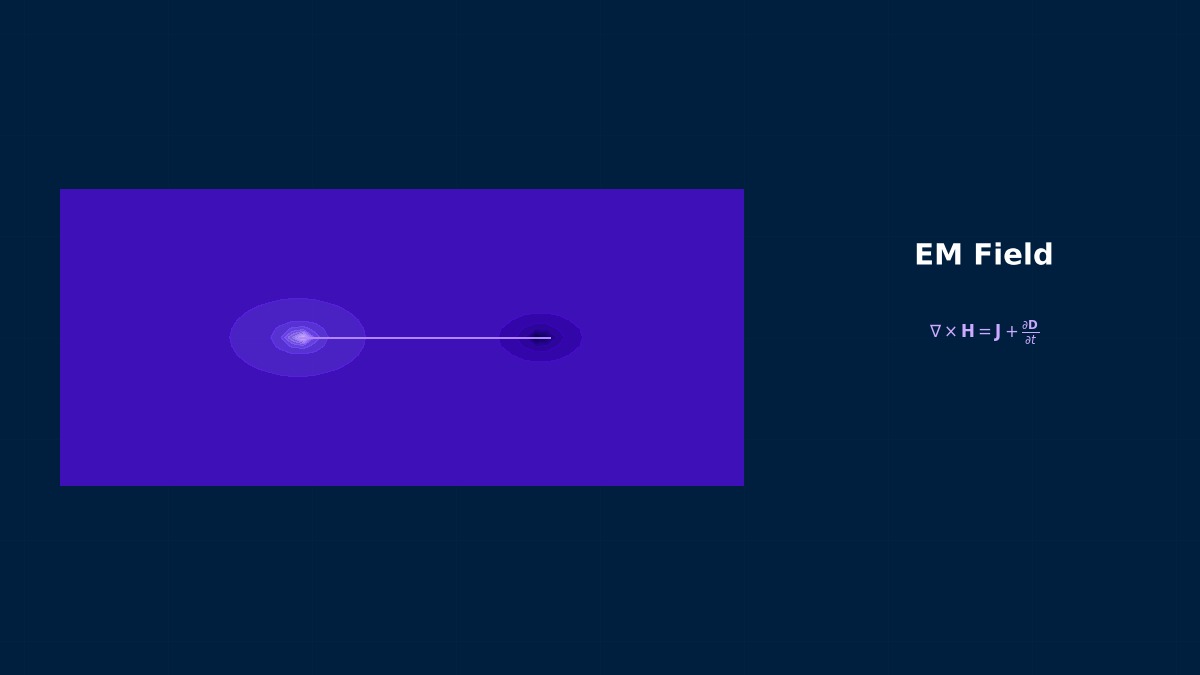
Theory and Physics
Fundamentals of Electromagnetic Force
Professor, calculating electromagnetic force is at the core of motor design, right?
The force experienced by an electric current in a magnetic field, namely the Lorentz force, is the starting point.
For current in a conductor, the volume force density is:
How is the Maxwell stress tensor used?
The stress tensor derived from the magnetic field energy:
Force is calculated via surface integration: $F_i = \oint_S T_{ij} n_j \, dS$. Another method is the principle of virtual work: $F = -\partial W_m / \partial x$.
Summary
- Lorentz Force — $\mathbf{f} = \mathbf{J} \times \mathbf{B}$
- Maxwell Stress Tensor — Calculates force via surface integration
- Virtual Work Method — High-precision method to obtain force from energy change
The Discovery of Lorentz Force—The Force Was Measured Before the Electron's Mass
When we say "electromagnetic force," we think of the Lorentz force F = q(E + v × B). This force law was experimentally established in the 1890s, thanks to Hendrik Lorentz's theoretical organization. Interestingly, the law of electromagnetic force was measured before the existence of the electron (discovered by J.J. Thomson in 1897). At a stage when neither the mass nor the charge of charged particles was known, the phenomenon of "a current experiencing a force in a magnetic field" could be described quantitatively. This is a classic example in the history of physics where theory construction preceded the elucidation of the physical entity.
Physical Meaning of Each Term
- Electric Field Term $\nabla \times \mathbf{E} = -\partial \mathbf{B}/\partial t$: Faraday's law of electromagnetic induction. A time-varying magnetic flux density generates an electromotive force. 【Everyday Example】A bicycle dynamo (generator) produces a voltage in a nearby coil by rotating a magnet—a direct application of this law that a changing magnetic field induces an electric field. Induction cooking (IH) heaters also use the same principle, where high-frequency magnetic field changes induce eddy currents in the pot bottom, heating it via Joule heat.
- Magnetic Field Term $\nabla \times \mathbf{H} = \mathbf{J} + \partial \mathbf{D}/\partial t$: Ampère-Maxwell's law. Electric current and displacement current generate a magnetic field. 【Everyday Example】When current flows through a wire, a magnetic field is created around it—this is Ampère's law. Electromagnets operate on this principle, passing current through a coil to create a strong magnetic field. Smartphone speakers also apply this law: current → magnetic field → force on the diaphragm. At high frequencies (e.g., GHz-band antennas), the displacement current $\partial D/\partial t$ cannot be ignored, describing electromagnetic wave radiation.
- Gauss's Law $\nabla \cdot \mathbf{D} = \rho_v$: Indicates that electric charge is the divergence source of electric flux. 【Everyday Example】Rubbing a plastic sheet against hair makes hair stand up due to static electricity—the charged sheet (electric charge) radiates electric field lines outward, exerting force on the light hair. In capacitor design, the electric field distribution between electrodes is calculated using this law. ESD (electrostatic discharge) countermeasures are also based on electric field analysis grounded in Gauss's law.
- Magnetic Flux Conservation $\nabla \cdot \mathbf{B} = 0$: Expresses that magnetic monopoles do not exist. 【Everyday Example】Cutting a bar magnet in half does not create a magnet with only a N pole or only a S pole—N and S poles always exist as a pair. This means magnetic field lines form "closed loops with no start or end points." In numerical analysis, the formulation using vector potential $\mathbf{B} = \nabla \times \mathbf{A}$ is used to satisfy this condition, automatically guaranteeing magnetic flux conservation.
Assumptions and Applicability Limits
- Linear material assumption: Permeability and permittivity are independent of magnetic/electric field strength (nonlinear B-H curve needed in saturation region)
- Quasi-static approximation (low frequency): Displacement current term can be ignored ($\omega \varepsilon \ll \sigma$). Common in eddy current analysis
- 2D assumption (cross-section analysis): Effective when current direction is uniform and end effects can be ignored
- Isotropy assumption: For anisotropic materials (e.g., silicon steel rolling direction), direction-specific property definitions are needed
- Non-applicable cases: Additional constitutive relations are needed for plasma (ionized gas), superconductors, nonlinear optical materials
Dimensional Analysis and Unit Systems
| Variable | SI Unit | Notes / Conversion Memo |
|---|---|---|
| Magnetic Flux Density $B$ | T (Tesla) | 1T = 1 Wb/m². Permanent magnets: 0.2 to 1.4T |
| Magnetic Field Strength $H$ | A/m | Horizontal axis of B-H curve. Conversion from CGS Oersted: 1 Oe = 79.577 A/m |
| Current Density $J$ | A/m² | Calculated from conductor cross-section and total current. Note non-uniform distribution due to skin effect |
| Permeability $\mu$ | H/m | $\mu = \mu_0 \mu_r$. In vacuum $\mu_0 = 4\pi \times 10^{-7}$ H/m |
| Electrical Conductivity $\sigma$ | S/m | Copper: approx. 5.96×10⁷ S/m. Decreases with temperature rise |
Numerical Methods and Implementation
Force Calculation Methods in FEM
Are there multiple methods to calculate electromagnetic force in FEM?
There are mainly three methods.
1. Maxwell Stress Tensor Method — Calculates force on an integration surface in the air gap. Results depend on surface position, so average over multiple surfaces
2. Virtual Work Method — Calculates force from energy change when an object is infinitesimally displaced. Highest accuracy
3. Arkkio's Method — Volume integration over the air gap. Standard method for torque calculation in rotating machines
Which method is used in JMAG?
JMAG also implements the Nodal Force Method. It directly calculates the electromagnetic force acting on each node, which can be passed as a load for structural analysis. In Ansys Maxwell, the Virtual Work Method is the default.
Summary
- Maxwell Stress — Simple but depends on integration surface
- Virtual Work Method — High accuracy but high computational cost
- Arkkio's Method — Standard for rotating machine torque
Maxwell Stress Method or Lorentz Force Method?—The Mystery of Mismatched Answers
There are two types of methods for determining electromagnetic force: the "Maxwell Stress Tensor Method" and the "Lorentz Force Method (Virtual Work Method)." In theory, the total force should match regardless of which method is used. However, in practical FEA calculations, results can sometimes slightly differ. The cause is mesh coarseness; the stress tensor method is sensitive to the accuracy of magnetic field values on the integration surface, so errors can occur if the mesh on the air gap surface is coarse. The standard countermeasure is to "set up a fine mesh layer on the air gap." Mastering just this one point makes the results from the two methods almost coincide.
Edge Elements (Nedelec Elements)
Elements specialized for electromagnetic field analysis. Automatically guarantee continuity of tangential components and eliminate spurious modes. Standard for 3D high-frequency analysis.
Nodal Elements
Used for scalar potential formulations. Effective for scalar potential methods in magnetostatics and electrostatic field analysis.
FEM vs BEM (Boundary Element Method)
FEM: Handles nonlinear materials and non-homogeneous media. BEM: Naturally handles infinite domains (open region problems). Hybrid FEM-BEM is also effective.
Nonlinear Convergence (Magnetic Saturation)
Nonlinearity of B-H curve handled by Newton-Raphson method. Residual criterion: $||R||/||R_0|| < 10^{-4}$ is typical.
Frequency Domain Analysis
Reduced to a steady-state problem by assuming time-harmonic conditions. Requires complex number operations, but broadband characteristics are obtained via time-domain analysis.
Time Domain Time Step
Time step must be less than 1/20 of the highest frequency component. Implicit time integration allows larger steps but requires attention to accuracy.
Choosing Between Frequency Domain and Time Domain
Frequency domain analysis is like "tuning a radio to a specific frequency"—it can efficiently calculate the response at a single frequency. Time domain analysis is like "recording all channels simultaneously"—it can reproduce transient phenomena containing all frequency components, but computational cost is high.
Related Topics
なった
詳しく
報告