Electromagnetic Wave Propagation
Theory and Physics
Maxwell's Equations and the Wave Equation
Professor, could you please explain the governing equations for electromagnetic waves?
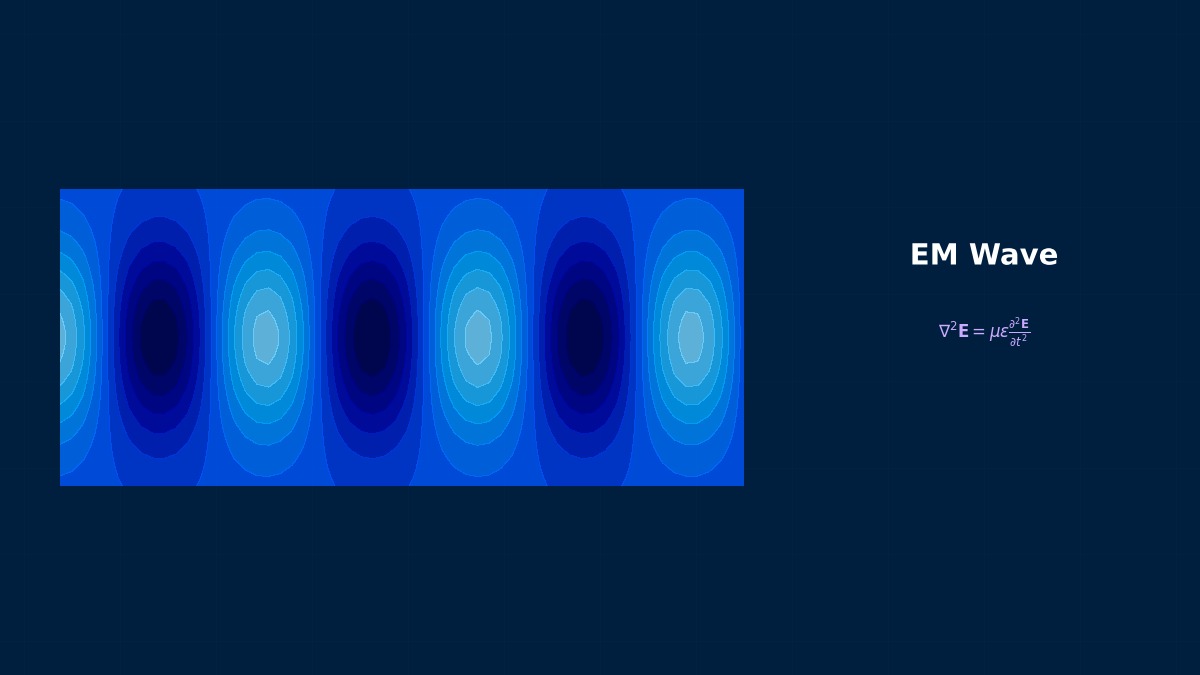
The wave equation derived from Maxwell's equations:
Phase velocity $v_p = 1/\sqrt{\mu\varepsilon}$. In vacuum, the speed of light $c = 3 \times 10^8$ m/s.
So the velocity slows down in dielectric materials, right?
In a medium with relative permittivity $\varepsilon_r$, $v_p = c/\sqrt{\varepsilon_r}$. In an FR-4 substrate ($\varepsilon_r \approx 4.4$), it's about $0.48c$. The wavelength also shortens, which becomes a size issue in high-frequency circuits.
Summary
- Wave Equation — Derived from Maxwell's equations
- Phase Velocity $v_p = c/\sqrt{\varepsilon_r}$ — Slows down in media
- Lossy Media — Extend $\varepsilon$ to complex $\varepsilon' - j\varepsilon''$
Electromagnetic waves predicted by Maxwell in 1865—23 years until Hertz proved them
Maxwell predicted the existence of electromagnetic waves from his equations in 1865. However, many physicists were skeptical of this "mathematical existence," and it was not until 1888—a full 23 years later—that Heinrich Hertz successfully demonstrated the transmission and reception of electromagnetic waves in a laboratory. Hertz used spark discharge to generate radio waves of several hundred MHz. The theory of electromagnetic waves in the GHz to hundreds of GHz range handled by modern high-frequency CAE is built upon the work of these two giants. Whenever you look at Maxwell's equations, remember the weight of those 23 years.
Physical Meaning of Each Term
- Electric Field Term $\nabla \times \mathbf{E} = -\partial \mathbf{B}/\partial t$: Faraday's law of electromagnetic induction. A time-varying magnetic flux density generates an electromotive force. 【Everyday Example】A bicycle dynamo (generator) produces voltage in a nearby coil by rotating a magnet—a direct application of this law where a changing magnetic field induces an electric field. An induction heating (IH) cooker also uses the same principle, where a high-frequency magnetic field induces eddy currents in the pot bottom, heating it via Joule heating.
- Magnetic Field Term $\nabla \times \mathbf{H} = \mathbf{J} + \partial \mathbf{D}/\partial t$: Ampère-Maxwell law. Current and displacement current generate a magnetic field. 【Everyday Example】When current flows through a wire, a magnetic field is created around it—this is Ampère's law. Electromagnets operate on this principle, passing current through a coil to create a strong magnetic field. A smartphone speaker also applies this law: current → magnetic field → force on the diaphragm. At high frequencies (e.g., GHz-band antennas), the displacement current $\partial D/\partial t$ cannot be ignored and describes electromagnetic wave radiation.
- Gauss's Law $\nabla \cdot \mathbf{D} = \rho_v$: Indicates that electric charge is the divergence source of electric flux. 【Everyday Example】Rubbing a plastic sheet on hair makes hair stand up due to static electricity—electric field lines radiate from the charged sheet (charge) and exert force on the light hair. In capacitor design, the electric field distribution between electrodes is calculated using this law. ESD (electrostatic discharge) countermeasures are also based on electric field analysis following Gauss's law.
- Magnetic Flux Conservation $\nabla \cdot \mathbf{B} = 0$: States that magnetic monopoles do not exist. 【Everyday Example】If you cut a bar magnet in half, you cannot create a magnet with only a north or south pole—they always exist as a pair. This means magnetic field lines form "closed loops with no start or end points." In numerical analysis, to satisfy this condition, the formulation using vector potential $\mathbf{B} = \nabla \times \mathbf{A}$ is used, automatically guaranteeing magnetic flux conservation.
Assumptions and Applicability Limits
- Linear material assumption: Permeability and permittivity do not depend on magnetic/electric field strength (nonlinear B-H curve needed in saturation region)
- Quasi-static approximation (low frequency): Displacement current term can be ignored ($\omega \varepsilon \ll \sigma$). Common in eddy current analysis
- 2D assumption (cross-section analysis): Effective when current direction is uniform and edge effects can be ignored
- Isotropic assumption: For anisotropic materials (e.g., silicon steel rolling direction), direction-specific property definitions are needed
- Non-applicable cases: Additional constitutive relations are needed for plasma (ionized gas), superconductors, nonlinear optical materials
Dimensional Analysis and Unit Systems
| Variable | SI Unit | Notes / Conversion Memo |
|---|---|---|
| Magnetic Flux Density $B$ | T (Tesla) | 1T = 1 Wb/m². Permanent magnets: 0.2 to 1.4T |
| Magnetic Field Strength $H$ | A/m | Horizontal axis of B-H curve. Conversion from CGS Oe (Oersted): 1 Oe = 79.577 A/m |
| Current Density $J$ | A/m² | Calculated from conductor cross-section and total current. Note non-uniform distribution due to skin effect |
| Permeability $\mu$ | H/m | $\mu = \mu_0 \mu_r$. In vacuum $\mu_0 = 4\pi \times 10^{-7}$ H/m |
| Electrical Conductivity $\sigma$ | S/m | Copper: approx. 5.96×10⁷ S/m. Decreases with temperature rise |
Numerical Methods and Implementation
Numerical Methods
What numerical methods are used to solve electromagnetic waves?
| Method | Formulation | Strong Points |
|---|---|---|
| FEM | Frequency Domain | Resonators, waveguides, complex shapes |
| FDTD | Time Domain | Broadband, transient response, large-scale |
| MoM | Integral Equation | Open space, antennas |
| FIT | Integral Form Maxwell | Foundation of CST Studio Suite |
HFSS uses FEM, CST Studio Suite uses FIT/FDTD, FEKO (Altair) is based on MoM.
How do you determine the mesh size?
A guideline is less than 1/10 of the wavelength $\lambda$. With second-order FEM elements, $\lambda/5$ can still provide good accuracy. For FDTD, the CFL condition $\Delta t \leq \Delta x/(c\sqrt{3})$ must be satisfied.
Summary
- FEM (HFSS) — Frequency domain analysis for complex shapes
- FDTD (CST) — Time domain analysis for broadband
- $\lambda/10$ Rule — Guideline for mesh size
Ray Tracing Method and Radio Wave Design for Cellular Base Stations
For cellular base station design in urban areas, radio wave propagation simulation considering reflection, diffraction, and scattering of electromagnetic waves by buildings and terrain is essential. Full-wave FDTD is accurate but computationally prohibitively expensive for city models spanning hundreds of meters. This is where the Ray Tracing method shines, quickly calculating propagation loss and delay for each path using an analogy of light ray tracing. It is still used today for "area design" to determine optimal 5G base station placement, and the accuracy of the building model greatly influences simulation accuracy.
Edge Elements (Nedelec Elements)
Elements specialized for electromagnetic field analysis. Automatically guarantee continuity of tangential components and eliminate spurious modes. Standard for 3D high-frequency analysis.
Nodal Elements
Used for scalar potential formulations. Effective for scalar potential methods in magnetostatics and electrostatic field analysis.
Related Topics
なった
詳しく
報告