Cogging Torque Analysis and Reduction Methods
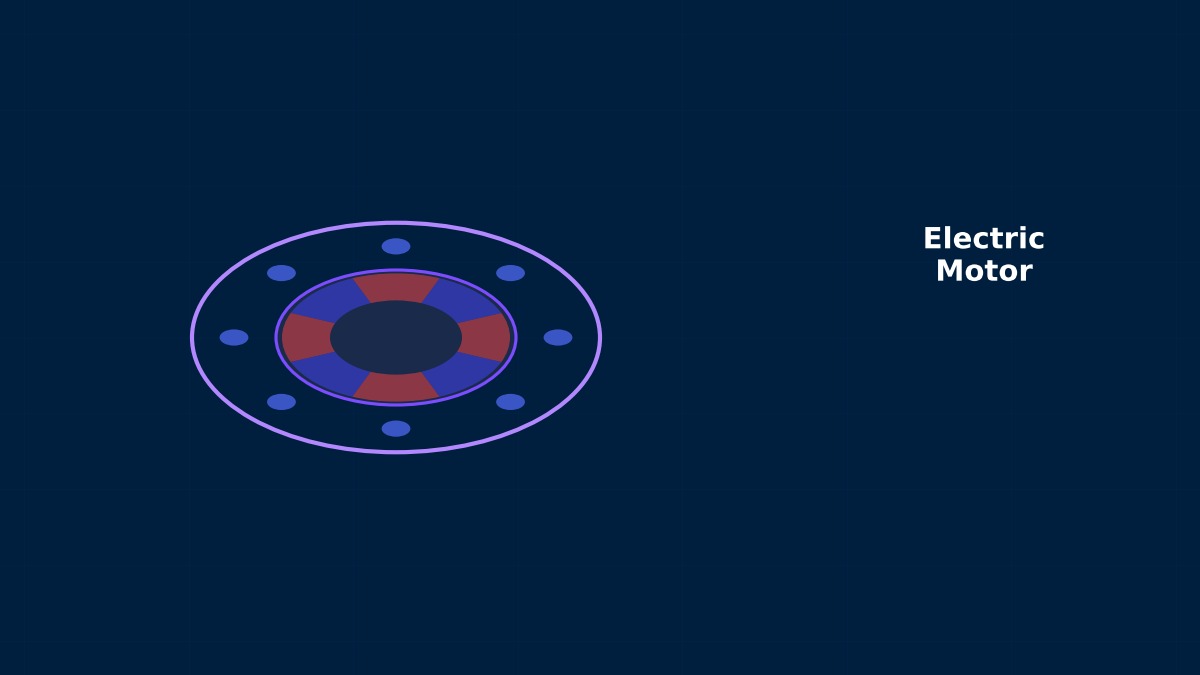
Cogging Torque Analysis and Reduction Methods: Theoretical Foundations
What is Cogging Torque?
Is cogging torque that 'rumbling' feeling when a motor rotates?
Yes, it's the pulsating torque caused by the magnetic attraction between the permanent magnets and the slots. It directly affects the quietness of EVs and the positioning accuracy of robots.
So torque is produced even without current flowing? That's strange.
Exactly. Even without current in the coils, when the magnetic flux lines from the permanent magnets pass through the stator slot openings, the magnetic reluctance changes depending on the angle. Magnetic flux lines prefer the 'easier path,' so when a magnet approaches a slot opening, a catching force is generated. This is cogging torque.
I see, it's like the 'notchy' feeling when you turn a bicycle dynamo by hand.
Good analogy. In fact, if cogging torque is high in an EV's steering motor, the driver feels vibration every time they turn the wheel. For industrial robots, positioning accuracy drops, and for linear motors, it directly affects stopping accuracy. So 'how to reduce cogging' is a key area where motor designers show their skill.
Generation Mechanism
I'd like to know more about why pulsation occurs. Is it related to the magnetic flux in the air gap?
The essence of cogging torque is that the magnetic energy $W_{mag}$ in the air gap fluctuates depending on the rotation angle $\theta$. The magnetic flux density is determined by the 'multiplication' of the magnetomotive force distribution created by the permanent magnets and the permeance (magnetic conductance) distribution caused by the slot openings.
Simply put, permeance drops sharply at the slot openings. Every time a magnet passes over this 'hole,' the energy fluctuates, and its angular derivative appears as cogging torque.
Here $i=0$ means the no-current state. In other words, cogging torque is determined purely by the geometric relationship between the magnets and slots.
So the image is that 'catching → release' repeats each time a magnet passes a single slot.
Actually, it's a bit more complex; a single magnet may simultaneously span multiple slots. Therefore, the period of cogging torque is not simply 'the number of slots,' but is determined by the least common multiple (LCM) of the pole number and slot number.
Governing Equations and Fourier Series Expansion
How is cogging torque expressed mathematically?
Since cogging torque is a periodic function, it's natural to expand it as a Fourier series.
Here $N_{LCM} = \text{LCM}(N_s,\, 2p)$ (LCM of slot number $N_s$ and pole number $2p$), $T_n$ is the amplitude of the $n$th harmonic, and $\phi_n$ is the phase.
If the LCM is larger, the fundamental frequency becomes higher, so does the amplitude become smaller?
Exactly right. Generally, as the harmonic order increases, the amplitude decays rapidly. Therefore, pole-slot combinations with a larger LCM tend to have smaller cogging torque.
Another important equation is torque calculation using the Maxwell stress tensor. Integrating over a closed surface $S$ in the air gap gives:
Here $B_r$, $B_\theta$ are the radial and tangential magnetic flux density components respectively, and $r$ is the air gap radius. In FEM analysis, this integral is calculated numerically to determine the cogging torque.
LCM Theory of Pole and Slot Numbers
Can you give me a concrete example of LCM? How much difference does it actually make?
Let's compare typical combinations.
| Pole Number 2p | Slot Number Ns | LCM | Cogging Tendency |
|---|---|---|---|
| 4 | 6 | 12 | Large (integer slot pitch) |
| 8 | 12 | 24 | Medium |
| 10 | 12 | 60 | Very small (fractional slot pitch) |
| 14 | 12 | 84 | Extremely small |
| 8 | 9 | 72 | Small (fractional slot concentrated winding) |
I often hear about 10-pole 12-slot for EV drive motors, so it's because the cogging is small!
Exactly. With LCM=60, the pulsation is distributed into 60 tiny pulses per rotation, so it feels almost zero. However, fractional slots have the disadvantage of a lower winding factor, so a trade-off with torque density is necessary. It's said that '70% of the cogging problem is decided at the stage of determining slot and pole numbers'—it's that important a design parameter.
System of Reduction Methods
Besides poles and slots, what other techniques are there to reduce cogging?
The main reduction methods can be summarized systematically as follows.
| Method | Principle | Reduction Effect | Side Effects |
|---|---|---|---|
| Skew (Inclination) | Inclining slots or magnets in the axial direction | 50–90% | Average torque drops by a few percent |
| Fractional Slot Pitch | Increase LCM to disperse harmonics | 60–95% | Possible reduction in winding factor |
| Magnet Shape Chamfering | Soften permeance change at magnet edges | 30–60% | Almost none |
| Magnet Eccentric Placement | Offset the arc center of magnets | 20–50% | Design complexity increases |
| Slot Opening Width Optimization | Reduce permeance fluctuation | 20–40% | Leakage flux increases |
| Step Skew | Shift phase in multiple axial segments | 60–85% | Lamination process complexity increases |
| Unequal Pitch Magnets | Vary the angle between adjacent magnets | 30–70% | Impact on torque ripple |
Skew alone can reduce it by 90%! Amazing.
Theoretically, skewing by one slot pitch ($360°/N_s$) makes the fundamental cogging wave zero. However, average torque also decreases in a sinc function manner, so in practice, it's often limited to about half a slot pitch. In any case, FEM analysis is essential for making quantitative decisions on 'which method to apply and to what extent.'
Cogging Can Be Halved Just by 'Chamfering' the Slot Opening
A practical and cost-effective method for reducing cogging torque is 'chamfering (chamfering) the slot opening.' Simply beveling the edges of the stator slot opening softens the steep permeance change when a magnet passes, which can reduce cogging torque by 30–50%. There's almost no added manufacturing cost, and the magnetic flux quantity hardly changes. In practice, it's common to use FEM to parametrically vary the shape and find the optimal chamfer angle and depth. 'Before tackling difficult multi-variable optimization, first try chamfering' is a golden rule in design sites.
Experience the theory firsthand with the interactive simulator for this field
All Simulators