Electromagnetic Field CAE Analysis of SPM Motors (Surface Permanent Magnet Type)
Electromagnetic Field CAE Analysis of SPM: Theoretical Foundations
SPM vs IPM — Structural Differences
What's the difference between surface permanent magnet and interior permanent magnet types?
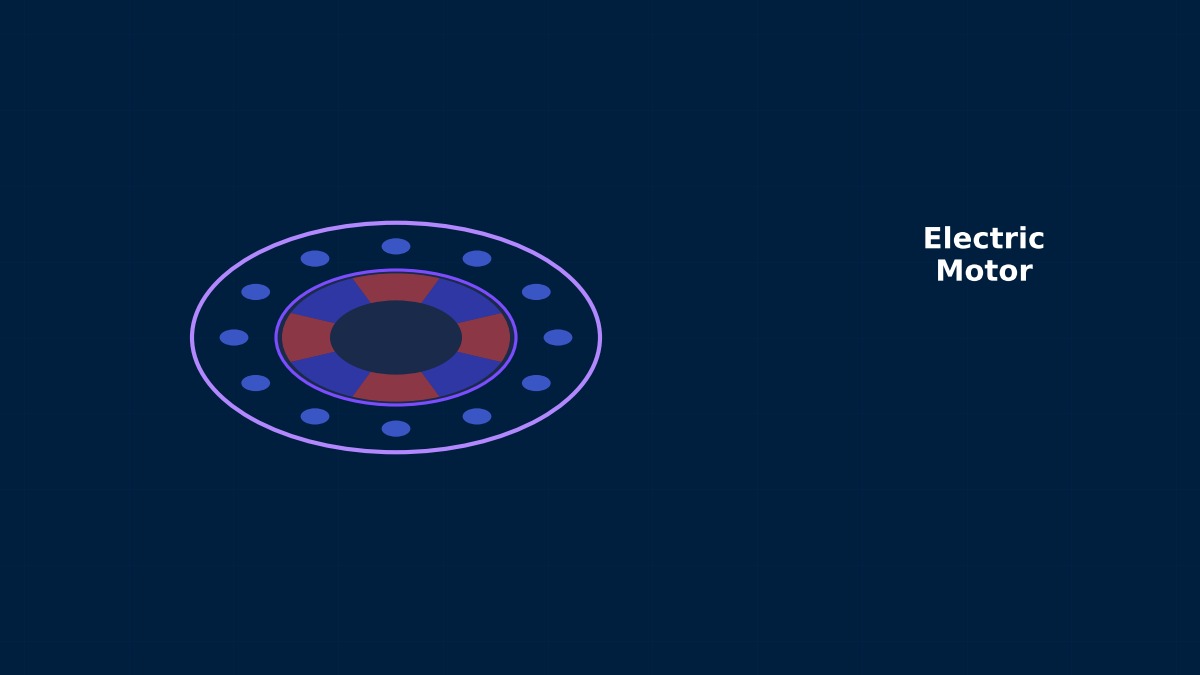
In SPM, magnets are attached to the rotor surface. Since the permeability of the magnet is almost the same as air, the d-axis and q-axis inductances are equal, and no reluctance torque is produced. The structure is simple and suitable for high-speed rotation, but there is a risk of magnets flying off due to centrifugal force.
Wow, magnets flying off sounds scary! So is IPM more versatile?
You can't say that definitively. IPM embeds magnets inside the rotor core, creating saliency and allowing the use of reluctance torque as well. However, punching holes in the core makes mechanical design more complex, and torque characteristics change drastically depending on the magnet placement pattern.
Thanks to its simple structure, SPM remains mainstream in applications where fast torque response is required, such as servo motors, robot joints, and drone motors. Control is also straightforward since Id=0 control works fine.
| Item | SPM (Surface Permanent Magnet) | IPM (Interior Permanent Magnet) |
|---|---|---|
| Magnet Position | Attached to rotor surface | Embedded inside rotor core |
| Saliency Ratio $L_q/L_d$ | ≒ 1 | 1.5 to 3.0 or more |
| Reluctance Torque | None | Present (30–50% of total torque) |
| Control Method | $I_d = 0$ control | Maximum Torque per Ampere (MTPA) control |
| High-Speed Rotation | Risk of magnet detachment due to centrifugal force | Safe, covered by core |
| Main Applications | Servo, robot joints, drones | EV traction motors, air conditioner compressors |
Airgap Flux Density Distribution
How is the flux density distributed in an SPM motor? What becomes important when analyzing it?
Since magnets are uniformly attached to the rotor surface in SPM, the airgap flux density distribution becomes nearly trapezoidal. If the magnet opening angle (the angle covered by the magnet per pole) is $\alpha_p$, the magnitude of the fundamental component can be obtained by Fourier expansion.
The fundamental wave amplitude of the airgap flux density due to magnets alone is approximated by:
Here, $B_r$ is the magnet remanent flux density, $l_m$ is the magnet thickness, $\mu_r$ is the magnet relative permeability (approx. 1.05 for NdFeB), $g$ is the mechanical airgap length, and $\alpha_p$ is the magnet opening ratio (0 to 1).
$\mu_r$ being 1.05 means the magnet's permeability is really almost the same as air! So that's why there's no difference between d-axis and q-axis...
Exactly. That's the physical essence of SPM. Since the magnet is on the d-axis but magnetically almost like air, $L_d \approx L_q$. This is the root cause of the characteristic "no reluctance torque is produced."
dq-Axis Model and Torque Equation
I learned about dq-axis transformation in class, but does the torque equation become simpler for SPM?
The general torque equation for PMSM is:
The first term is the magnet torque, and the second term is the reluctance torque. In SPM, since $L_d \approx L_q$, the second term disappears:
Here, $p$ is the number of pole pairs, $\Phi_m$ is the permanent magnet flux linkage, and $I_q$ is the q-axis current.
That's very simple. If torque is proportional to $I_q$, control seems easier too.
Yes. For SPM, setting $I_d = 0$ and generating torque solely with q-axis current is the most efficient. It can be controlled with the same intuition as a DC motor, which is why it's preferred for servo applications. However, without flux weakening control ($I_d < 0$), voltage becomes insufficient at high speeds—this is also a weakness of SPM.
The permanent magnet flux linkage $\Phi_m$ is calculated from the magnet shape and motor dimensions using:
$R_s$ is the stator inner radius, $L_{\text{stk}}$ is the stack length, and $k_w$ is the winding factor.
Back-EMF
Does the Back-EMF equation also take a special form for SPM?
The RMS value of the Back-EMF is expressed as:
$\omega_m$ is the mechanical angular velocity, $N_s$ is the number of stator turns, and $k_e$ is the Back-EMF constant. The Back-EMF waveform is determined by the Fourier components of the flux density distribution, and in SPM, the 5th and 7th harmonics can be suppressed by optimizing the magnet opening ratio $\alpha_p$.
In practice, $\alpha_p \approx 0.83$ (5/6) is often used. With this value, the 5th harmonic becomes almost zero. It's common to check the Back-EMF waveform in FEM analysis and aim for a THD (Total Harmonic Distortion) below 5%.
Loss Mechanism
What kinds of losses specifically exist in an SPM motor? I want to improve efficiency.
SPM motor losses are broadly classified into four categories:
- Copper Loss $P_{Cu} = 3 I^2 R_s$ — Heating due to winding resistance. Dominant in low-speed, high-torque regions.
- Iron Loss $P_{Fe} = k_h f B^{1.6} + k_e f^2 B^2$ — Hysteresis loss and eddy current loss. Increases rapidly at high speeds.
- Magnet Eddy Current Loss — A problem specific to SPM. Since magnets are conductive, slot harmonics induce eddy currents, causing magnet heating and increasing demagnetization risk.
- Mechanical Loss — Bearing friction and windage loss.
Magnet eddy current loss is specific to SPM, huh. Can it be calculated with FEM analysis?
It can, but caution is needed. You need to include magnet conductivity in the model and run a transient analysis, but the eddy current path changes depending on whether the magnet is segmented circumferentially. In actual motors, segmenting magnets into 3–5 pieces is common for demagnetization countermeasures, and if this segmentation isn't reproduced in the FEM model, the loss will be overestimated.
SPM Still Lives Inside Hard Disk Drives
Although somewhat overshadowed by smartphones, Hard Disk Drives (HDDs) almost exclusively use SPM (Surface Permanent Magnet) motors for their spindle. They require precision and reliability to spin at 5400–7200 rpm for over 10,000 hours without failure. SPM, which attaches magnets directly to the rotor surface, is low-cost and easy to manufacture due to its simple structure. The SPM characteristic of "simple and reliable" maintains its stronghold in applications where stable operation is prioritized over torque density, such as HDD spindles and medical equipment.
Computational Methods for Electromagnetic Field CAE Analysis of SPM
Governing Equations and Vector Potential Method
What equations are being solved in FEM analysis of an SPM motor?
The starting point is Maxwell's equations, but for low-frequency electromagnetic devices, we use the quasi-static approximation which ignores displacement current. To automatically satisfy magnetic flux conservation $\nabla \cdot \mathbf{B} = 0$, we introduce the magnetic vector potential $\mathbf{A}$:
Combining this with Ampere's law $\nabla \times \mathbf{H} = \mathbf{J}$ yields the governing equation for the SPM motor:
Related Topics
Experience the theory firsthand with the interactive simulator for this field
All Simulators