IPM Motor (Interior Permanent Magnet Type)
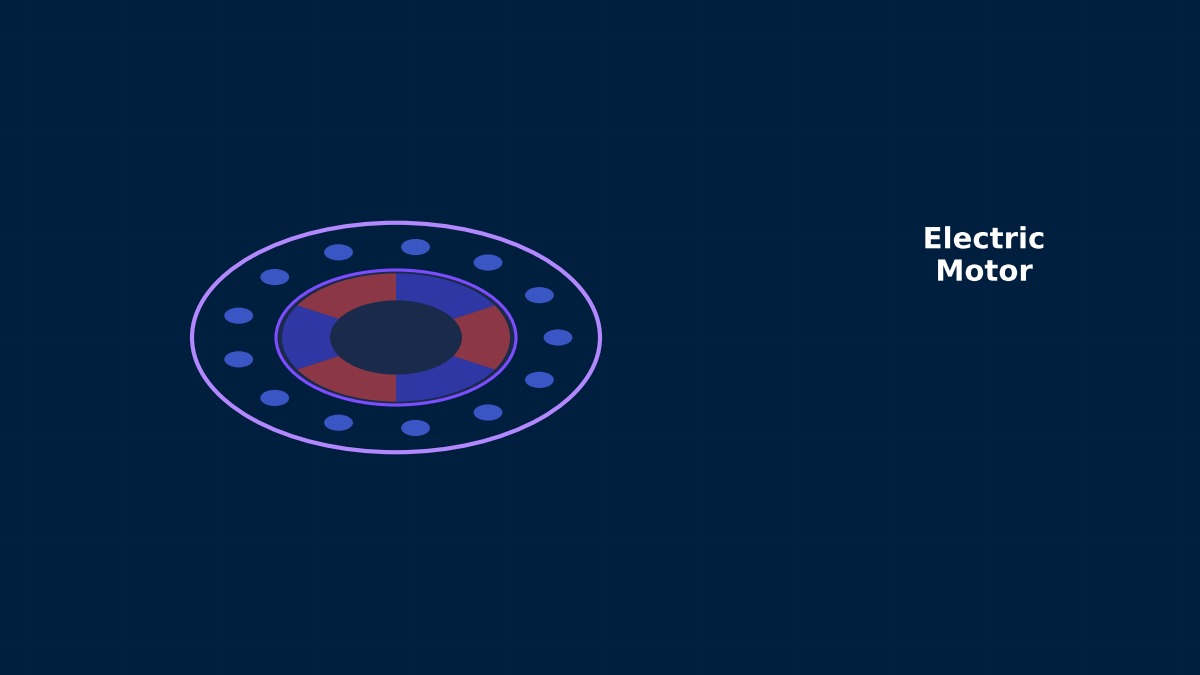
IPM Motor (Interior Permanent Magnet Type): Theoretical Foundations
Overview
Professor, I often hear the name IPM motor, but what is fundamentally different from SPM?
An IPM (Interior Permanent Magnet) motor has a structure where permanent magnets are embedded inside the rotor core. Unlike SPM which attaches magnets to the surface, IPM can utilize the saliency of the iron core. In other words, a difference arises between the d-axis and q-axis inductances.
What's the advantage of having a difference in inductance?
In addition to magnet torque, Reluctance torque can be used. This is the greatest strength of IPM. The reason it is adopted as the main motor for EV propulsion is that it can achieve both high torque density and a wide constant power operating range.
Governing Equations
How is the torque of an IPM motor expressed mathematically?
The torque equation in the dq coordinate system is as follows.
Here, $p$ is the number of pole pairs, $\psi_m$ is the permanent magnet flux linkage, $L_d$, $L_q$ are the d-axis and q-axis inductances, and $i_d$, $i_q$ are the d-axis and q-axis currents.
The first term is the magnet torque, and the second term is the reluctance torque, right? The larger $L_d - L_q$ is, the larger the reluctance torque becomes?
Exactly. In IPM, the magnets block the d-axis magnetic path, so $L_d < L_q$, and the saliency ratio $\xi = L_q / L_d$ becomes about 1.5 to 3. The larger this saliency ratio, the greater the contribution of reluctance torque.
Also, the voltage equations are important.
From these voltage equations, the voltage limitation at high speeds determines the necessity of field-weakening control.
I see. So when analyzing an IPM in JMAG, we extract the parameters for these equations from FEM.
That's right. In JMAG and Ansys Maxwell, the flux linkage is calculated for each rotation angle to determine the dq-axis inductances. Note that due to nonlinearity, the inductance changes depending on the current magnitude.
Fundamental Equations for Electromagnetic Field Analysis
What equations are actually being solved in FEM?
It's the diffusion equation using the 2D magnetic vector potential $A_z$.
Here, $\nu$ is the magnetic reluctivity (reciprocal of permeability), $\mathbf{J}_0$ is the external current density, $\mathbf{M}$ is the magnetization vector, and $\sigma$ is the conductivity.
The magnet part is represented by $\nabla \times \mathbf{M}$, right? And eddy currents by the $\sigma \partial A / \partial t$ term?
Exactly. The nonlinear B-H characteristic of the iron core is incorporated as $\nu(B)$, and nonlinear iteration is performed using the Newton-Raphson method. In IPM, magnetic saturation is strong, so this nonlinear processing is key to analysis accuracy.
Practical Considerations
What should we be especially careful about when analyzing IPM motors?
Let me summarize the important points.
- Bridge Mesh: The thin bridge (0.5-1mm) that holds the magnets experiences severe magnetic saturation. Place at least 3 layers of elements here.
- Nonlinear B-H Curve: Characteristics vary greatly depending on the type of electrical steel sheet (35H300, 20HIM, etc.)
- Temperature Dependence of Magnets: The residual flux density of NdFeB magnets decreases with a temperature coefficient of $\alpha_B \approx -0.12\%/°C$.
- Current Phase Angle Sweep: To find the MTPA (Maximum Torque Per Ampere) control point, sweep the $\beta$ angle from 0° to 90°.
In JMAG, can the magnet bridge part be handled with automatic meshing?
JMAG-Designer has an automatic recognition function for thin parts, but don't rely on it too much. Always visually check the mesh quality and ensure the aspect ratio of the bridge part is 5 or less.
The "Bonus" Reluctance Torque Made IPM the King
The biggest reason IPM motors surpass surface permanent magnet (SPM) types is the physical phenomenon called "reluctance torque." In addition to the magnet torque, this "bonus torque" generated from the inductance difference between the d-axis and q-axis accounts for 20-30% of the total. Toyota discovered (or rather, skillfully utilized) this characteristic during the Prius design, allowing greater torque to be extracted with the same amount of magnet. The essence of IPM is this dual-wielding approach: "the magnet works, and the iron also works."