Diffusion Flames and Mixture Fraction
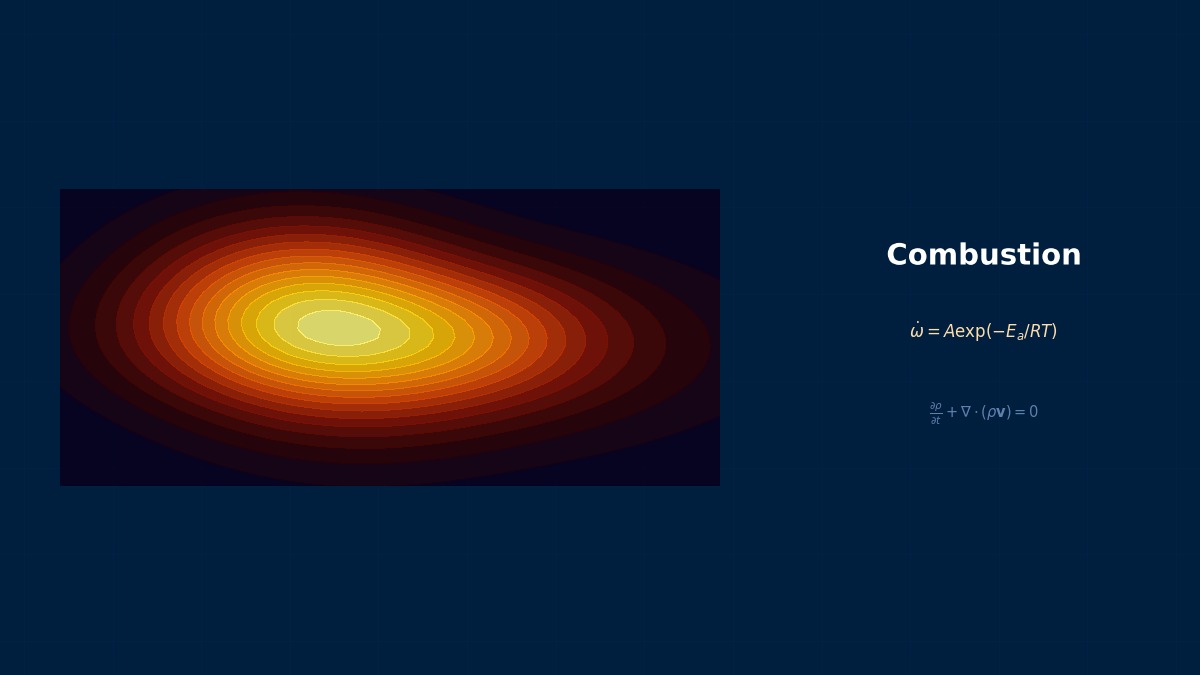
Diffusion Flames and Mixture Fraction: Theoretical Foundations
Overview
Professor, what kind of combustion mode is a diffusion flame?
A diffusion flame (non-premixed flame) is a mode where fuel and oxidizer are supplied separately, and combustion proceeds simultaneously with mixing. Examples include candle flames, diesel engines, and gas turbine combustors. The flame forms at the surface where fuel and oxidizer meet at the stoichiometric ratio (stoichiometric surface).
So it's fundamentally different from a premixed flame.
Correct. In premixed flames, the burning velocity is the governing parameter, but in diffusion flames, the mixing rate becomes the rate-limiting step. Utilizing this property, describing the flame structure with the variable mixture fraction $Z$ is the core of the Burke-Schumann theory.
Mixture Fraction
Please explain the definition of mixture fraction $Z$.
Mixture fraction is a conserved scalar representing "how much mass from the fuel stream is contained within a fluid element." Bilger's definition is widely used.
Here, $Y_F$ is the fuel mass fraction, $Y_O$ is the oxidizer mass fraction, subscript 1 indicates values from the fuel stream, and subscript 2 indicates values from the oxidizer stream. $s$ is the mass-based stoichiometric ratio.
So $Z=0$ is pure oxidizer and $Z=1$ is pure fuel?
Exactly. The stoichiometric mixture fraction $Z_{st}$ is $Z_{st} = Y_{O,2}/(s\,Y_{F,1} + Y_{O,2})$. For methane/air, $Z_{st} \approx 0.055$. The flame is located at the iso-surface where $Z = Z_{st}$.
Burke-Schumann Solution
What is the Burke-Schumann solution?
Assuming the chemical reaction is infinitely fast ($Da \to \infty$), fuel and oxidizer react instantaneously at the flame surface, and temperature and chemical species become functions of mixture fraction only.
This is the Burke-Schumann solution, where the temperature profile becomes triangular, peaking at $Z_{st}$. This solution is also the starting point for the flamelet model.
Mixture Fraction Transport Equation
Mixture fraction $Z$ obeys a transport equation without a source term (independent of chemical reaction).
Since there's no source term, we can solve for the $Z$ field without knowing the details of the chemical reaction, right?
That's the major advantage of the mixture fraction approach. It encapsulates the complexity of chemical reactions into the flamelet equations in $Z$ space, and in CFD, we only need to transport $Z$ and its variance $\widetilde{Z''^2}$.
So the theory of diffusion flames is entirely based on the concept of mixture fraction.
Yes. It's no exaggeration to say that mixture fraction is the most important variable in CFD for non-premixed combustion.
The Candle Flame Was the "Textbook" Diffusion Flame—The Limits of the Burke-Schumann Solution
The analytical solution for diffusion flames proposed by Burke and Schumann in 1928 is based on the "infinite reaction rate" assumption that mixing of fuel and oxidizer completes instantaneously. A candle flame can be reproduced surprisingly well with this model. However, when the same assumption is used in actual gas turbine combustors, the predicted NOx generation can be over ten times the measured value. Even though mixing should be rate-limiting when mixing is slow, the finite reaction rate becomes apparent in high-temperature regions. This is why field engineers say, "The Burke-Schumann solution is excellent for conceptual understanding, but cannot be used for design."
Computational Methods for Diffusion Flames and Mixture Fraction
Details of Numerical Methods
How is a mixture fraction-based combustion model implemented in CFD?
In non-premixed combustion models, the transport equations for $Z$ and $\widetilde{Z''^2}$ (mixture fraction variance) are solved in CFD, and chemical reaction information is retrieved from a lookup table.
Transport Equations
The equations for Favre-averaged mixture fraction $\widetilde{Z}$ and variance $\widetilde{Z''^2}$ in a turbulent field are as follows.
What is the last term $\widetilde{\chi}$ in the variance equation?
That's the scalar dissipation rate. It is defined as $\chi = 2D|\nabla Z|^2$ and represents how quickly the fine structure of the mixture fraction dissipates. Under turbulent conditions, it is modeled as $\widetilde{\chi} = C_\chi \frac{\varepsilon}{k}\widetilde{Z''^2}$ (where $C_\chi \approx 2.0$).
PDF (Probability Density Function)
Please explain the role of the PDF.
In a turbulent field, $Z$ fluctuates within a cell, so the average value alone cannot correctly represent the flame structure. We assume a probability density function $P(Z)$ for $Z$ and calculate the average temperature and average chemical species through integration.
The $\beta$ function distribution is widely used for the PDF shape. The shape of the $\beta$ distribution is uniquely determined from the two parameters $\widetilde{Z}$ and $\widetilde{Z''^2}$.
Lookup Table Construction
How is the table created?
We solve the flamelet equations or chemical equilibrium beforehand to create a table of temperature and chemical species with $Z$ and $\chi_{st}$ (stoichiometric dissipation rate) as parameters. The table integrated with the PDF is referenced during CFD runtime.
| Table Variable | Dimensions | Purpose |
|---|---|---|
| $\widetilde{Z}$, $\widetilde{Z''^2}$ | 2D | Equilibrium chemistry / thin flames |
| $\widetilde{Z}$, $\widetilde{Z''^2}$, $\widetilde{\chi_{st}}$ | 3D | Steady flamelet |
| $\widetilde{Z}$, $\widetilde{Z''^2}$, $\widetilde{C}$ | 3D | FGM (with progress variable added) |
How is it set up in Fluent?
In Fluent, select Models > Species > Non-Premixed Combustion, import the reaction mechanism in CHEMKIN format, and let it automatically generate the PDF table. A table resolution (number of divisions in the $Z$ direction) of at least 64 points, preferably 128 points, is recommended.
The mixture fraction + PDF table method is clever because it solves the chemical reactions beforehand.
Yes. The biggest strength is that there's no need to solve chemical reactions during 3D CFD runtime, so computational cost remains almost unchanged even with detailed chemical reactions.
How to Solve for Scalar Dissipation Rate χ—The Most Debated Variable in Diffusion Flame Model Implementation
When implementing a flamelet model for diffusion flames, the variable that troubles implementers the most is the calculation of the scalar dissipation rate χ (chi). χ represents the intensity of mixing at the flame surface (the stretching rate of fuel-oxidizer due to turbulence), and higher χ makes the flame more prone to extinction. However, there are multiple formulas for directly calculating χ in turbulent CFD, and results vary depending on the choice of Favre averaging and model constants. Especially in regions where recirculation zones (burner wake) coexist with areas of low χ near zero and high χ in shear layers, the accuracy of spatial distribution calculation directly affects NOx and soot predictions. "How to calculate χ" often becomes a vendor's secret sauce.
Related Topics
Experience the theory firsthand with the interactive simulator for this field
All Simulators