Eddy Dissipation Concept (EDC) Model
Category: 流体解析(CFD) | Integrated 2026-04-06
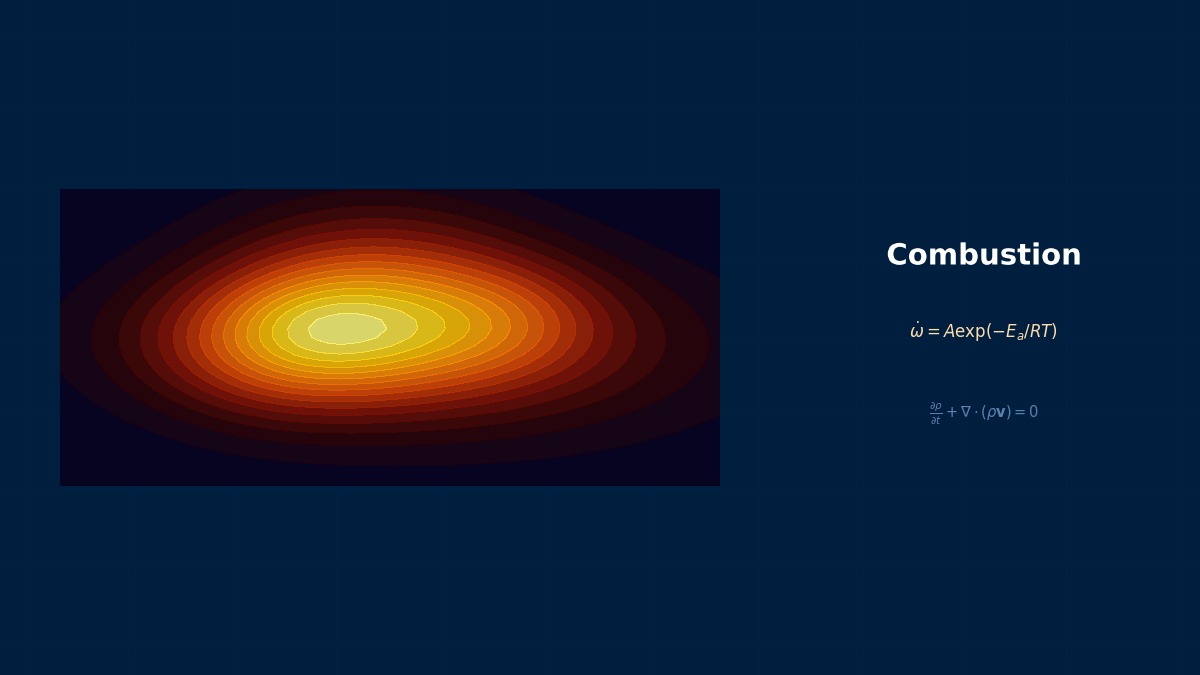
CAE visualization for edc model theory - technical simulation diagram
EDCモデル(Eddy Dissipation Concept)

Theory and Physics

Overview

🧑‍🎓

Professor, what does the EDC model stand for?


🎓

It stands for Eddy Dissipation Concept, a turbulent combustion model developed by Magnussen as an extension of the Eddy Dissipation Model (EDM). EDM assumed infinitely fast chemical reactions, whereas EDC was extended to handle finite-rate detailed chemical reaction mechanisms in turbulent fields.


🧑‍🎓

So it's a superior replacement for EDM?


🎓

Yes. In EDM, the reaction rate is determined by turbulent mixing, like $\dot{\omega} = A\,\rho\,\frac{\varepsilon}{k}\min(Y_F, Y_O/s)$, ignoring Arrhenius kinetics. This is valid when the Damkohler number is large (reactions are sufficiently fast), but it is inaccurate for finite-rate reactions like CO oxidation or NOx formation. EDC overcomes this limitation.


EDC Formulation

🧑‍🎓

Please explain the governing equations for EDC.


🎓

EDC considers that chemical reactions proceed within the fine structures of the turbulent field. The volume fraction $\xi^*$ and residence time $\tau^*$ of the fine structures are determined from the turbulence $k$ and $\varepsilon$ as follows.


$$ \xi^* = C_\xi \left(\frac{\nu\varepsilon}{k^2}\right)^{1/4} $$

$$ \tau^* = C_\tau \left(\frac{\nu}{\varepsilon}\right)^{1/2} $$

Here, $C_\xi = 2.1377$, $C_\tau = 0.4082$ (Magnussen's standard constants), and $\nu$ is the kinematic viscosity.


🧑‍🎓

Does the fine structure size correspond to the Kolmogorov scale?


🎓

Sharp observation. $\xi^*$ corresponds to the volume fraction of the Kolmogorov scale, and $\tau^*$ is on the order of the Kolmogorov time scale. Physically, the image is that "chemical reactions proceed within the smallest eddies of turbulence."


Reaction Rate Expression

🎓

The mean reaction rate for chemical species $i$ can be written as follows.


$$ \dot{\omega}_i = \frac{\rho\,(\xi^*)^2}{\tau^*\,[1 - (\xi^*)^3]}\,(Y_i^* - Y_i) $$

Here, $Y_i^*$ is the mass fraction within the fine structure, which is the composition after detailed chemical reactions have progressed over $\tau^*$. $Y_i$ is the cell-averaged mass fraction.


🧑‍🎓

How is $Y_i^*$ determined?


🎓

It is obtained by time-integrating a constant-volume 0D reactor within the fine structure for $\tau^*$. Stiff ODE solvers like CVODE are used for this 0D integration. In other words, the majority of EDC's computational cost lies in this 0D chemical reaction integration.


🧑‍🎓

So the EDC concept is "solving a 0D reactor within the fine structures of turbulence."


🎓

Exactly. The strength of EDC lies in its physically clear model representation of the interaction between turbulence and chemical reactions.


Coffee Break Trivia

The "Interface of Turbulence and Combustion" Conceived by Magnussen in Norway – The Background of EDC's Birth

Bjørn Magnussen presented EDC at the Norwegian Institute of Technology (NTH) in 1977. At that time, detailed reaction mechanisms could not be solved with available computers. So he devised a model where "reactions occur only within the Kolmogorov-scale eddies of turbulence," successfully describing reactions solely with "fine structure volume fraction" and "turbulent dissipation." Despite its low computational cost, its prediction accuracy for furnaces and burners reached a practical level, quickly drawing attention from the petroleum industry. It was subsequently refined at SINTEF (Norwegian Institute for Industrial Research) and is now standard in Fluent and STAR-CCM+.

Physical Meaning of Each Term
  • Time Term $\partial(\rho\phi)/\partial t$: Imagine the moment you turn on a faucet. At first, water comes out in an unstable, spluttering manner, but after a while, it becomes a steady flow, right? This "period of change" is described by the time term. The pulsation of blood flow from a heartbeat, or the flow fluctuation each time an engine valve opens and closes—all are unsteady phenomena. So what is steady-state analysis? It looks only at "after sufficient time has passed and the flow has settled down"—meaning setting this term to zero. Since computational cost drops significantly, solving first in steady-state is a basic CFD strategy.
  • Convection Term $\nabla \cdot (\rho \mathbf{u} \phi)$: If you drop a leaf into a river, what happens? It gets carried downstream by the flow, right? This is "convection"—the effect where fluid motion transports things. Warm air from a heater reaching the far corner of a room is also because the "carrier," air, transports heat via convection. Here's the interesting part—this term contains "velocity × velocity," making it nonlinear. That is, as the flow becomes faster, this term rapidly strengthens, making control difficult. This is the root cause of turbulence. A common misconception: "Convection and conduction are similar" → They are completely different! Convection is carried by flow, conduction is transmitted by molecules. There is an order-of-magnitude difference in efficiency.
  • Diffusion Term $\nabla \cdot (\Gamma \nabla \phi)$: Have you ever put milk in coffee and left it? Even without stirring, after a while it naturally mixes, right? That's molecular diffusion. Now a question—honey and water, which flows more easily? Obviously water, right? Honey has high viscosity ($\mu$), so it flows poorly. When viscosity is high, the diffusion term becomes strong, and the fluid moves in a "thick" manner. In low Reynolds number flows (slow, viscous), diffusion is dominant. Conversely, in high Re number flows, convection overwhelmingly dominates, and diffusion plays a supporting role.
  • Pressure Term $-\nabla p$: When you push the plunger of a syringe, liquid shoots out forcefully from the needle tip, right? Why? Because the piston side is high pressure, the needle tip is low pressure—this pressure difference provides the force that pushes the fluid. Dam discharge works on the same principle. On a weather map, where isobars are tightly packed? That's right, strong winds blow. "Flow arises where there is a pressure difference"—this is the physical meaning of the pressure term in the Navier-Stokes equations. A point of confusion here: "Pressure" in CFD is often gauge pressure, not absolute pressure. If results go wrong immediately after switching to compressible analysis, mixing up absolute/gauge pressure might be the cause.
  • Source Term $S_\phi$: Warmed air rises—why? Because it becomes lighter (lower density) than its surroundings, so it is pushed upward by buoyancy. This buoyancy is added to the equation as a source term. Other examples: chemical reaction heat generated by a gas stove flame, Lorentz force acting on molten metal in a factory's electromagnetic pump... These are all actions that "inject energy or force into the fluid from the outside," expressed by source terms. What happens if you forget the source term? In natural convection analysis, forgetting buoyancy means the fluid doesn't move at all—a physically impossible result where warm air doesn't rise in a room with the heater on in winter.
Assumptions and Applicability Limits
  • Continuum Assumption: Valid for Knudsen number Kn < 0.01 (mean free path ≪ characteristic length)
  • Newtonian Fluid Assumption: Linear relationship between shear stress and strain rate (viscosity model needed for non-Newtonian fluids)
  • Incompressibility Assumption (for Ma < 0.3): Treat density as constant. For Mach number ≥ 0.3, consider compressibility effects
  • Boussinesq Approximation (Natural Convection): Consider density changes only in the buoyancy term, using constant density in other terms
  • Non-applicable Cases: Rarefied gases (Kn > 0.1), supersonic/hypersonic flows (shock capturing required), free surface flows (VOF/Level Set etc. required)
Dimensional Analysis and Unit Systems
VariableSI UnitNotes / Conversion Memo
Velocity $u$m/sWhen converting from volumetric flow rate for inlet conditions, pay attention to cross-sectional area units
Pressure $p$PaDistinguish between gauge and absolute pressure. Use absolute pressure for compressible analysis
Density $\rho$kg/m³Air: approx. 1.225 kg/m³ @20°C, Water: approx. 998 kg/m³ @20°C
Viscosity Coefficient $\mu$Pa·sBe careful not to confuse with kinematic viscosity coefficient $\nu = \mu/\rho$ [m²/s]
Reynolds Number $Re$Dimensionless$Re = \rho u L / \mu$. Criterion for laminar/turbulent transition
CFL NumberDimensionless$CFL = u \Delta t / \Delta x$. Directly related to time step stability

Numerical Methods and Implementation

Details of Numerical Methods

🧑‍🎓

What points should I be careful about in the numerical implementation of EDC?


🎓

The numerical cost of EDC is dominated by the chemical reaction ODE integration. A 0D reactor must be solved in each CFD cell every iteration (RANS) or every time step (LES).


Computational Cost Estimation

🧑‍🎓

Specifically, how much does it cost?


🎓

Let me give you a rough estimate.


Reaction MechanismNumber of SpeciesIntegration Time per CellTotal Cost for 1M Cells (1 iteration)
Global 2-step50.01 ms10 seconds
DRM-19190.1 ms100 seconds
GRI-Mech 3.0531 ms1000 seconds (~17 minutes)
Detailed C7H1616010 ms10000 seconds (~3 hours)
🧑‍🎓

17 minutes per iteration for GRI-Mech 3.0... For a steady RANS calculation with 3000 iterations, that would take 35 days.


🎓

That's precisely why combining it with ISAT is essential. Using ISAT, even GRI-Mech 3.0 can run in practical time. In Fluent, the default recommended setting is the combination of EDC + Stiff Chemistry Solver + ISAT.


Settings in Fluent

🧑‍🎓

Please explain the EDC setup procedure in Fluent.


🎓

1. Enable Models > Species > Species Transport

2. Reactions: Select Volumetric and import the reaction mechanism in CHEMKIN format

3. Turbulence-Chemistry Interaction: Select Eddy Dissipation Concept

4. EDC Model Constants: Usually OK with default values ($C_\xi = 2.1377$, $C_\tau = 0.4082$)

5. ODE Solver: Enable ISAT, error tolerance $10^{-4}$

6. Solution Controls: Set Species Under-Relaxation to 0.8-0.9


Implementation in OpenFOAM

🧑‍🎓

What about in OpenFOAM?


🎓

In OpenFOAM's reactingFoam solver, specify EDC in combustionProperties.


```

combustionModel EDC;

EDCCoeffs

{

version v2005;

C1 2.1377;

C2 0.4082;

}

```


🎓

OpenFOAM's EDC implementation also supports v2005 (Magnussen's 2005 revised version). The revised version includes Reynolds number-dependent $\xi^*$ correction, improving accuracy in low Re number regions.


Sensitivity of EDC Constants

🧑‍🎓

How do the results change if I modify the EDC constants $C_\xi$, $C_\tau$?


🎓

Increasing $C_\xi$ increases the fine structure volume, raising the reaction rate. Increasing $C_\tau$ extends the residence time, also advancing the reaction. Usually, default values are sufficient, but there are research reports adjusting $C_\xi$ by about ±20% for flame lift-off height tuning. However, this adjustment is case-dependent, and there is no universal recommended value.


🧑‍🎓

So in practice, the key to EDC implementation is combining it with ISAT.


🎓

Yes. EDC calculations without ISAT are extremely time-consuming even for research purposes. Tune it along with ISAT's accuracy settings.


Coffee Break Trivia

Combining EDC with Strang Splitting – The Wisdom of Implementation to "Split" Reaction and Diffusion

A technique often used in the numerical implementation of the EDC model is "Strang Splitting." The time scales of the reaction source term (chemical time scale: microseconds) and turbulent mixing (fluid time scale: milliseconds) differ by orders of magnitude, so solving both as the same ODE causes stiffness to explode. The splitting method solves alternately at each time step: "first the chemical reaction step with a CHEMKIN solver in an inner loop → then the transport step." This dramatically reduces the stiffness of each sub-step. OpenFOAM's reactingFoam also adopts this implementation, with reports of speedups of over 1.5 times just by selecting the order of Strang Splitting.

Upwind Scheme (Upwind)

1st-order upwind: Large numerical diffusion but stable. 2nd-order upwind: Improved accuracy but risk of oscillations. Essential for high Reynolds number flows.

Central Differencing (Central Differencing)

2nd-order accuracy, but numerical oscillations occur for Pe number > 2. Suitable for low Reynolds number diffusion-dominated flows.

TVD Schemes (MUSCL, QUICK, etc.)

Suppress numerical oscillations while maintaining high accuracy via limiter functions. Effective for capturing shock waves or steep gradients.

Finite Volume Method vs Finite Element Method

FVM: Naturally satisfies conservation laws. Mainstream in CFD. FEM: Advantageous for complex shapes and multiphysics. Mesh-free methods like SPH are also developing.

CFL Condition (Courant Number)

Explicit method: CFL ≤ 1 is the stability condition. Implicit method: Stable even for CFL > 1, but affects accuracy and iteration count. LES: CFL ≈ 1 recommended. Physical meaning: Information does not advance more than one cell in one time step.

Residual Monitoring

Related Topics

関連シミュレーター

この分野のインタラクティブシミュレーターで理論を体感しよう

シミュレーター一覧

関連する分野

熱解析V&V・品質保証構造解析
この記事の評価
ご回答ありがとうございます!
参考に
なった
もっと
詳しく
誤りを
報告
参考になった
0
もっと詳しく
0
誤りを報告
0
Written by NovaSolver Contributors
Anonymous Engineers & AI — サイトマップ
About the Authors