Reynolds Transport Theorem
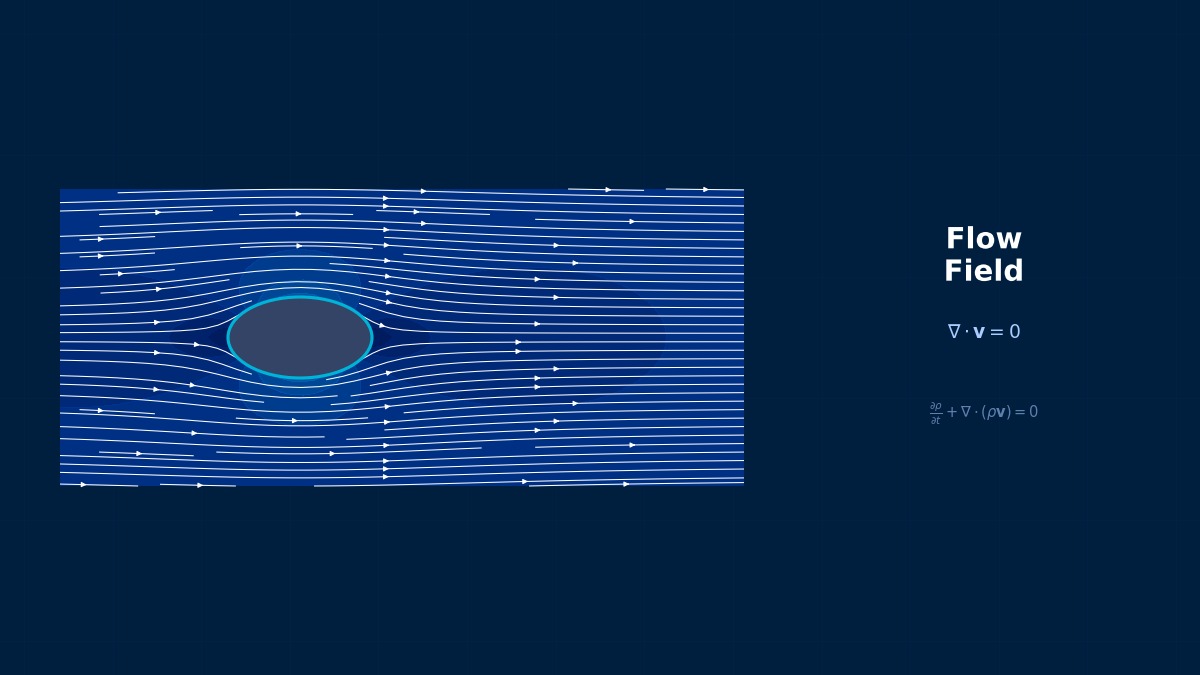
Theory and Physics
Overview
Professor, what is the Reynolds Transport Theorem? How is it related to the NS equations?
Physical laws (Mass Conservation, Momentum Conservation, Energy Conservation) are formulated for a Lagrangian system (a system that follows fluid particles), but in CFD we want to solve them in an Eulerian system (a control volume fixed in space). The Reynolds Transport Theorem (RTT) is the bridging theorem that performs this transformation. The NS equations, Continuity Equation, and Energy Equation are all derived from RTT.
Theorem Statement
The time rate of change of any extensive physical quantity $B$ within a material volume $V_m(t)$ (a volume moving with the fluid) can be written as:
Here $b = B/m$ is the quantity per unit mass. RTT transforms this into an expression for a fixed control volume $V_{cv}$.
What do the two terms on the right-hand side represent?
The first term is the rate of change (accumulation rate) of $B$ inside the control volume. The second term is the net outflow rate (flux) of $B$ through the surface of the control volume. Their sum equals the total time rate of change of $B$ for the system.
Relationship with the Material Derivative
In differential form, RTT corresponds to the material derivative. For any scalar field $\phi$,
where the material derivative is $\frac{D\phi}{Dt} = \frac{\partial\phi}{\partial t} + \mathbf{u}\cdot\nabla\phi$.
Derivation of Conservation Laws
Each conservation law is obtained by choosing what to substitute for $b$.
| Choice of $b$ | Derived Conservation Law | Resulting Equation | ||
|---|---|---|---|---|
| $b = 1$ | Mass Conservation | Continuity Equation | ||
| $b = \mathbf{u}$ (velocity) | Momentum Conservation | NS Equations (Momentum Equation) | ||
| $b = e + \frac{1}{2} | \mathbf{u} | ^2$ (total energy) | Energy Conservation | Energy Equation |
| $b = \mathbf{r}\times\mathbf{u}$ (angular momentum) | Angular Momentum Conservation | Euler's Equation for Turbomachinery |
So all of them come from this single theorem. That's very unified.
Yes. RTT can be called the grand unifying principle of conservation laws in fluid dynamics. It is the starting point for all equations solved in CFD.
The Origin of the Reynolds Transport Theorem—The Diverse Achievements of Osborne Reynolds (1842–1912)
Osborne Reynolds, whose name graces the "Reynolds Transport Theorem," made revolutionary contributions not only through the discovery of turbulence (1883) but across all of fluid dynamics. In 1895, he derived the time-averaged N-S equations—the "Reynolds-Averaged Navier-Stokes (RANS) equations"—laying the foundation for the engineering treatment of turbulence. The Reynolds Transport Theorem (the relationship between material systems and control volumes) is a universal transformation principle in continuum mechanics, applicable to all conservation laws: mass, momentum, energy, and angular momentum. Even 140 years later, in the modern era, the governing equations (Navier-Stokes) in CFD are fundamentally based on the form derived by Reynolds, and his achievements remain undiminished in the age of computational simulation.
Physical Meaning of Each Term
- Temporal Term $\partial(\rho\phi)/\partial t$: Think of the moment you turn on a faucet. At first, water comes out in an unstable, spluttering manner, but after a while, the flow becomes steady, right? This "period of change" is described by the temporal term. The pulsation of blood flow due to a heartbeat, or the flow fluctuation each time an engine valve opens and closes—all are unsteady phenomena. So what is steady-state analysis? It looks only at "after sufficient time has passed and the flow has settled down"—meaning this term is set to zero. Since computational cost drops significantly, a basic CFD strategy is to first try solving for a steady state.
- Convection Term $\nabla \cdot (\rho \mathbf{u} \phi)$: What happens if you drop a leaf into a river? It gets carried downstream by the flow, right? This is "convection"—the effect where fluid motion transports things. Warm air from a heater reaching the far corner of a room is also due to air, the "carrier," transporting heat via convection. Here's the interesting part—this term contains "velocity × velocity," making it nonlinear. That is, as the flow becomes faster, this term rapidly strengthens, making control difficult. This is the root cause of turbulence. A common misconception: "Convection and conduction are similar" → They are completely different! Convection is carried by flow, conduction is transmitted by molecules. There is an order-of-magnitude difference in efficiency.
- Diffusion Term $\nabla \cdot (\Gamma \nabla \phi)$: Have you ever put milk in coffee and left it? Even without stirring, after a while they naturally mix. That's molecular diffusion. Now a question—honey and water, which flows more easily? Obviously water, right? Honey has high viscosity ($\mu$), so it flows poorly. When viscosity is large, the diffusion term becomes strong, and the fluid moves in a "thick" manner. In low Reynolds number flow (slow, viscous), diffusion dominates. Conversely, in high Re number flow, convection overwhelms and diffusion plays a supporting role.
- Pressure Term $-\nabla p$: When you push the plunger of a syringe, liquid shoots out forcefully from the needle tip, right? Why? Because the plunger side is high pressure, the needle tip is low pressure—this pressure difference provides the force that pushes the fluid. Dam discharge works on the same principle. On a weather map, where isobars are tightly packed? That's right, strong winds blow. "Flow is generated where there is a pressure difference"—this is the physical meaning of the pressure term in the Navier-Stokes equations. A point of confusion here: The "pressure" in CFD is often gauge pressure, not absolute pressure. If results go wrong immediately after switching to compressible analysis, it might be due to mixing up absolute/gauge pressure.
- Source Term $S_\phi$: Heated air rises—why? Because it becomes lighter (lower density) than its surroundings, so buoyancy pushes it upward. This buoyancy is added to the equation as a source term. Other examples: chemical reaction heat from a gas stove flame, Lorentz force acting on molten metal in a factory's electromagnetic pump... These are all actions that "inject energy or force into the fluid from the outside," expressed by source terms. What happens if you forget a source term? In natural convection analysis, forgetting buoyancy means the fluid doesn't move at all—a physically impossible result where warm air doesn't rise in a heated winter room.
Assumptions and Applicability Limits
- Continuum Assumption: Valid for Knudsen number Kn < 0.01 (mean free path ≪ characteristic length)
- Newtonian Fluid Assumption: Shear stress and strain rate have a linear relationship (non-Newtonian fluids require viscosity models)
- Incompressibility Assumption (for Ma < 0.3): Treat density as constant. For Mach number ≥ 0.3, consider compressibility effects.
- Boussinesq Approximation (Natural Convection): Consider density variation only in the buoyancy term, using constant density in other terms.
- Non-applicable Cases: Rarefied gases (Kn > 0.1), supersonic/hypersonic flow (requires shock capturing), free surface flow (requires VOF/Level Set, etc.)
Dimensional Analysis and Unit Systems
| Variable | SI Unit | Notes / Conversion Memo |
|---|---|---|
| Velocity $u$ | m/s | When converting from volumetric flow rate for inlet conditions, pay attention to cross-sectional area units. |
| Pressure $p$ | Pa | Distinguish between gauge and absolute pressure. Use absolute pressure for compressible analysis. |
| Density $\rho$ | kg/m³ | Air: ~1.225 kg/m³ @20°C, Water: ~998 kg/m³ @20°C |
| Viscosity Coefficient $\mu$ | Pa·s | Be careful not to confuse with kinematic viscosity $\nu = \mu/\rho$ [m²/s] |
| Reynolds Number $Re$ | Dimensionless | $Re = \rho u L / \mu$. Indicator for laminar/turbulent transition. |
| CFL Number | Dimensionless | $CFL = u \Delta t / \Delta x$. Directly related to time step stability. |
Numerical Methods and Implementation
Relationship Between RTT and the Finite Volume Method
How does RTT connect to discretization in CFD?
The Finite Volume Method is a direct discretization of the integral form of RTT. It treats each computational cell as a control volume and calculates the flux balance through the cell faces.
Here $F_f$ is the advective flux through face $f$, $D_f$ is the diffusive flux, and $S_i$ is the source term. This is the discrete version of RTT.
Moving Control Volume (ALE Method)
What happens when the control volume itself moves?
In the ALE (Arbitrary Lagrangian-Eulerian) method, the control volume itself moves with velocity $\mathbf{u}_g$. RTT is modified as follows.
$$ \frac{d}{dt}\int_{V(t)} \rho\phi\,dV + \oint_{S(t)} \rho\phi\,(\mathbf{u} - \mathbf{u}_g)\cdot\mathbf{n}\,dS = \text{(Source Terms)} $$
What happens when the control volume itself moves?
In the ALE (Arbitrary Lagrangian-Eulerian) method, the control volume itself moves with velocity $\mathbf{u}_g$. RTT is modified as follows.
The key point is that the advection velocity becomes $\mathbf{u} - \mathbf{u}_g$ (the difference between fluid velocity and mesh velocity). This form is used for dynamic mesh problems (piston motion, rotating machinery, etc.).
Geometric Conservation Law (GCL)
For moving meshes, the Geometric Conservation Law (GCL) must be satisfied. It requires that conservation holds exactly when substituting $\phi = 1$ (a uniform field).
What happens if GCL is not satisfied?
A uniform flow would not remain uniform, and artificial mass generation or destruction would occur. This becomes particularly serious in problems with large mesh deformation (FSI, free surfaces, etc.). Commercial solvers typically implement GCL satisfaction automatically, but caution is needed with user-defined dynamic meshes.
Practical Applications of Control Volume Analysis
The integral form of RTT can also be used directly to calculate forces and moments from CFD results.
There is a "far-field force calculation method" that determines forces from fluxes on a control volume surface surrounding an object, not just from pressure/friction integrals on the object surface. This is particularly useful for decomposing aircraft drag (pressure drag, friction drag, induced drag).
So RTT is not just theory; it's directly connected to actual CFD post-processing as well.
How the "Cutting" of the Control Volume Can Change Computational Efficiency by 10x
When implementing the Reynolds Transport Theorem into numerical methods, how you set up the control volume dramatically changes computational cost. In turbomachinery stage analysis, the approach of setting a "mixing plane" for each stage to handle the stator-rotor interface versus solving all stages together unsteadily can differ in computation time by 10 to 100 times. While textbooks on the Finite Volume Method say "it's the same everywhere," in actual industrial design, the very way of cutting the control volume becomes a technical differentiator.
Upwind Differencing (Upwind)
First-order upwind: Large numerical diffusion but stable. Second-order upwind: Improved accuracy but risk of oscillations. Essential for high Reynolds number flows.
Central Differencing (Central Differencing)
Second-order accurate, but numerical oscillations occur for Pe number > 2. Suitable for low Reynolds number, diffusion-dominated flows.
TVD Schemes (MUSCL, QUICK, etc.)
Maintain high accuracy while suppressing numerical oscillations via limiter functions. Effective for capturing shocks and steep gradients.
Finite Volume Method vs Finite Element Method
FVM: Naturally satisfies conservation laws. Mainstream in CFD. FEM: Advantageous for complex shapes and multiphysics. Mesh-free methods like SPH are also developing.
CFL Condition (Courant Number)
Explicit methods: CFL ≤ 1 is the stability condition. Implicit methods: Stable even for CFL > 1, but affects accuracy and iteration count. LES: CFL ≈ 1 is recommended. Physical meaning: Information should not travel more than one cell per timestep.
Residual Monitoring
Convergence is typically judged when residuals for the Continuity Equation, momentum, and energy drop by 3-4 orders of magnitude. The mass conservation residual is especially important.
Relaxation Factors
Typical initial values: Pressure: 0.2–0.3, Velocity: 0.5–0.7. If diverging, lower the relaxation factor. After convergence, increase to accelerate.
Related Topics
なった
詳しく
報告