SIMPLE Method
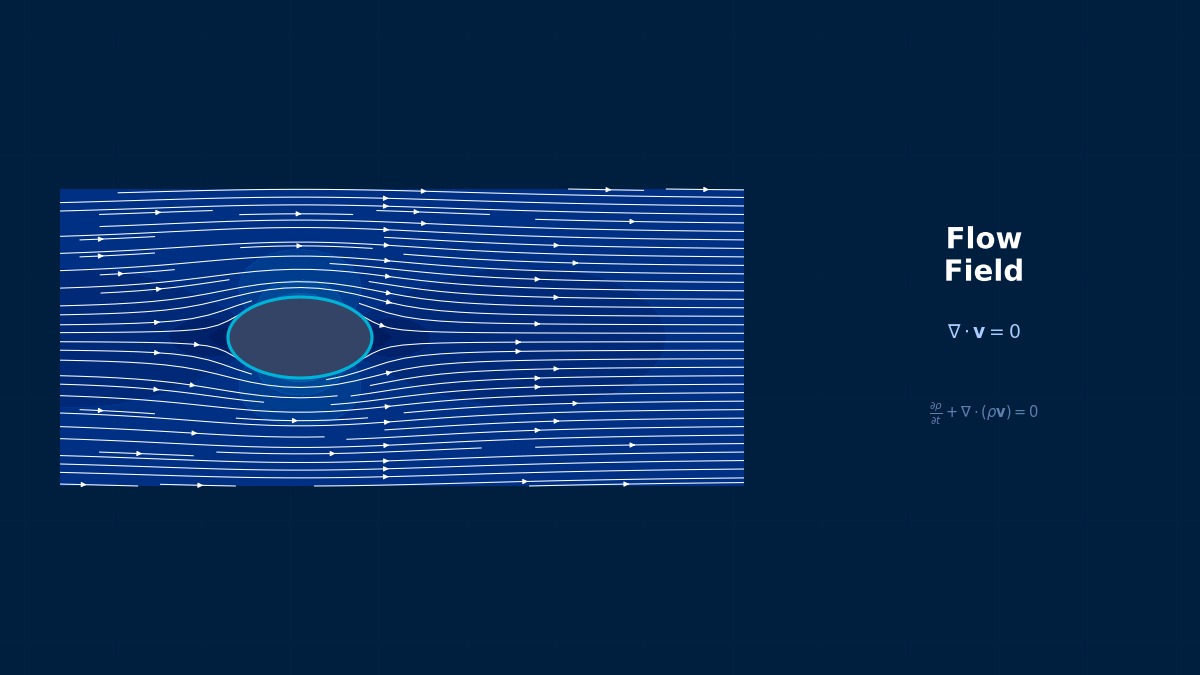
SIMPLE Method: Theoretical Foundations
Overview of the SIMPLE Method
Professor, I often hear the name SIMPLE method, but what does it stand for and what kind of method is it?
SIMPLE stands for Semi-Implicit Method for Pressure-Linked Equations. It's a pressure-velocity coupling algorithm published by Patankar and Spalding in 1972. When solving the incompressible Navier-Stokes equations with the finite volume method, it solves the problem of how to consistently obtain pressure and velocity.
Why is pressure-velocity coupling so troublesome?
In incompressible flow, the continuity equation (Mass Conservation) does not contain an independent equation for pressure. Since density is constant, pressure cannot be determined from the equation of state. As a result, we need to find a pressure field and velocity field that simultaneously satisfy the momentum equation and the continuity equation. This is the pressure-velocity coupling problem.
Governing Equations
First, please tell me the basic equations.
The governing equations for incompressible flow are as follows.
Continuity Equation (Mass Conservation):
Momentum Equation (Navier-Stokes Equation):
Here, $\mathbf{u}$ is the velocity vector, $p$ is pressure, $\rho$ is density, and $\nu$ is the kinematic viscosity coefficient.
There are 4 unknowns (u, v, w, p) and 4 equations, so in principle it should be solvable, right?
Yes. However, directly deriving and solving the pressure Poisson equation simultaneously is computationally expensive. The SIMPLE method uses a "predictor-corrector" approach to efficiently separate and solve this coupling.
SIMPLE Method Algorithm
Please tell me the specific procedure.
One iteration of the SIMPLE method consists of the following 4 steps.
Step 1: Solve the momentum equation with a tentative pressure $p^*$
This yields a tentative velocity $\mathbf{u}^*$. This velocity field generally does not satisfy the continuity equation.
Step 2: Solve the pressure correction equation
Find the pressure correction $p'$ to eliminate the residual of the continuity equation:
Step 3: Correct pressure and velocity
Here, $\alpha_p$ is the pressure relaxation factor.
Step 4: Solve other scalar equations and perform convergence check
$a_P$ is the diagonal coefficient of the momentum equation, right? The right-hand side of the pressure correction equation being the divergence of velocity means it's driving the residual of the continuity equation towards zero.
Exactly. As iterations are repeated, $\nabla \cdot \mathbf{u}^* \to 0$, and mass conservation is satisfied.
Role of Relaxation Factors
What does the relaxation factor $\alpha_p$ mean?
In the SIMPLE method, there is an approximation where the contribution of neighboring cell coefficients (the $a_N$ term) is omitted in the pressure correction, which tends to cause over-correction in a single step. Therefore, it's common to apply under-relaxation, typically around $\alpha_p = 0.3$ for pressure and $\alpha_u = 0.7$ for velocity. As a rule of thumb, some practices use $\alpha_u + \alpha_p \approx 1$.
I see, relaxation is needed as a trade-off for the approximation. Is this the reason it's called "Semi-Implicit" in SIMPLE?
Yes. Solving it fully implicitly would require a coupled solver, but the SIMPLE method is very efficient as a segregated solver.
The story of Patankar running the SIMPLE method on 1970s computers
S.V. Patankar, who developed the SIMPLE method (Semi-Implicit Method for Pressure-Linked Equations), took on the challenge of solving the Navier-Stokes equations with the computers of 1972. The memory back then was less than one ten-thousandth of a modern smartphone. The strategy he adopted was an iterative method of "separating and alternately solving pressure and velocity"—this is the essence of SIMPLE. The paradigm shift of not having to solve the perfect system of equations all at once was a wisdom to maximize the use of limited computational resources. The fact that SIMPLE is still used for CFD analyses with millions of cells today is a testament to the simplicity and proven track record of this "segregated iteration" approach.
Computational Methods for SIMPLE Method
Comparison of SIMPLE Family Algorithms
I also hear about SIMPLEC and SIMPLER besides SIMPLE. What's the difference?
There are several variations that improve upon the SIMPLE method. Let's compare the main ones.
SIMPLEC (SIMPLE-Consistent)
Proposed by Van Doormaal and Raithby (1984). An improved version that partially considers the influence of neighboring cell coefficients in the pressure correction equation.
Using $a_P - \sum a_N$ instead of $a_P$ allows the pressure relaxation factor to be closer to 1.0. Convergence is often faster.
SIMPLER (SIMPLE-Revised)
Proposed as an improved version by Patankar (1980). A method that solves a separate pressure equation before pressure correction to estimate a better pressure field.
It's great that SIMPLEC allows larger relaxation factors. Which one is commonly used in practice?
| Algorithm | Relaxation Factor (Pressure) | Convergence Rate | Stability | Cost per Iteration |
|---|---|---|---|---|
| SIMPLE | 0.2~0.5 | Slow | High | Low |
| SIMPLEC | 0.7~1.0 | Medium | Medium | Low |
| SIMPLER | 0.5~0.8 | Fast | Medium | High (solves pressure twice) |
For steady-state calculations, SIMPLEC is a practical choice. For unsteady calculations, the PISO method is often used.
Rhie-Chow Interpolation
When implementing SIMPLE with the finite volume method, how are the pressure and velocity grid arrangements handled?
This is a very important point. Using a collocated grid (placing pressure and velocity at the same location) causes the problem of pressure checkerboard patterns.
Rhie-Chow interpolation (1983) is a technique to solve this. When calculating velocity on cell faces, it adds a term akin to the third derivative of pressure to suppress checkerboard oscillations.
Most current commercial CFD codes adopt collocated grids + Rhie-Chow interpolation.
Is it unnecessary for staggered grids (placing velocity and pressure at different locations)?
In staggered grids, the checkerboard problem is naturally avoided. However, extension to unstructured grids is difficult, so collocated grids are mainstream in modern CFD codes.
Linear Equation System Solvers
At each step, a linear equation system is solved. What methods are used for that?
Several iterative solvers are commonly used depending on the type of equations. For momentum equations with nonsymmetric matrices, BiCG (BiConjugate Gradient) or GMRES (Generalized Minimal RESidual) methods are used. For the pressure Poisson equation which is symmetric, conjugate gradient (CG) or algebraic multigrid (AMG) methods are effective. AMG in particular is known for excellent scalability on large-scale problems.
AMG sounds like it's for more advanced use cases. Is there a reason multigrid is so effective?
Multigrid solvers reduce errors at all frequency scales by solving on coarser grids recursively. For elliptic equations like the pressure Poisson equation, this is very efficient. Most industrial CFD codes now include AMG or geometric multigrid as standard.